Main Points :
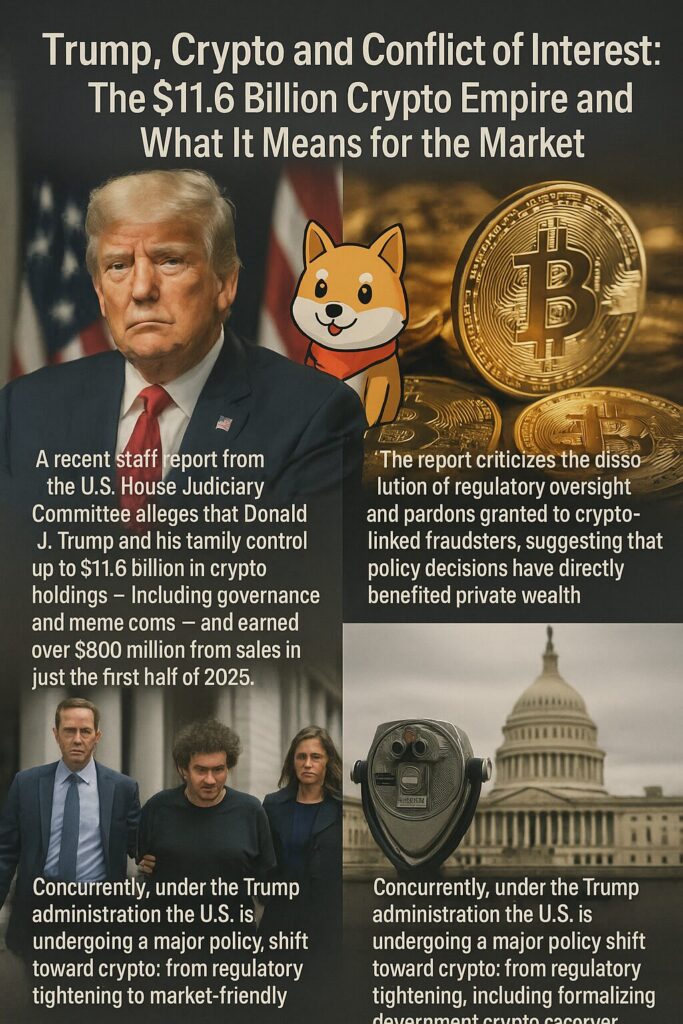
- A recent staff report from the U.S. House Judiciary Committee alleges that Donald J. Trump and his family control up to $11.6 billion in crypto holdings — including governance and meme coins — and earned over $800 million from sales in just the first half of 2025.
- The report criticizes the dissolution of regulatory oversight and pardons granted to crypto-linked fraudsters, suggesting that policy decisions have directly benefited private wealth.
- The alleged ties between foreign investors, certain platforms (e.g. World Liberty Financial), and the Trump family raise national security and anti-money laundering concerns.
- Concurrently, under the Trump administration the U.S. is undergoing a major policy shift toward crypto: from regulatory tightening to market-friendly legislation, including formalizing government crypto reserves.
- This confluence of private profit and public policy marks a key moment for users, investors, and developers — highlighting both opportunities and risks for the broader cryptocurrency ecosystem.
The Allegations: Crypto Wealth at the Center of Power
A staff report released by the U.S. House Judiciary Committee on November 25, 2025 claims that Donald J. Trump and his family have built what amounts to a “multi-billion-dollar crypto empire.” According to the report, the family’s crypto holdings may be worth as much as $11.6 billion, including investments in governance tokens, stablecoins, and meme coins such as those issued by World Liberty Financial and the so-called “TRUMP” coin.
Moreover, the report indicates that in just the first half of 2025, sales of crypto assets yielded over $800 million for the Trump family. The report paints a picture of a presidency that has been leveraged to pump up personal wealth through crypto — effectively turning the Oval Office into “the world’s most corrupt crypto startup operation.”
The details are disturbing: growth in crypto holdings coincided with dismantling of regulatory safeguards, pardons for crypto-linked fraudsters, and deregulation — raising flags about self-dealing, conflict of interest, and the undermining of protections for ordinary investors.
Even more troubling: the report suggests that foreign governments, foreign investors, and shady corporate allies participated in funding or purchasing these crypto assets — potentially using token sales and liquidity provision as a mechanism for foreign influence or “shadow lobbying.”
In short, the report argues we are witnessing one of the largest ever instances of crypto-related corruption and political self-enrichment, raising serious ethical, legal, and national security questions.
Policy Shift: From Crackdown to Crypto Embrace
But this story isn’t just about alleged corruption. It also coincides with a sweeping shift in U.S. crypto policy under the Trump administration — a shift that may reshape the entire landscape for builders, investors, and institutions.
In early 2025, Trump announced plans to make digital assets a strategic priority. His administration proposed creating a formal crypto advisory council, loosening regulatory frameworks, and even exploring the establishment of a national crypto reserve.
As part of that, a March 2025 executive order directed that Bitcoin (BTC) held by the government — often seized in criminal cases — should not be sold, but instead retained as a “Strategic Bitcoin Reserve,” akin to gold or foreign-currency reserves.
Advocates argue this elevates digital assets to a “new asset class” for national financial stability, possibly paving the way for state-level holdings and even institutional adoption — potentially a boon for crypto developers and firms looking for clarity and legitimacy.
At the same time, U.S. regulators are considering broader reforms: for example, the Commodity Futures Trading Commission (CFTC) is exploring permitting regulated domestic exchanges to offer leveraged spot crypto trading — a move that could shift trading volume away from offshore exchanges back to domestic markets.
Taken together, these moves suggest the U.S. might be embracing a much more crypto-friendly regulatory regime — albeit one entangled with serious governance and ethical concerns.
Risks, Market Implications, and What It Means for Investors/Builders
Ethical and Regulatory Risk
The core revelation — that the sitting president and his family may personally profit from crypto while shaping policy — undermines trust in governance. For investors and institutions, that poses a risk: political backlash, regulatory reversals, or legal consequences if the alleged misconduct triggers investigations or litigation.
Moreover, the involvement of foreign entities raises money-laundering and national security concerns. Regulators globally (not just in the U.S.) may ramp up scrutiny of token issuances, KYC/AML compliance, and transparency of funding sources.
Market Volatility and Confidence
While the “crypto-friendly” stance might seem bullish for prices and adoption, the inherent volatility of crypto — now entwined with geopolitics and high-stakes power dynamics — could deter more conservative investors. Indeed, recent reporting has already highlighted that the violent swings in crypto prices have hit the wealth of the Trump family and their followers.
For builders and developers in blockchain, this mixed environment means opportunities — but also unstable ground. The regulatory landscape might be favorable, but it could shift dramatically if political tides turn.
Institutional and Mainstream Adoption Potential
On the flip side: formal recognition of crypto as a strategic asset — via national reserves or regulatory frameworks — could provide legitimacy and infrastructure needed for large-scale institutional adoption. That could drive demand for real-world applications (payments, stablecoins, treasury functions) and bring more capital into the space.
For firms and developers: this could open doors. Especially for those building compliance-first platforms (wallets, exchanges, payment rails), or services tied to stablecoins, cross-border payments, or tokenized assets.
What It Means for New or Alternative Crypto Assets
For retail investors, speculators, or builders chasing “the next big thing,” the environment remains murky. Meme coins or platform tokens associated with politically exposed people (PEPs) may carry outsized risk — even if valuations soar.
At the same time, sound projects with transparent governance, real use cases, and regulatory compliance may benefit from the broader legitimization of crypto. Stablecoins, payment-oriented tokens, DeFi tools — especially those designed for compliance and institutional-grade custody — may stand to gain. Graphic: A Hypothetical Breakdown of Trump Crypto Holdings
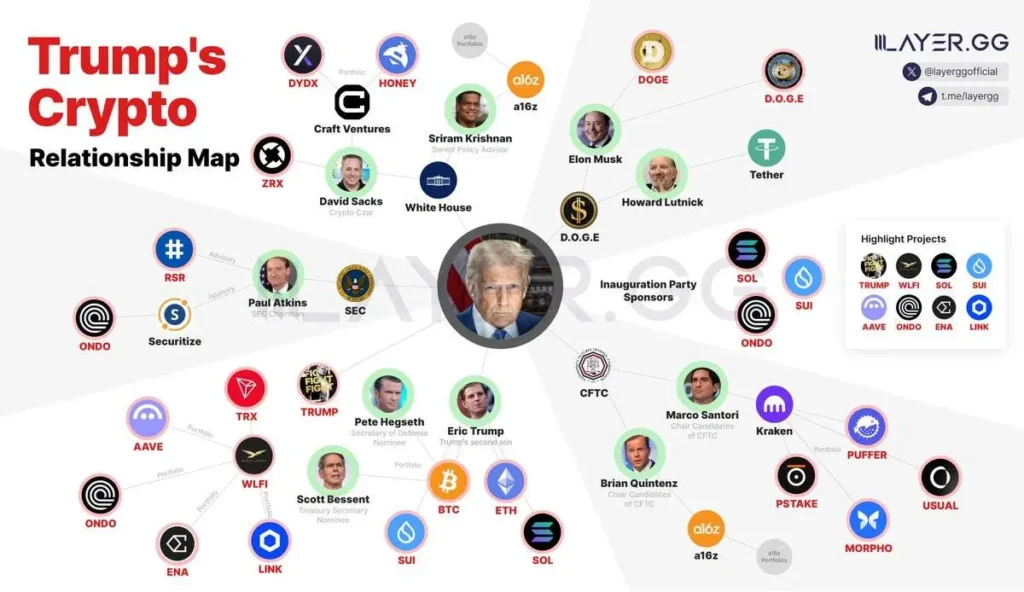
Suggested Caption: “Illustrative breakdown – alleged components and scale of the Trump family’s crypto portfolio.”
Conclusion
The new report alleging that Donald J. Trump and his family have amassed as much as $11.6 billion in crypto holdings — and reaped hundreds of millions in sales within months — is nothing less than a seismic moment for the crypto industry. It lays bare a convergence of political power, private profit, and digital finance.
On one hand, the pivot of U.S. policy under the Trump administration — toward embracing crypto, establishing national crypto reserves, and formalizing favorable regulation — could mark the beginning of a new era of legitimacy, institutional adoption, and real-world deployment of blockchain technology. For developers, builders, and compliant businesses, the timing could be auspicious.
On the other hand, the very same nexus of power and profit raises serious concerns: corruption, regulatory capture, money laundering, and political volatility. For investors seeking the next big asset, meme coins or politically connected tokens may represent high-risk, short-term gambles.
For the broader ecosystem — especially those focused on sustainable, utility-driven blockchain adoption — the current moment is a call for caution, transparency, and governance. Projects emphasizing compliance, real user value, and clear tokenomics may emerge as the real winners, while politically tainted or speculative tokens risk becoming collateral damage in a broader reckoning.
In short: the crypto market may be entering a new “golden age” — but only if participants build with integrity, not just hype.