
Main Points :
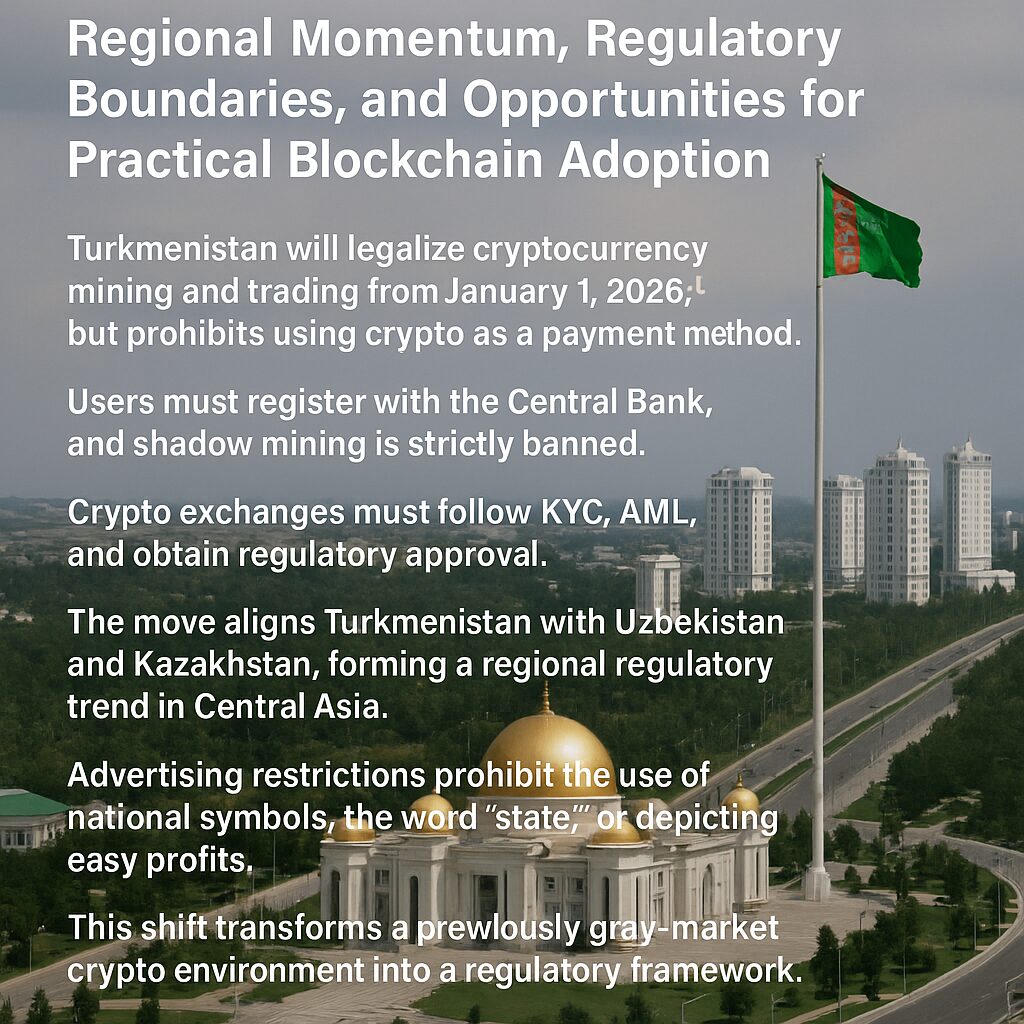
- Turkmenistan will legalize cryptocurrency mining and trading from January 1, 2026, but prohibits using crypto as a payment method.
- Users must register with the Central Bank, and shadow mining is strictly banned.
- Crypto exchanges must follow KYC, AML, and obtain regulatory approval.
- The move aligns Turkmenistan with Uzbekistan and Kazakhstan, forming a regional regulatory trend in Central Asia.
- Advertising restrictions prohibit the use of national symbols, the word “state,” or depicting easy profits.
- This shift transforms a previously gray-market crypto environment into a regulatory framework.
- For investors, miners, and businesses, Turkmenistan’s law signals new structured opportunities, though within limits that aim for financial stability and government oversight.
Introduction: A Turning Point for Crypto Governance in Central Asia
Turkmenistan’s decision to legalize cryptocurrency mining and trading beginning January 1, 2026 represents more than a local policy reform; it marks another significant alignment with a broader regional movement across Central Asia. As Uzbekistan and Kazakhstan have already adopted structured digital asset frameworks, Turkmenistan’s late but decisive entry into regulated crypto governance indicates a shared regional ambition: enabling innovation while retaining strict control over money flows and national financial security.
For readers exploring new crypto assets, emerging markets, and practical blockchain applications, Turkmenistan’s new approach offers insights into how an underdeveloped market might open opportunities—albeit under highly regulated conditions—to miners, infrastructure providers, and compliant exchanges.
1. Overview of the 2026 Digital Asset Law
President Serdar Berdimuhamedow signed the new legislation governing the issuance, storage, and trading of digital assets. The law becomes effective on January 1, 2026, at which point crypto mining and trading will be fully legal—but explicitly not recognized as legal tender or a permitted payment method.
Key Provisions :
- Mining & Trading Legalized
Individuals and companies will be allowed to participate in crypto mining and trading without fear of violating criminal or administrative laws. - Mandatory Registration with the Central Bank
Anyone mining tokens must register with the Central Bank of Turkmenistan. The country aims to centralize oversight of mining infrastructure and prevent unauthorized or clandestine extraction of digital assets. - Ban on “Shadow Mining”
Using another party’s infrastructure without consent, or using public resources secretly, is strictly prohibited. - Exchange Regulation
Crypto exchanges operating in Turkmenistan must obtain official registration and implement:- Know-Your-Customer (KYC) procedures
- Anti–Money Laundering (AML) controls
- Record-keeping of customer identities
- Presumably, a ban on anonymous wallets
This model closely resembles frameworks already implemented in Uzbekistan and Kazakhstan.
2. What Users Can and Cannot Do Under the New Law
While mining and trading are legalized, cryptocurrency cannot be used for payments. This divide between investment/trading and payment functionality is common in emerging regulatory environments such as Central Asia, India, and (historically) Russia.
What is allowed
- Mining BTC, ETH, and other digital assets
- Operating licensed exchanges
- Storing cryptocurrency in compliant wallets
- Engaging in trading activities
What is prohibited
- Using cryptocurrency as a means of payment
- Conducting transactions through anonymous or unregistered systems
- Using state imagery or any symbols in crypto advertising
- Shadow mining through unauthorized hardware or facilities
Turkmenistan’s government maintains a conservative stance: crypto may serve as an investment or industrial activity, but not as an alternative currency.
3. Advertising Restrictions: A Highly Controlled Communication Environment
The law is unusually strict on promotional activities.
Businesses cannot:
- Use the word “state”
- Use Turkmenistan’s name or national symbols
- Depict easy profits, luxury goods, or minors
- Publish ads without disclaimers stating possible full loss of funds
Such restrictions aim to prevent speculation bubbles and protect inexperienced retail users.
For crypto startups seeking market entry, this means:
- Marketing must be conservative and compliance-driven.
- Branding must avoid any national or governmental impression.
- Investor education becomes essential to build trust without violating restrictions.
4. Regional Context: Central Asia’s Expansion of Digital Asset Regulation
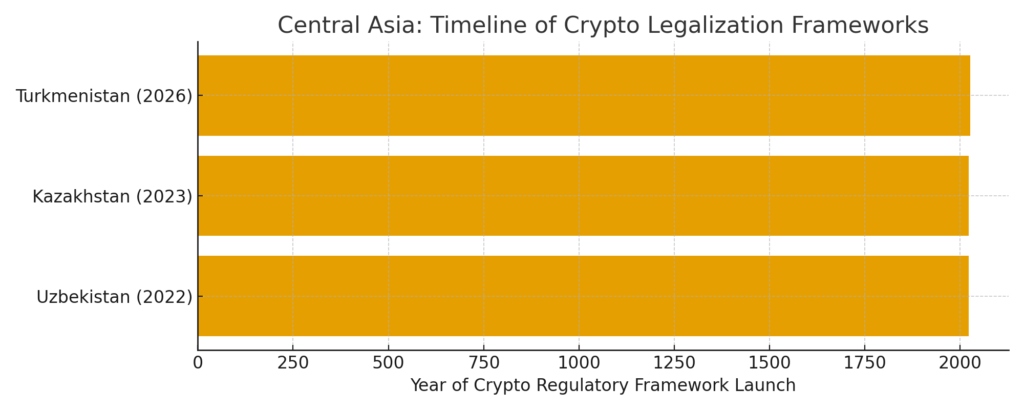
Turkmenistan’s move is not isolated. It closely follows Uzbekistan (2022) and Kazakhstan (2023), which both introduced formal licensing, mining regulation, and exchange compliance systems.
Central Asia Crypto Regulatory Timeline
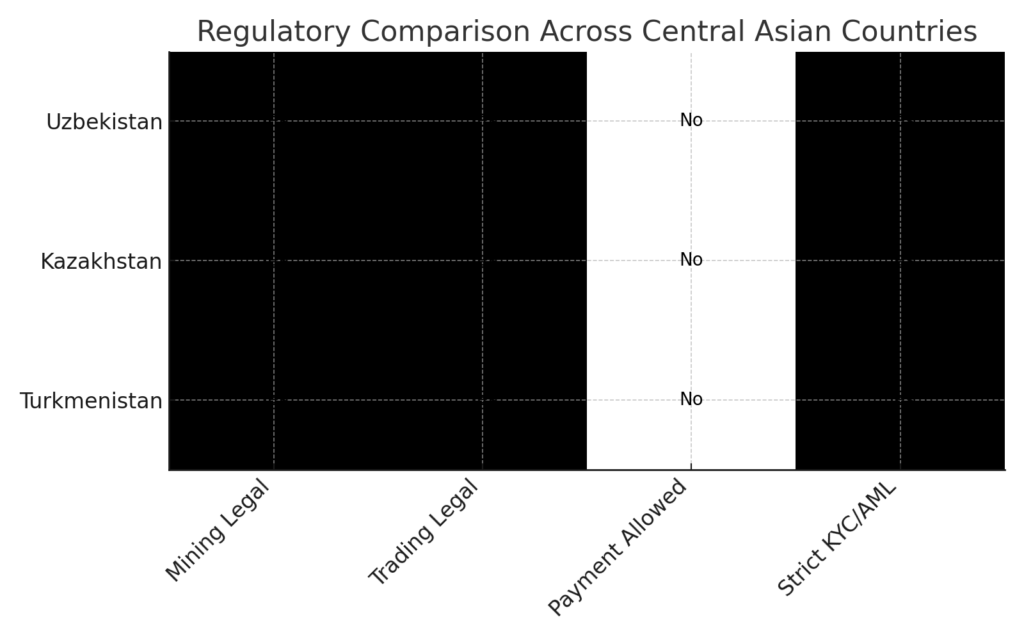
This alignment demonstrates a regional convergence toward formalized crypto governance, driven by:
- Rising crypto mining profitability
- The desire to attract controlled investment
- The need to curb illegal or unmonitored financial activity
- A recognition that digital assets cannot be ignored
In all three countries, crypto is explicitly not recognized as legal tender, reinforcing a shared regional policy: encourage regulated mining and trading while protecting the fiat monetary system.
5. Turkmenistan’s Previous “Gray Zone” Crypto Market
Before this legislation, crypto mining and trading were not illegal in Turkmenistan, but also not formally permitted.
There was:
- No licensing
- No regulatory clarity
- No AML/KYC rules for exchanges
- No framework for commercial mining farms
This meant users operated in a legal gray area, facing uncertainty about whether their activities were tolerated or at risk of retroactive enforcement.
The new law removes this ambiguity, creating a defined path for compliant operations.
6. Opportunities for Investors, Miners, and Blockchain Companies
1. Mining Infrastructure Expansion
Being a resource-rich country with low energy costs, Turkmenistan may become an attractive location for compliant mining farms—similar to Kazakhstan’s mining boom.
2. Exchange Licensing and Market Entry
Licensed exchanges may enter early and build market dominance before competition increases.
3. Blockchain Service Providers
Demand will increase for:
- Compliance tools
- Custody software
- Travel rule solutions
- Mining hardware suppliers
- Infrastructure monitoring systems
4. Institutional Custody and Asset Management
Since anonymous wallets may be banned, institutional custodial solutions aligned with KYC will likely be required, creating opportunities for professional-grade wallet providers.
5. Public–Private Partnerships
The Central Bank’s involvement indicates potential future collaboration programs for government-backed digital registries or tokenized assets—though no such plans are officially announced.
7. Risks and Limitations for Market Participants
Despite the opportunities, the regulatory environment is highly restrictive, presenting key risks:
- No payment use case: Limits adoption and utility.
- Strict advertising rules: Hard for companies to attract retail customers.
- Centralized control: Government registration could limit scalability and raise operational costs.
- Potential surveillance or data retention requirements: Exchanges must comply with strict AML/KYC frameworks.
- Unclear taxation policies: More details will be needed for investment firms.
For companies entering Turkmenistan, compliance becomes the central pillar of operations—not aggressive market growth.
8. Global Trend Comparison and Recent Developments
Worldwide, nations are moving toward compliant crypto integration, with varying models:
- EU (MiCA 2024–2025): Regulatory clarity with licensing and stablecoin governance.
- United States: Fragmented regulation; enforcement-first approach by SEC, but growing institutional adoption via BTC ETFs.
- Middle East (UAE): Pro-growth architecture attracting global exchanges.
- South Asia (India): Trading allowed but payments and anonymity banned—similar to Turkmenistan.
Turkmenistan fits into the global pattern of controlled legalization rather than open liberalization.
This suggests that practical blockchain applications, such as industrial tokenization, mining operations, and enterprise-use cases, may grow faster than retail crypto payments or speculative retail trading.
Conclusion: A Structured Yet Restrictive Opening to Digital Assets
Turkmenistan’s 2026 crypto legalization is not a permissive opening of its financial system, but rather the construction of a controlled environment in which mining, trading, and storage are permitted under strict government oversight.
For investors and companies, the message is clear:
- Opportunities exist, especially in mining, compliance-based exchanges, and blockchain infrastructure.
- Regulation will dictate business models, requiring conservative, compliant, and carefully structured operations.
- The region is becoming a unified regulated crypto zone, potentially creating cross-border synergies in mining and exchange services.
Turkmenistan’s decision ultimately reflects the broader global trend: digital assets are too significant to ignore—but governments will only embrace them within frameworks that preserve monetary sovereignty and maintain financial stability.




