
Main points :
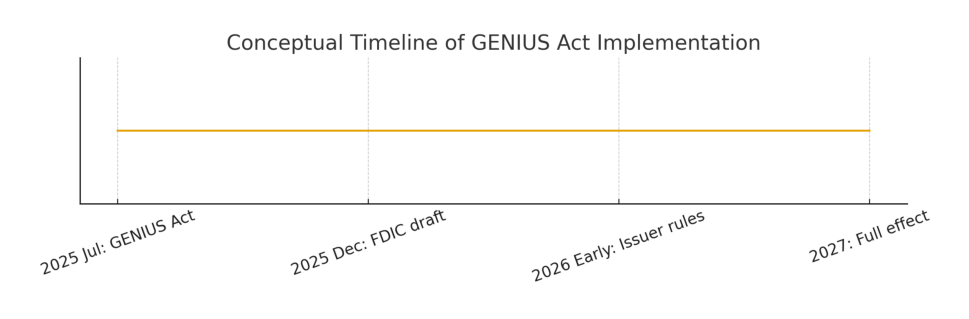
- The Federal Deposit Insurance Corporation (FDIC) plans to publish a draft regulatory proposal for stablecoin issuers under the GENIUS Act by the end of December 2025.
- The GENIUS Act codifies a clear, bank-based licensing regime for “payment stablecoins,” requiring full backing by low-risk assets, monthly reserve disclosure, and strict AML/KYC compliance.
- Only certain entities — e.g. bank subsidiaries, regulated financial institutions, or approved non-banks — can become permitted stablecoin issuers; foreign firms need approval via a special committee.
- The Act excludes regulated payment stablecoins from classification as “securities” or “commodities,” putting them in a separate legal category.
- For industry participants — crypto firms, payment providers, and banks — this signals a major shift: stablecoins may see broader adoption under clearer rules, but the barrier to issuance is high.
Background: Why the GENIUS Act matters
In July 2025, the U.S. Congress — via the GENIUS Act — enacted the first comprehensive federal law to regulate stablecoins. Before this, stablecoins in the U.S. occupied a regulatory gray zone, as neither fully regulated bank liabilities nor securities. The new law aims to firmly integrate stablecoins into the traditional financial system as regulated payment instruments.

By defining stablecoins as “payment stablecoins” (i.e., intended for payments/settlements and redeemable at par), the law establishes concrete legal clarity. In doing so, it also excludes compliant stablecoins from securities or commodity classification — thereby reducing regulatory uncertainty and potential enforcement risk from agencies like the U.S. Securities and Exchange Commission (SEC) or the Commodity Futures Trading Commission (CFTC).
For stablecoins to qualify under the GENIUS Act, issuers must meet stringent criteria:
- Maintain 1:1 backing with U.S. dollars, U.S. Treasury securities, insured deposits, or other high-quality liquid assets.
- Disclose monthly reserve holdings and, if holdings exceed certain thresholds, publish audited, transparent financials.
- Comply with standard bank-level AML/KYC requirements (e.g., customer due diligence, suspicious activity reporting) under applicable banking laws.
- Only certain entities can issue stablecoins — typically bank subsidiaries, regulated banks/financial institutions, or other approved entities. Foreign firms must receive unanimous approval from a dedicated multi-agency committee.
This marks a clear shift from the earlier landscape, where many stablecoins — such as U.S. dollar–backed tokens — operated without explicit federal licensing, and reserve transparency was uneven.
Latest: FDIC Moves to Define Implementation Rules
Now, as of early December 2025, the FDIC — under Acting Chair Travis Hill — has signaled it will publish draft regulations implementing the GENIUS Act by late December.
Specifically:
- The first rule is expected to define the application process for stablecoin issuers. Entities that want to become permitted “Payment Stablecoin Issuers” (PPSIs) will need to apply under the new regulatory regime.
- The FDIC is also developing guidance on “tokenized deposits” — i.e., traditional bank deposits represented on a blockchain — which signals a potential future where banks can offer blockchain-native deposit services under regulated frameworks.
- Depending on how many entities choose to apply, and how stringent the rules are, the stablecoin issuance landscape could become either highly centralized (only a few regulated banks) or moderately open (includes approved non-banks).
The law itself stipulates that regulatory requirements — concerning capitalization, liquidity, reserve asset diversification, interest risk management, etc. — must be published within 12 months of enactment. After that, stablecoins will be regulated under two possible timings: eighteen months after passage (i.e., January 18, 2027) or 120 days after regulators publish final rules — whichever is earlier.
Implications for Crypto Investors, Projects, and Fintech Innovators
For Investors and Market Participants
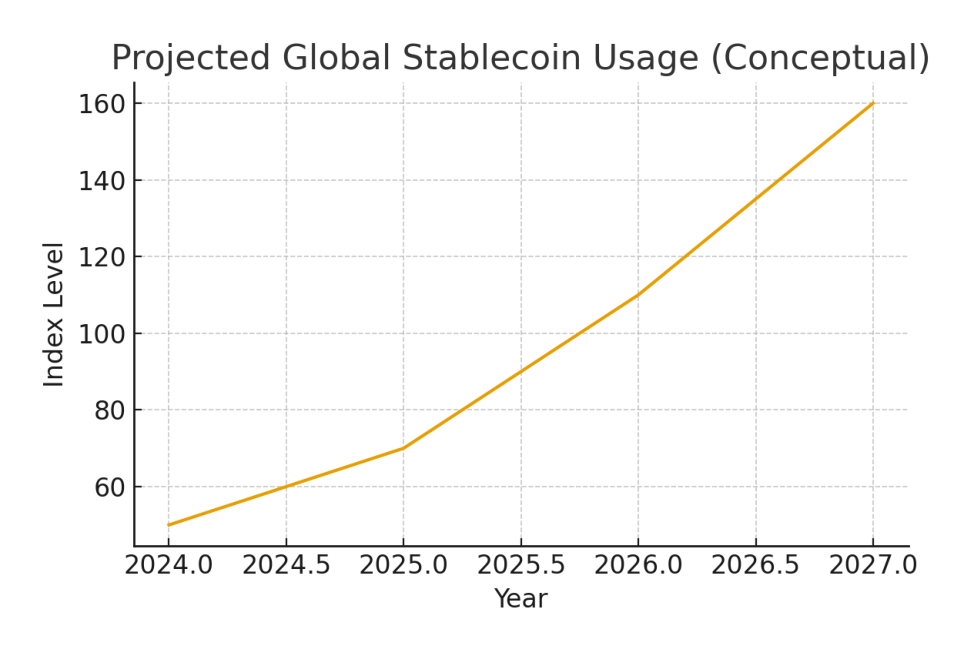
- The GENIUS Act establishes a credible regulatory foundation for U.S.-dollar-pegged stablecoins. As a result, investors and businesses may gain greater confidence in stablecoin-backed assets and platforms. The requirement of transparent, 1:1 backing with low-risk assets reduces the kind of reserve opacity that has historically undermined trust in some stablecoins.
- Because stablecoins are now placed outside the realm of securities or commodities (assuming compliance), holders may avoid certain legal/regulatory risks tied to securities law — although other compliance requirements still apply.
- For risk-Adjusted investors or firms considering using stablecoins as part of investment strategies, this clarity may encourage higher adoption — especially for payment-stablecoins used in cross-border remittance, DeFi, or real-world asset tokenization.
For Crypto Projects, Fintech Platforms, and Non-Bank Issuers
- The licensing thresholds (bank subsidiary, regulated entity, or special approval for non-banks) raise the bar significantly. That may limit stablecoin issuance to large financial institutions or well-funded players — reducing open-source or community-based stablecoin experiments.
- For fintech and blockchain firms looking to build payment rails, cross-border remittance, or tokenized-asset platforms, a compliant stablecoin — so long as it’s issued under the new framework — becomes a more viable foundation. The law potentially reduces legal/regulatory friction for real-world adoption.
- The FDIC’s signals that tokenized deposit insurance guidance is coming suggests banks could soon hold blockchain-native deposits or stablecoins directly, bridging traditional banking and crypto-native infrastructure. That would open the door for “real-world asset (RWA)” tokenization, tokenized deposits, and blockchain-integrated banking services.
Challenges and Criticisms
While the GENIUS Act marks a major milestone for stablecoin regulation, it is not without challenges and open questions:
- Barrier to entry for smaller or decentralized issuers: Because only regulated financial institutions (often banks or their subsidiaries) or specially approved entities can issue stablecoins, this may stifle smaller, more nimble crypto-native ventures. This centralization may run counter to the decentralized ideals many in the crypto community value.
- Compliance, transparency, and cost burden: The requirements for monthly reserve disclosure, audited financials, AML/KYC compliance, and reserve-asset restrictions impose burdens that may dissuade issuers, or be passed on via higher fees or narrower services.
- Unclear supervisory scope: As of now, the FDIC has not clarified exactly how broad the supervision universe will be — how many issuers will be approved, and under what criteria.
- Potential slowdown vs. speed to market: While regulation brings legitimacy and stability, it might slow down innovation, especially for experimental stablecoins or novel tokenized mechanisms. For developers and projects, this means careful compliance is required — but that could limit agility.
What This Means for Japan and International Actors
For stakeholders outside the U.S., such as in Japan, Europe, or other regions, the GENIUS Act may effectively set a de facto global standard for stablecoin issuance — especially for dollar-backed coins.
- Projects issuing or dealing with dollar-pegged tokens may gravitate toward compliance with GENIUS-style frameworks, to ensure access to U.S. users or institutions.
- For Japanese stablecoin issuers (e.g., yen-backed coins), this could drive reconsideration of their own compliance frameworks to maintain “interoperable” standards with U.S. and global markets.
- For international financial institutions and fintechs, the clear regulation may encourage cross-border stablecoin flows — but it might also strengthen the dominance of the U.S. dollar in global crypto payments. The impact on monetary sovereignty, deposit models, and integration of real-world assets should be carefully considered.
Conclusion
The GENIUS Act and the forthcoming regulations from the FDIC mark a watershed moment for the stablecoin industry. For the first time, there is a comprehensive federal law in the United States that defines who can issue stablecoins, under what conditions — and how those coins must be backed, audited, and disclosed. For crypto investors, fintech firms, DeFi platforms, and traditional banks alike, this opens the door to greater legitimacy, reduced legal ambiguity, and potentially broader adoption of stablecoins as real payment instruments or rails for tokenized economies.
At the same time, the high compliance burden and restricted issuance eligibility may concentrate power among large institutions, limiting open and decentralized experiments. As implementation proceeds, much will hinge on the details of the FDIC’s final rules — who gets licensed, how flexible reserve requirements are, and how patents develop around tokenized deposits and real-world-asset integration.
For players in Japan and beyond — including those like you exploring new tokenomics models, cross-chain infrastructure, or stablecoin-based payment rails — this is a signal to re-evaluate design assumptions. Aligning with a clear, internationally recognizable regulatory baseline may improve credibility. But it may also demand increased governance, transparency, and institutional partnerships.
As 2027 approaches (or sooner, if regulations are finalized), the question won’t just be whether stablecoins survive — but whether they can thrive under scrutiny, while remaining useful, accessible, and innovative.