Key Takeaways :
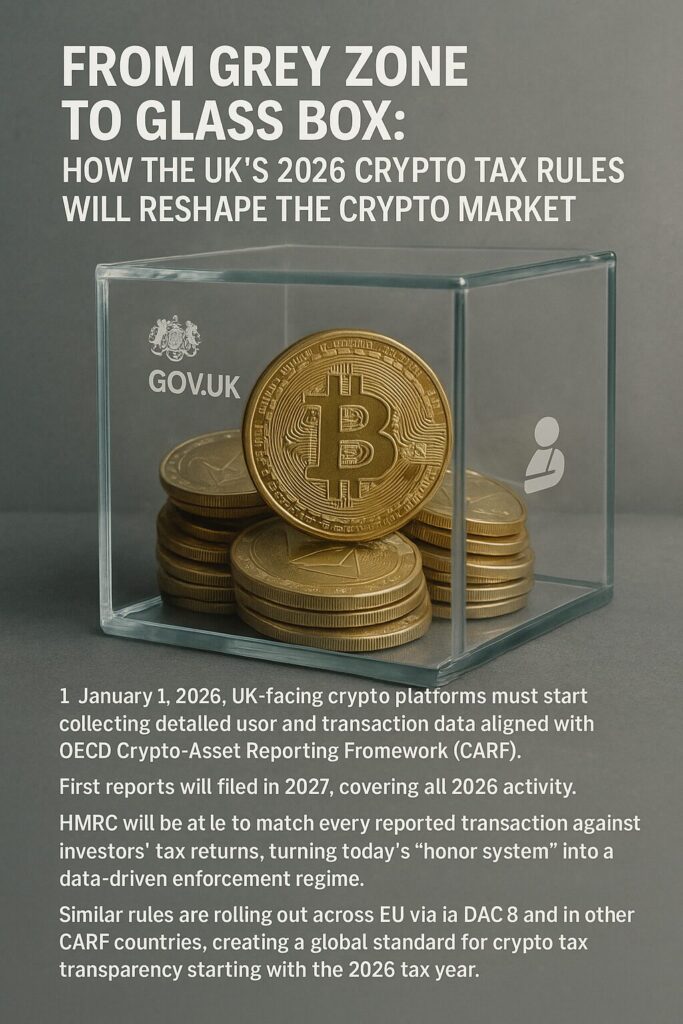
- From 1 January 2026, UK-facing crypto platforms must start collecting detailed user and transaction data aligned with the OECD Crypto-Asset Reporting Framework (CARF). First reports will be filed in 2027, covering all 2026 activity.
- HMRC will be able to match every reported transaction against investors’ tax returns, turning today’s “honor system” into a data-driven enforcement regime.
- Similar rules are rolling out across the EU via DAC8 and in other CARF countries, creating a global standard for crypto tax transparency starting with the 2026 tax year.
- For users, this is not a new tax, but it removes the practical ability to “hide” gains. Fines of roughly $400 for non-disclosure and higher penalties for serious evasion are on the table.
- For builders and token hunters, there is growing demand for regtech, tax-automation tools, compliance-ready exchanges, and non-custodial infrastructure that works smoothly inside this new reporting reality.
1. What Changes in the UK from 2026?
The core message of the new UK rules is simple:
if a platform serves UK residents and handles crypto, HMRC wants a clear view of what happens on that platform.
Under regulations implementing the OECD’s Crypto-Asset Reporting Framework (CARF), any “Reporting Cryptoasset Service Provider” operating in or from the UK must begin collecting structured user and transaction data from 1 January 2026.
This includes:
- UK-based exchanges and custodial wallets
- Certain foreign platforms with UK-resident users
- In some cases, DeFi protocols or apps if there is a recognizable controlling entity (for example, a company that runs a front-end and exercises control over the protocol).
From 2026, every disposal, swap, or fiat cash-out executed on such platforms is no longer just a number on a trading screen. It becomes part of a standardized data feed that HMRC can use to cross-check your Self Assessment tax return.
The rules themselves do not introduce a new tax. UK investors will still pay Capital Gains Tax (CGT) and Income Tax under the existing framework. But from 2026 onward, HMRC will have the missing piece: independent data from the platforms, not just what taxpayers choose to report.
2. The Global Context: CARF, DAC8, and the End of the Anonymity Illusion
The UK is not acting in isolation. The new rules are the UK implementation of the OECD Crypto-Asset Reporting Framework (CARF), a global standard for automatic exchange of tax information in the digital asset space.
Across the world:
- The European Union is implementing its own version via DAC8, which requires crypto providers in EU member states to report user and transaction data for the 2026 calendar year, with the first reports due in 2027.
- Other early adopters include Canada, Australia, Japan, and South Korea, all moving toward similar schedules of starting data collection in 2026 and exchanging data internationally from 2027 onwards.
CARF is essentially the crypto-equivalent of the Common Reporting Standard (CRS) that already covers bank accounts and securities. It turns crypto accounts into reportable financial accounts in the eyes of tax authorities.
For traders who previously relied on offshore platforms or “crypto-to-crypto only” strategies to stay under the radar, this is a structural change. As CARF spreads, regulatory arbitrage shrinks: moving from UK to EU, or vice versa, no longer keeps your data out of sight.
3. What Exactly Will UK Platforms Have to Collect and Report?
HMRC guidance provides quite a detailed list of what platforms must collect.
3.1 User Identification
For individual users:
- Full legal name
- Date of birth
- Residential address
- Country (or countries) of tax residence
- A tax identification number (TIN) – for UK residents, typically a National Insurance number or Unique Taxpayer Reference
For entity users (companies, partnerships, trusts, charities):
- Legal name and address
- Tax residence
- Entity TIN
- Details of controlling persons (e.g., beneficial owners) in some cases
3.2 Transaction Data
Platforms must record and later report transaction-level data such as:
- Acquisition and disposal of crypto assets
- Crypto-to-fiat trades
- Crypto-to-crypto trades
- Transfers between user wallets and custodial accounts
- Retail payments made using crypto (for example, via crypto debit cards)
Amounts will be calculated in the platform’s functional currency, then effectively mapped into fiat value (e.g. US dollars) at the time of each transaction for tax purposes. When we talk about thresholds and gains below, all figures will be expressed in dollars for clarity, even when the original regulation is written in another currency.
3.3 Timeline and First Reports
The typical CARF timeline looks like this:
- 1 January 2026: Begin collecting standardized user and transaction data
- 2026 calendar year: Ongoing due diligence and record-keeping
- 2027 (specific deadline depending on jurisdiction): First annual reports filed to tax authorities; data then exchanged internationally
In the UK, the government expects these rules to raise around $417 million in additional tax revenue over the coming years, entirely by tightening reporting rather than by raising tax rates.

Figure 1 shows a simplified timeline: a preparation phase up to 2025, data collection from 2026, and the start of mandatory reporting and information exchange in 2027.
4. What This Means for Retail Users, Traders, and High-Net-Worth Investors
From a tax technical perspective, the rules are evolutionary. From a practical enforcement standpoint, they are revolutionary.
4.1 The End of the “Don’t Ask, Don’t Tell” Era
Up to now, many individual investors treated crypto tax as a self-reported, low-probability risk. HMRC had some tools – data from UK exchanges, bank account flows, and ad-hoc information requests – but no consistent global feed.
From 2026, that changes:
- If you are a UK tax resident, any crypto activity on an in-scope platform will be visible to HMRC when the first reports arrive in 2027.
- If you fail to disclose that activity in your Self Assessment return, HMRC will see a mismatch between your report and the platform data.
- You may face fixed penalties in the low hundreds of dollars for non-disclosure, escalating to higher fines, back taxes, and potentially criminal charges in cases of deliberate evasion.
For high-volume traders, algorithmic desks, and early-stage token investors, this means that every arbitrage cycle, every rotation into new altcoins, and every DeFi exit on a compliant platform must be tracked, documented, and correctly reported.
4.2 No New Tax, But Much Higher Effective Compliance
HMRC has repeatedly emphasized that CARF reporting does not introduce new categories of income or gains; it simply makes non-compliance much harder.
The practical effect is:
- Historic under-reporting from previous years may come under scrutiny once HMRC sees your 2026–2027 patterns.
- “I didn’t know” or “the platform is offshore” will be weak defenses once CARF is fully operational.
- Good record-keeping and professional tax advice move from “nice to have” to risk management essentials.
5. Opportunities: Where the Alpha Moves in a Transparent World
For readers hunting new crypto assets, yield, and practical blockchain use-cases, the headline risk may seem negative. But whenever a large system becomes more regulated and predictable, new business models and tokens emerge.
5.1 Regtech and Tax Automation Tokens
Investors who operate across multiple exchanges and chains already struggle to calculate realized gains, cost basis, and taxable income. With CARF, the complexity becomes even more obvious – and the market for solutions grows.
We can expect:
- Growth in crypto tax calculation platforms that ingest data from exchanges, self-custody wallets, and DeFi protocols, then reconcile it with CARF reports.
- Protocols and projects that tokenize access to such services (for example, utility tokens that pay for compliance reports or portfolio analytics).
- B2B-focused regtech startups building API-first compliance layers that exchanges can plug in to satisfy HMRC and DAC8 reporting with minimal engineering friction.
For an investor looking for the next revenue stream, this “plumbing layer” of compliance tooling is a strong candidate sector.
5.2 Compliance-First Exchanges and Custodial Services
Exchanges that can demonstrate robust CARF compliance may enjoy a “trust premium”:
- Institutional investors – especially funds with strict mandates – will prefer venues that can deliver clean, regulator-friendly reporting.
- Retail users who are concerned about audits will value platforms that essentially “pre-fill” tax data in a format their accountants can use.
This dynamic could support:
- Native tokens of compliant exchanges if they offer revenue-sharing, fee discounts, or governance rights.
- New entrants that focus specifically on transparent, fully reported crypto investing for high-net-worth clients and family offices.
5.3 Non-Custodial and DeFi Infrastructure
CARF mainly targets service providers that have identifiable entities and user relationships. This leaves a grey, but shrinking, zone for:
- Non-custodial wallets where the user retains full control of keys
- DeFi protocols where no central operator can easily be identified
However, even here, the combination of CARF, the Travel Rule, and local AML frameworks means that fiat on-ramps and regulated custodians will still be tightly monitored.
Opportunities:
- Wallet infrastructure with built-in transaction labeling and tax export features, making it easy for users to reconcile self-custodied positions with CARF-reported exchange data.
- DeFi projects that market themselves as “compliance-aware”, offering tools for users to voluntarily generate audit-ready histories, could win attention from more conservative capital.
5.4 Stablecoins and Tokenized Real-World Assets (RWA)
Finally, as tax transparency improves and regulators become more comfortable with data quality, that may accelerate the growth of:
- Regulated stablecoins fully backed by reserves, used within the compliant perimeter as settlement assets
- Tokenized government bonds, money-market funds, and other RWAs, where tax reporting can be automated via smart contracts plus CARF-compatible reporting modules
The upside for investors is that fully reported products are more likely to be adopted by institutions, creating deeper liquidity and potentially lower spreads.
6. Action Checklist for UK-Linked Users and Platforms
6.1 For UK-Resident Users
If you live in the UK and interact with crypto, you should use 2025 as a preparation year:
- Audit your history
- Export transaction data from all exchanges and wallets used since you started trading.
- Normalize all values into dollars using historical rates where needed.
- Regularize past years
- If you suspect under-reporting, consider voluntary disclosure before CARF data starts flowing to HMRC in 2027.
- Standardize your tool stack
- Choose portfolio tracking and tax software that can handle multiple platforms and generate reports aligned with UK tax rules.
- Consolidate platforms
- Reduce the number of exchanges and wallets you actively trade on, focusing on those with clear compliance commitments. This simplifies your data footprint.
6.2 For Platforms and Protocols With UK Users
If you operate any crypto service that touches the UK market:
- Map your user base and flows
- Identify how many users are UK or CARF-country residents, and which products they use.
- Implement CARF-grade onboarding
- Update KYC to capture full name, date of birth, address, tax residency, and TINs for individuals and entities.
- Capture detailed transaction logs
- Ensure that every trade, transfer, and payment is recorded with timestamps and fair-market dollar values.
- Plan reporting architecture
- Decide whether to build in-house reporting pipelines or integrate with third-party regtech/data providers.
- Communicate clearly with users
- Early, transparent messaging that “from 2026, we will report your activity under CARF” helps users adjust and builds trust.
7. Conclusion: Compliance as the New Alpha
The UK’s adoption of CARF from 2026 marks the end of the “crypto as a tax blind spot” phase. Within just a couple of years, crypto accounts will sit alongside traditional bank accounts in tax authorities’ information grids across multiple major economies.
For some early adopters, this will feel like a loss – less room for off-the-grid speculation, more paperwork, higher audit risk. But for the ecosystem as a whole, the new regime offers three important positives:
- Legitimacy: Fully reported, cross-border compliant crypto activity is harder to dismiss as fringe or shadow finance.
- Institutional capital: Pension funds, insurers, and large asset managers are more likely to participate when tax and compliance risks are quantifiable.
- New building blocks: The need for automated reporting, identity management, and traceable value flows creates fresh demand for infrastructure, tokens, and services that your readers can build or invest in.
In other words, CARF and the HMRC rules do not kill the crypto opportunity. They change where the opportunity lives. The alpha shifts from secrecy and complexity toward efficiency, automation, and compliant scale. For investors and builders who understand this shift early, the next few years could be less about hiding from the taxman and more about monetizing the rails that keep everyone honest.