

Main Points :
- Large investors (“whales”) are increasingly dominating Bitcoin accumulation in 2026
- Institutional inflows—especially via ETFs and corporate treasury allocations—are driving real demand
- Market structure has shifted from leverage-driven speculation to spot-driven accumulation
- Retail participation has declined, amplifying the price impact of large capital flows
- Current conditions resemble a classic “accumulation phase” before a potential macro uptrend
1. A Structural Shift: From Price Action to Capital Quality
The Bitcoin market in 2026 is undergoing a profound transformation—not merely in price behavior, but in the very quality and composition of capital flows. While retail investors historically played a significant role in driving volatility and momentum, current on-chain data reveals a stark contrast: large-scale investors are taking control of the market narrative.
One of the most telling indicators is the increase in average order size on spot markets. This metric, often overlooked by retail traders, provides a direct window into participant behavior. Rising average order sizes indicate that trades are being executed in larger blocks—something typically associated with institutional investors, hedge funds, and high-net-worth individuals rather than retail participants.
At the same time, smaller transactions have declined both in frequency and volume. This divergence strongly suggests that retail investors are either sidelined or exiting, while whales steadily accumulate positions.
2. Institutional Flows: The Backbone of Real Demand
This trend is not speculative—it is supported by hard capital inflows.
Recent data shows:
- Approximately $780 million in weekly inflows into Bitcoin spot ETFs
- Over $600 million flowing into BlackRock’s Bitcoin ETF within days
- Around $100 million in additional Bitcoin purchases by MicroStrategy
- Total digital asset inflows reaching $1.1 billion weekly
These figures represent spot-driven, long-term capital, not leveraged trading positions. This distinction is critical.
Unlike derivatives traders who may enter and exit positions rapidly, institutional buyers tend to:
- Accumulate gradually
- Hold for extended periods
- Reduce available circulating supply
This behavior creates a supply-demand imbalance that can eventually drive price appreciation—even if short-term price action remains muted.
3. The Great Deleveraging: Resetting Market Structure
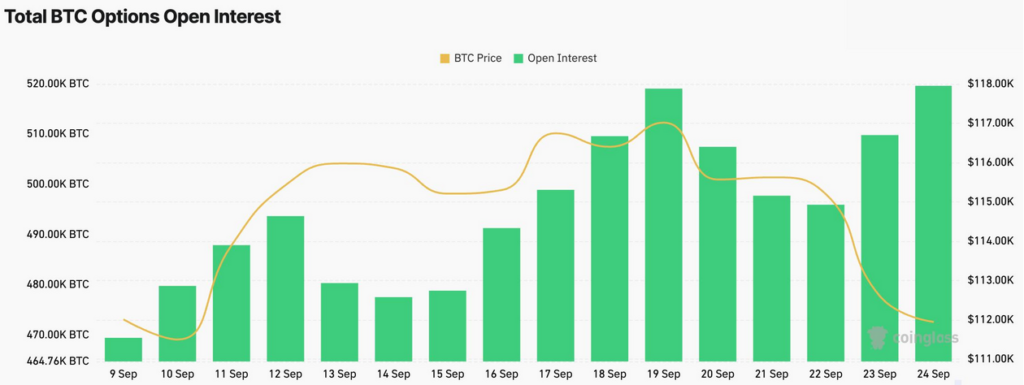
One of the most important structural changes behind this shift is the massive deleveraging of the crypto market.
During late 2025, Bitcoin’s total Open Interest (OI) in derivatives markets peaked at approximately $43 billion. However, by early 2026, this figure dropped to around $22 billion, effectively cutting leverage exposure in half.
This is not merely a reduction—it represents a complete reset of speculative excess.
Crucially, this decline in OI occurred without a corresponding collapse in price. This indicates:
- Forced liquidations and position closures occurred
- Weak hands were flushed out
- The market stabilized at lower leverage levels
This process can be described as a “healthy correction”, where risk is removed without damaging the underlying price structure.
As a result:
- The influence of derivatives markets has diminished
- Price discovery is increasingly driven by spot demand
- The market is structurally more stable
4. Retail Retreat and Liquidity Compression
Another defining characteristic of the current environment is the decline in retail participation.
On-chain transaction data shows:
- Reduced transaction counts
- Lower network activity
- Declining smaller-value transfers
This suggests that many retail investors are:
- Waiting on the sidelines
- Losing interest after previous volatility
- Reallocating capital elsewhere
From a market microstructure perspective, this creates liquidity compression.
When liquidity is thin:
- Large orders have a greater impact on price
- Market direction becomes more sensitive to whale activity
- Trends can form more easily with less resistance
In such conditions, whale accumulation directly shapes market direction.
5. Why Whales Are Buying Now: The Three Key Drivers
5.1 Post-Deleveraging Opportunity
With excessive leverage removed, the market presents a cleaner risk environment. Institutional investors prefer:
- Predictable volatility
- Reduced liquidation cascades
- Stable price structures
The current market satisfies these conditions.
5.2 Attractive Risk-Reward Zone
Bitcoin’s current price range aligns closely with:
- Long-term holder cost basis
- Historical realized price levels
This creates a favorable risk-reward profile, where downside risk is perceived as limited relative to upside potential.
5.3 Supply Migration to Strong Hands
On-chain metrics indicate:
- Increasing realized cap held by long-term holders
- Declining exchange balances
These trends confirm that Bitcoin is moving from:
- Weak hands (traders)
- To strong hands (long-term investors)
This transition is a hallmark of accumulation phases.
6. Accumulation Phase: Calm Before the Expansion
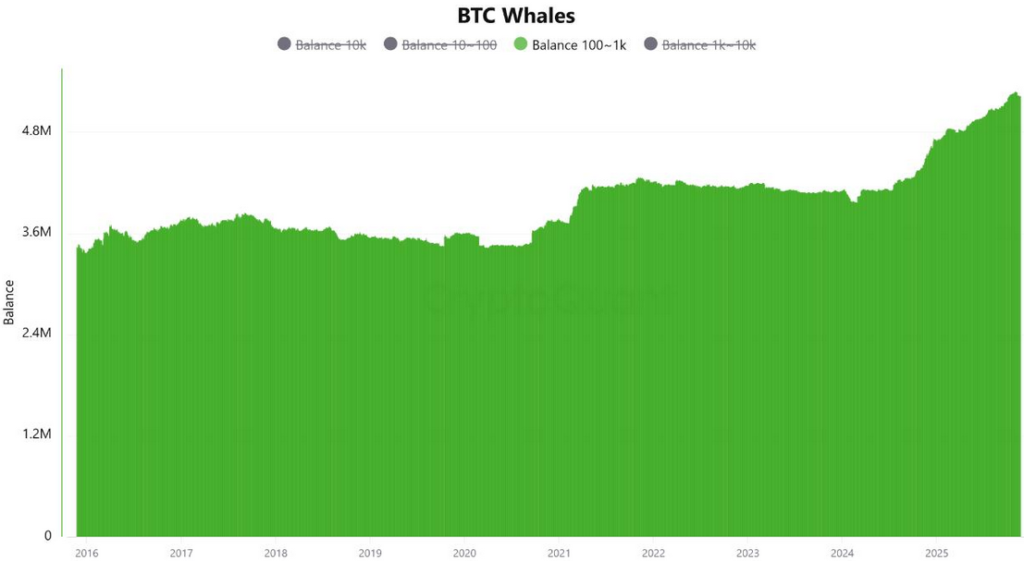
Historically, Bitcoin markets move through recognizable cycles:
- Accumulation
- Expansion (bull market)
- Distribution
- Contraction
The current environment strongly resembles the accumulation phase:
- Low retail interest
- Quiet but consistent whale buying
- Stable price range
- Reduced leverage
In previous cycles, this phase has often preceded major upward trends.
However, one key element is still missing:
broad market participation.
7. What Happens Next: The Trigger for the Next Bull Phase
For a sustained upward trend to emerge, the following conditions are typically required:
- Return of retail investors
- Increase in trading volume
- Rising on-chain activity
- Re-expansion of Open Interest (in a controlled manner)
If these factors align with ongoing institutional accumulation, the market could transition into a full-scale bullish phase.
Importantly, the sequence matters:
- Whales accumulate quietly
- Supply tightens
- Price begins to rise
- Retail re-enters
- Momentum accelerates
This pattern has repeated across multiple Bitcoin cycles.
8. Practical Implications for Investors and Builders
For readers seeking new crypto opportunities and revenue strategies, the current environment presents several key insights:
For Investors
- Focus on on-chain indicators, not just price
- Monitor ETF flows and institutional activity
- Identify accumulation zones rather than chasing momentum
For Builders and Operators
- Infrastructure aligned with spot markets will gain importance
- Custody, settlement, and liquidity solutions will be in demand
- Institutional-grade compliance and reporting will become critical
For Traders
- Expect lower volatility in the short term
- Prepare for sharp moves once liquidity returns
- Avoid over-reliance on leverage
Conclusion: A Market Defined by Structure, Not Noise
The Bitcoin market in 2026 is not simply “quiet”—it is strategically evolving.
The shift from:
- Leverage-driven speculation
- To spot-driven accumulation
marks a fundamental transformation in how value is formed and sustained.
At the center of this transformation are:
- Institutional investors
- Corporate treasury buyers
- Long-term holders
Understanding this structural shift is far more important than predicting short-term price movements.
Because in Bitcoin markets,
the real trend begins long before the crowd notices.



