
Main Points :
- A long-dormant Ethereum whale has suddenly moved hundreds of millions of dollars’ worth of ETH, raising questions about liquidity, intent, and market maturity.
- XRP is showing a notable increase in large-holder wallets for the first time since late 2025, coinciding with real-world banking and treasury integrations.
- Bitcoin remains under short-term pressure, but macro liquidity dynamics and institutional commentary suggest asymmetric upside scenarios.
- Solana and Avalanche are quietly advancing real-world asset (RWA) and ETF-linked adoption, reinforcing the shift from speculation to infrastructure.
- Across assets, the market is transitioning from leverage-driven cycles to use-case-, treasury-, and balance-sheet-driven crypto economics.
1. Market Context: A Weak Week That Hides Structural Signals
During the last week of January 2026, the crypto market experienced broad-based declines:
- Bitcoin (BTC): $84,209 (-5.7%)
- Ethereum (ETH): $2,801 (-5.0%)
- XRP: $1.80 (-6.4%)
- Solana (SOL): $117.49 (-8.5%)
At first glance, these numbers suggest a typical risk-off week. However, surface-level price action masks a deeper and more important transition underway.
Unlike previous cycles dominated by retail speculation and excessive leverage, the current market is increasingly shaped by:
- Treasury strategy decisions
- Institutional balance-sheet management
- On-chain behavior of long-term holders
- Practical blockchain deployments in finance, payments, and tokenization
For readers searching for new crypto assets, the next revenue model, or practical blockchain applications, these structural signals matter far more than weekly price volatility.
2. Bitcoin: Support Levels, Liquidity, and the Macro Backdrop
Bitcoin Support Is Being Watched, Not Chased
Chris Burniske, co-founder of crypto investment firm Placeholder, recently published an analysis identifying key Bitcoin support zones. While he stated that he is “not a buyer yet,” the implication is clear: Bitcoin is approaching levels where long-term capital begins to prepare, not panic.
This stance reflects a broader institutional mindset in 2026. Bitcoin is no longer treated purely as a speculative asset, but as:
- A macro liquidity hedge
- A balance-sheet diversification tool
- A potential beneficiary of monetary intervention
Gold Up, Bitcoin Down — For Now
Investment advisory firm CrossBorder Capital highlighted an unusual divergence: gold, silver, and copper have surged, while Bitcoin has lagged. Their analysis points to Chinese liquidity dynamics and global capital flows as key drivers.
Importantly, this divergence does not signal Bitcoin’s failure. Instead, it suggests timing asymmetry. Historically, Bitcoin tends to react after traditional liquidity channels expand, not before.
Japan, Bonds, and the Arthur Hayes Scenario
Arthur Hayes, co-founder of BitMEX, added another layer by suggesting that instability in Japan’s bond market could eventually force intervention by the U.S. Federal Reserve. If such intervention occurs, global liquidity would likely expand — a condition historically favorable to Bitcoin.
This reinforces a recurring theme:
Bitcoin’s upside is increasingly tied to policy response, not hype cycles.
3. Ethereum: Whale Awakening and the Question of Intent
A 9-Year Dormant Whale Moves
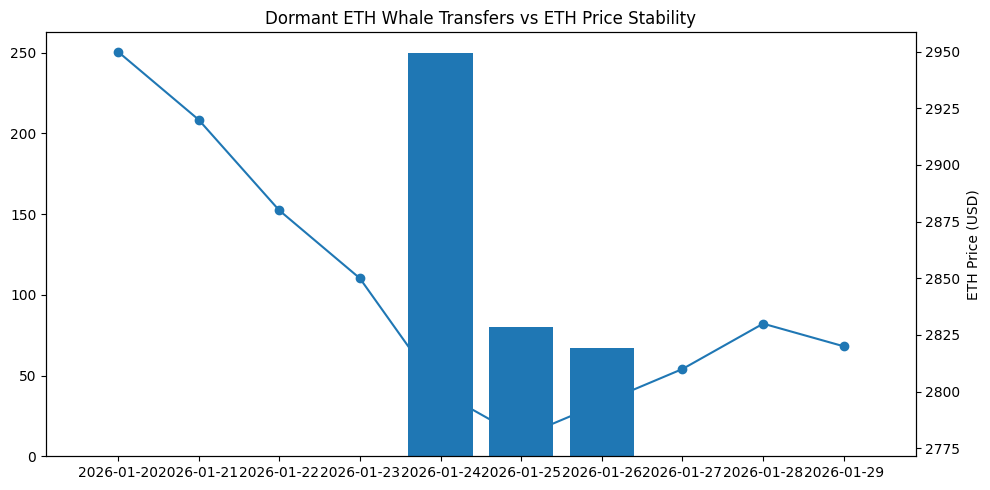
One of the most striking developments came from Ethereum. According to on-chain analytics firm Arkham Intelligence, a whale wallet inactive for approximately nine years transferred $250 million worth of ETH to Gemini. The total transfers from this wallet in the same week reached $397 million.
This raises several critical questions:
- Is this a liquidation event, or a strategic reallocation?
- Does it reflect renewed trust in exchange liquidity?
- Or is it simply a generational wealth transfer within crypto-native capital?
Importantly, the market absorbed this activity without systemic disruption — a sign of Ethereum’s liquidity maturity.
“Dormant ETH Whale Transfers vs ETH Price Stability”
Description:
- X-axis: Date
- Y-axis (left): ETH transferred (USD)
- Y-axis (right): ETH price
Insight: Large dormant movements no longer cause panic-driven crashes.
Institutional Accumulation Continues
At the same time, crypto investment firm BitMine disclosed that it had purchased over 40,000 ETH in one week, following a prior week’s purchase of 35,000 ETH. Cumulatively, BitMine now controls approximately 3.5% of total ETH supply.
This creates a fascinating duality:
- Long-dormant whales are waking up.
- New institutional holders are accumulating aggressively.
Ethereum is transitioning from a developer-centric asset to a strategic reserve layer for digital finance.
4. Ethereum’s Real Risk: Usefulness, Not Technology
Ethereum co-founder Vitalik Buterin recently stated that he is no longer worried about technical failure. Instead, he identified the real risk as a lack of socially meaningful applications.
This concern is timely. While Ethereum continues to dominate:
- DeFi infrastructure
- Token standards
- L2 ecosystems
Its long-term value will depend on whether these tools translate into:
- Payments
- AI-agent coordination
- Governance
- Real-world business logic
ERC-8004: AI Agents Meet Blockchain
Ethereum’s upcoming ERC-8004 standard aims to enable secure, discoverable, and interoperable AI agents across organizations. This is not a speculative feature — it directly targets:
- Enterprise AI workflows
- Cross-company automation
- Trust-minimized coordination
For readers interested in practical blockchain use, ERC-8004 may be more important than any meme-driven narrative.
5. XRP: Quiet Accumulation Meets Real-World Integration
Whale Wallets Are Increasing Again
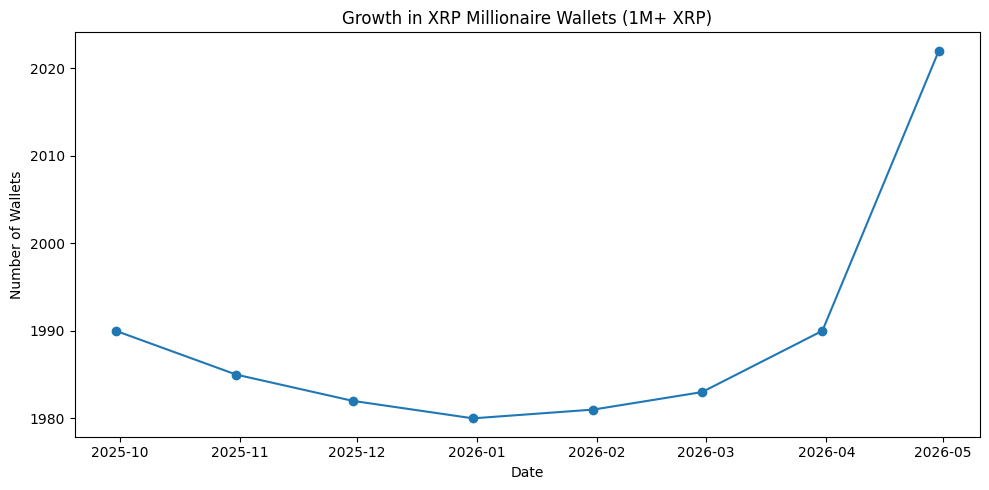
Blockchain analytics firm Santiment reported that wallets holding over 1 million XRP increased by 42 net wallets, marking the first sustained increase since September 2025.
Historically, XRP whale accumulation has correlated more strongly with:
- Enterprise adoption
- Payment corridor expansion
- Regulatory clarity
Than with speculative cycles.
“Number of XRP Millionaire Wallets vs XRP Price”
Description:
- X-axis: Time
- Y-axis: Wallet count
Insight: Accumulation precedes infrastructure expansion, not hype.
Ripple’s Strategic Expansion
Ripple announced a strategic partnership with Riyad Bank’s innovation arm, Jeel, focusing on:
- Cross-border payments
- Digital asset custody
- Tokenization
In parallel, Ripple introduced Ripple Treasury, a platform combining traditional treasury management expertise with digital asset infrastructure.
This positions XRP not as a consumer speculation token, but as:
- A liquidity bridge
- A treasury asset
- A settlement layer for regulated finance
6. Solana and Avalanche: The Infrastructure Phase Accelerates
Solana and Tokenized Funds
WisdomTree expanded its tokenized fund offerings to Solana, enabling both retail and institutional investors to access regulated tokenized assets across chains.
This reflects a broader industry shift:
- From chain maximalism
- To multi-chain utility
Solana’s strengths — speed, cost efficiency, and growing institutional tooling — make it a natural RWA settlement layer.
Avalanche ETF: A Quiet Milestone
VanEck launched the first U.S.-listed spot Avalanche ETF, providing regulated exposure to AVAX.
While less sensational than Bitcoin ETFs, this development is arguably more forward-looking. It signals:
- Acceptance of application-specific chains
- Demand for diversified blockchain exposure
- Maturation beyond single-asset narratives
7. What This Means for Crypto Investors and Builders
Across Bitcoin, Ethereum, XRP, Solana, and Avalanche, a shared pattern is emerging:
- Leverage is no longer the primary growth engine.
- Dormant capital is re-entering in controlled ways.
- Institutions are building tools, not chasing pumps.
- Revenue models are shifting toward infrastructure, custody, and settlement.
For those seeking new crypto assets or the next revenue stream, the opportunity lies less in short-term price prediction and more in:
- Treasury tooling
- Tokenization platforms
- AI + blockchain coordination
- Regulated settlement layers
Conclusion: A Market Growing Up, Not Slowing Down
The early 2026 crypto market may appear subdued on the surface, but underneath, it is undergoing a profound transformation.
Dormant Ethereum whales moving funds without causing panic. XRP whales accumulating alongside real banking integrations. Bitcoin’s fate increasingly tied to global liquidity mechanics. Solana and Avalanche embedding themselves into regulated financial products.
This is not the end of crypto’s growth story.
It is the beginning of its operational era.
For investors, builders, and institutions alike, the question is no longer “Which token will pump next?”
It is “Which networks will quietly become indispensable?”
