
Key Takeaways :
- President Donald Trump explicitly framed U.S. crypto policy as a geopolitical competition with China, not merely a domestic financial reform.
- The GENIUS Act, signed in July, positions USD-pegged stablecoins as a strategic tool against China’s digital yuan (e-CNY).
- The stalled CLARITY Act exposes a deep policy conflict over yield-bearing stablecoins, which may determine whether the dollar remains competitive in digital payments.
- China’s decision to allow interest on digital yuan deposits could give e-CNY a structural advantage if U.S. regulation remains restrictive.
- For investors and builders, the U.S. is shifting from “regulation by enforcement” toward strategic financial statecraft, creating both opportunities and political risk.
1. Davos 2025: Crypto Becomes a Tool of Geopolitics
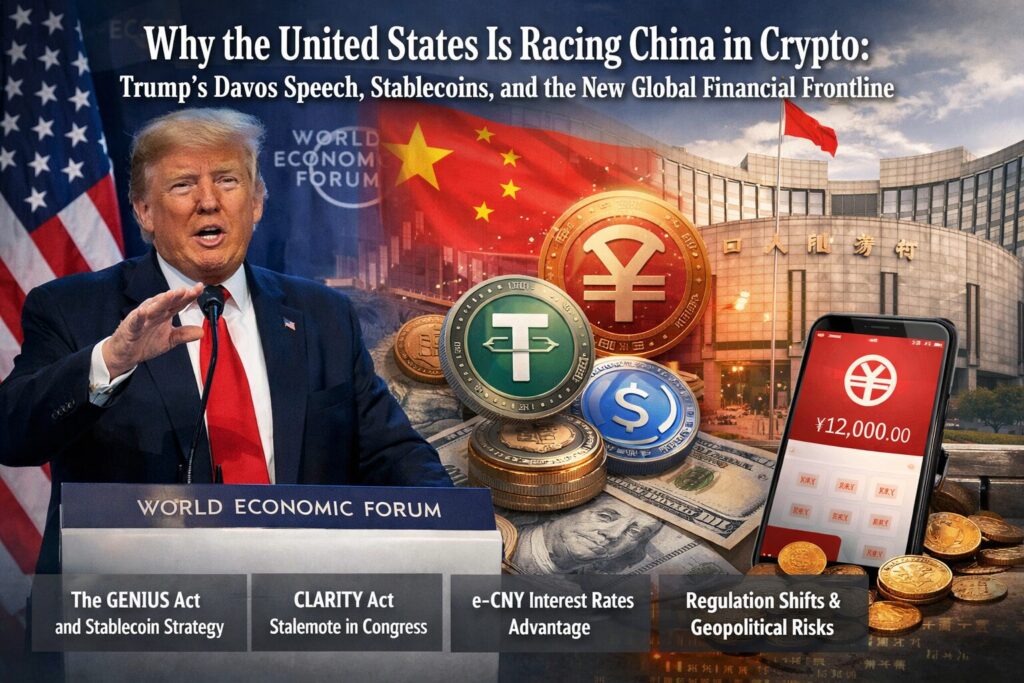
At the 2025 Annual Meeting of the World Economic Forum in Davos, President Donald Trump made an unusually direct statement: U.S. crypto policy is designed not only to stimulate innovation, but to prevent China from taking control of the future financial system.
Speaking in Switzerland, Trump explained that his decision to sign the GENIUS Act—legislation focused on payment stablecoins—was motivated by more than domestic political popularity. According to Trump, China was already targeting the same market, and allowing Beijing to dominate would be irreversible.
This framing marks a clear evolution in how cryptocurrencies are discussed at the highest political level. Crypto is no longer treated merely as a speculative asset class or a regulatory headache. Instead, it is being positioned as critical financial infrastructure, comparable to energy grids or telecommunications networks.
Trump reinforced this message by reiterating his earlier pledge, first made at WEF 2025 via remote participation from Washington, D.C., to make the United States the global hub for artificial intelligence and cryptocurrencies. The implication is clear: technological leadership and monetary influence are now inseparable.
2. The GENIUS Act: Stablecoins as Strategic Infrastructure
Signed into law in July, the GENIUS Act focuses on payment-oriented stablecoins, particularly those pegged to the U.S. dollar. While the law has been praised for providing long-awaited clarity, its implementation timeline reveals the cautious pace of U.S. regulatory machinery.
Under the statute, enforcement begins 120 days after regulatory approval or 18 months after enactment, whichever comes first. This delay has sparked debate among industry experts, many of whom argue that speed is essential in a global race where China is already deploying state-backed digital currency infrastructure.
From a strategic standpoint, the GENIUS Act reflects a belief that private-sector USD stablecoins—issued by regulated entities but operating globally—can extend dollar dominance far beyond traditional banking rails. In effect, stablecoins become exportable monetary policy, moving dollars at internet speed.
However, this vision depends on one critical factor: competitiveness.
3. The CLARITY Act Stalemate and the Yield Problem
During his Davos remarks, Trump also hinted that he may soon sign the CLARITY Act, a comprehensive crypto market structure bill currently under Senate review. Yet the bill has encountered significant resistance, including public criticism from Brian Armstrong, CEO of Coinbase.
The controversy centers on yield-bearing stablecoins.
Many banking industry groups have pushed to prohibit platforms or issuers from paying interest on stablecoin balances, arguing that such features blur the line between deposits and securities. Crypto-native firms counter that banning yield would cripple the global competitiveness of USD stablecoins—especially against China.
As of now, the Senate Banking Committee has not scheduled the next CLARITY Act hearing, and legislative insiders suggest a delay of several weeks or more.
4. China’s Digital Yuan: Quietly Adding Yield
While Washington debates, Beijing acts.
Since January, the People’s Bank of China has allowed domestic commercial banks to pay interest on digital yuan deposits. This move fundamentally changes the economic profile of e-CNY.
A yield-bearing digital currency is not just a payment tool—it becomes a store of value. For consumers and businesses choosing between a non-yielding USD stablecoin and an interest-paying e-CNY, the incentive structure is obvious.
If U.S. regulation permanently forbids yield on stablecoins, critics warn that the dollar could lose ground in cross-border trade, especially in emerging markets where yield differentials matter more than ideology.
5. Beyond Politics: What This Means for Investors and Builders
For crypto investors seeking new assets and revenue models, this policy divergence is not abstract—it directly shapes opportunity.
- Stablecoin issuers may migrate innovation offshore if U.S. rules remain restrictive.
- DeFi protocols could benefit if yield mechanisms shift from issuers to on-chain money markets.
- Payment startups must design around regulatory asymmetry between jurisdictions.
At the same time, Trump’s explicit political endorsement of crypto introduces a new risk: policy volatility tied to electoral cycles. What one administration frames as strategic infrastructure, another could reclassify as systemic risk.
6. The Bigger Picture: Crypto as Financial Statecraft
The most important takeaway from Davos is not any single bill, but the underlying mindset. Crypto is now being treated as financial statecraft—a tool to project power, defend currency influence, and shape global standards.
In this context, the debate over yield-bearing stablecoins is not a technical footnote. It is a decision about whether the dollar will remain the default digital settlement layer, or whether rival systems—starting with China’s—will fill the gap.
Conclusion
President Trump’s Davos remarks crystallized a reality the crypto industry has long sensed: the future of digital assets will be decided as much by geopolitics as by code.
The GENIUS Act and the unresolved CLARITY Act together form a crossroads. If U.S. policymakers prioritize caution over competitiveness, China’s digital yuan may gain structural advantages that are difficult to reverse. If, however, regulation evolves to support innovation while managing risk, USD-backed stablecoins could become the backbone of global digital finance.
For investors, builders, and institutions, the message is clear. Crypto is no longer just about technology or returns—it is about who writes the rules of the next monetary era.
