
Main Points :
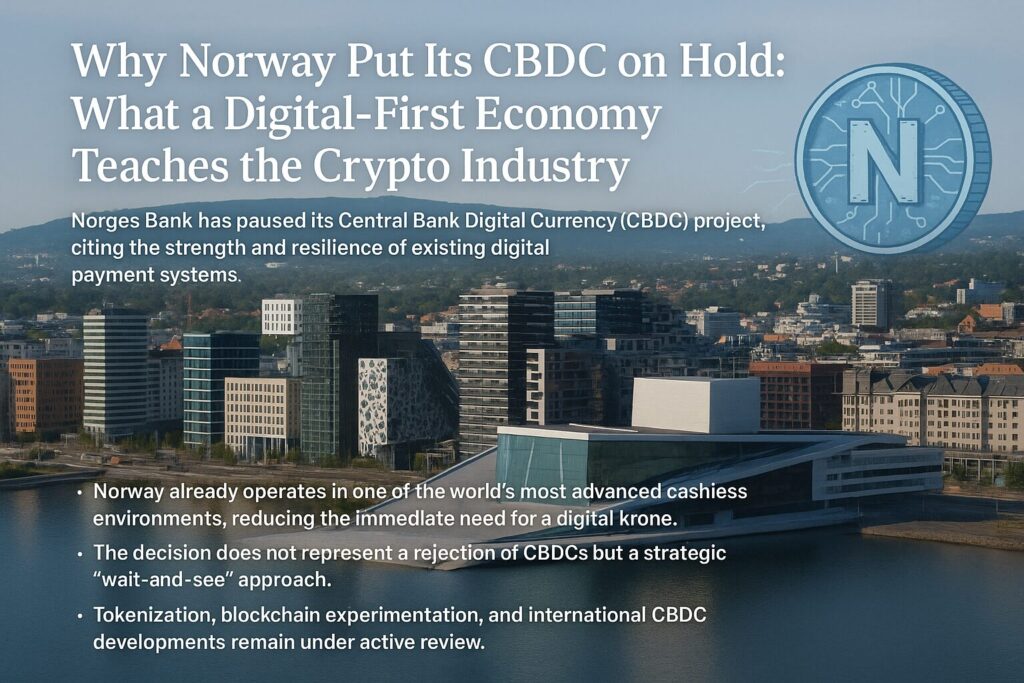
- Norges Bank has paused its Central Bank Digital Currency (CBDC) project, citing the strength and resilience of existing digital payment systems.
- Norway already operates in one of the world’s most advanced cashless environments, reducing the immediate need for a digital krone.
- The decision does not represent a rejection of CBDCs but a strategic “wait-and-see” approach.
- Tokenization, blockchain experimentation, and international CBDC developments remain under active review.
- For crypto investors and builders, Norway’s case highlights when not to deploy blockchain—and when optionality matters more than speed.
1. Norway’s Decision to Pause the Digital Krone
Norges Bank, Norway’s central bank, announced that it will temporarily halt its plans to introduce a Central Bank Digital Currency (CBDC), commonly referred to as the “digital krone.” This decision follows several years of research, pilot studies, and policy discussions examining whether a state-issued digital currency is necessary in a modern economy.
The core conclusion is straightforward: Norway’s existing payment infrastructure already works extremely well. Consumers, merchants, and financial institutions enjoy fast, secure, low-cost, and reliable digital payments. From the central bank’s perspective, introducing a CBDC at this stage would add complexity without solving a clear problem.
This stance places Norway among a growing group of advanced economies that are choosing prudence over haste in the global CBDC race.
2. A Nearly Cashless Society by Design
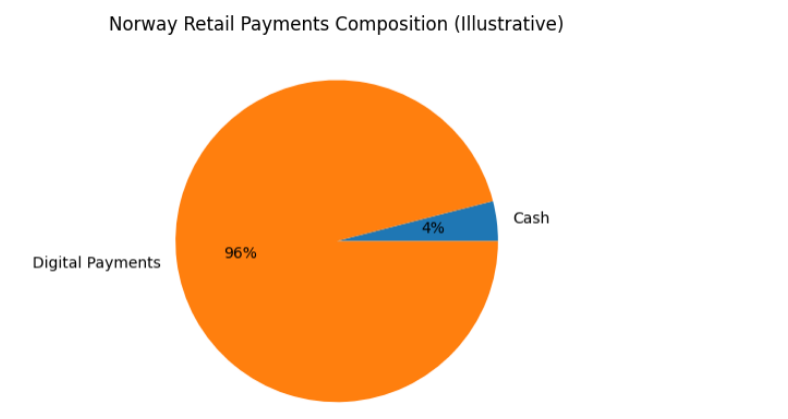
Norway is often cited as one of the world’s most cashless economies. Physical cash usage in retail transactions is estimated to be below 5%, among the lowest globally. Debit cards, mobile payments, and instant bank transfers dominate everyday commerce.
Key domestic systems include:
- BankAxept: A national card payment system widely accepted across merchants.
- Vipps: A mobile payment application used by a majority of the population for peer-to-peer and merchant payments.
- Real-time bank transfers: Supporting both retail and interbank settlement with high availability.
These systems are not only fast but also inexpensive, benefiting from economies of scale and strong coordination between banks and regulators.
[Norway Retail Payments Composition]
3. Resilience and Crisis Preparedness
One of the original motivations behind CBDCs globally has been resilience: the idea that a digital form of central bank money could act as a fallback if private payment systems fail.
Norges Bank, however, concluded that Norway already meets this requirement. Existing payment rails have redundancy, offline contingencies, and strong cybersecurity safeguards. Even in emergency scenarios, the central bank believes there is no urgent need for a digital cash substitute issued directly to the public.
This assessment is particularly important because resilience—not innovation—has often been the strongest argument for retail CBDCs in advanced economies.
4. “Not Now” Does Not Mean “Never”
Governor Ida Wolden Bache was careful to emphasize that the digital krone has not been abandoned. Instead, it has been deprioritized.
Her position can be summarized as follows:
- A CBDC is not necessary under current conditions.
- Structural changes in payments, private money, or global standards could change that assessment.
- Norway wants to remain technically and institutionally prepared.
In practice, this means research continues, but implementation is paused.
5. Tokenization and Blockchain Research Continues
Importantly for the crypto and blockchain industry, Norges Bank is not stepping away from digital finance innovation.
Areas of ongoing interest include:
- Tokenization of financial instruments
- Wholesale settlement using distributed ledger technology
- Cross-border payment efficiency
- Risk reduction in settlement processes
These initiatives align closely with enterprise blockchain use cases rather than public retail crypto adoption. The message is clear: blockchain as infrastructure still matters, even if a retail CBDC does not.
6. Europe and the Global CBDC Landscape
Norway’s decision stands in contrast to—but also in dialogue with—developments elsewhere.
- The European Central Bank continues to explore a digital euro.
- Emerging markets are often moving faster, motivated by financial inclusion and weak legacy systems.
- Several advanced economies have slowed down, reassessing costs versus benefits.
[Global CBDC Status Snapshot]
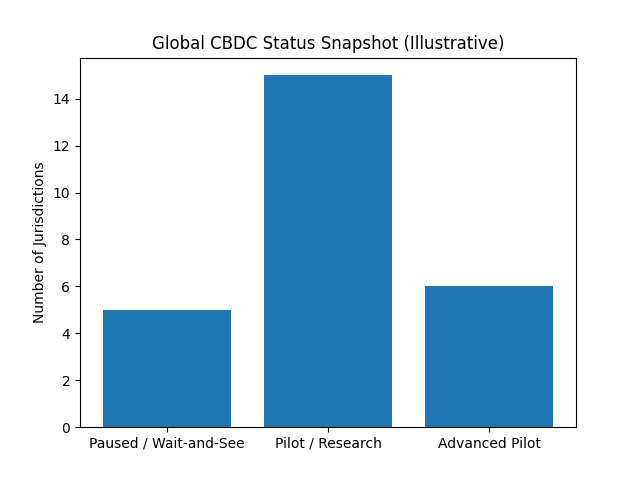
This divergence suggests that CBDCs are not a one-size-fits-all solution. Economic structure, trust in institutions, and payment maturity matter more than technological capability.
7. Lessons for Crypto Investors and Builders
For readers seeking new crypto assets, revenue models, or blockchain applications, Norway’s case offers several insights:
- Strong systems reduce disruptive opportunities
In markets where payments already work flawlessly, blockchain-based disruption is harder. - Optionality is valuable
Norway preserves the option to deploy a CBDC later, mirroring how savvy investors value flexibility. - Infrastructure over hype
The focus on tokenization and settlement efficiency aligns with long-term, lower-risk blockchain value creation. - Regulatory maturity favors selective adoption
Not every blockchain use case needs a token or a public network.
8. Strategic Implications for the Crypto Industry
The pause in Norway’s CBDC plan reinforces a broader trend: the crypto industry is moving from experimentation to selective integration.
Rather than mass deployment of new digital currencies, institutions are focusing on:
- Back-end efficiency
- Risk management
- Interoperability
- Regulatory alignment
For entrepreneurs and investors, this means that the next wave of opportunity may lie less in consumer-facing tokens and more in invisible financial plumbing.
Conclusion: A Signal of Maturity, Not Retreat
Norway’s decision to pause its CBDC initiative should not be interpreted as skepticism toward digital money or blockchain. Instead, it reflects confidence—confidence in existing systems, regulatory frameworks, and institutional readiness.
In a world where many jurisdictions are rushing forward, Norway demonstrates the value of restraint. For the global crypto ecosystem, this is a reminder that the most advanced markets adopt technology not because they can, but because they must.
