

Main Points :
- Bitcoin faces structural liquidity exhaustion that prevents sustainable breakouts above $70,000.
- Even modest realized profits exceeding $5 million per hour now trigger price rejection.
- In contrast, during Q3 2025, the market absorbed $200–$350 million per hour without breakdown.
- Order book depth and capital inflow have weakened significantly.
- ETF inflows remain positive but are insufficient to create speculative expansion.
- Sustainable recovery requires liquidity restoration, structural capital rotation, and new narrative catalysts.
1. A Structural Liquidity Problem, Not Just Technical Resistance
Bitcoin (BTC) is not failing at $70,000 because of a mere chart pattern. The issue is deeper: structural demand exhaustion.
Recent on-chain analysis indicates that the current market environment lacks the capital absorption capacity necessary to sustain a breakout into the $70,000–$80,000 range. The most striking evidence is how little selling pressure is required to reverse price momentum. When net realized profits exceed roughly $5 million per hour, selling pressure overwhelms demand and pushes price downward.
This signals a fragile liquidity regime. In strong bull cycles, markets can digest profit-taking without collapsing. Today, they cannot.
2. Historical Contrast: Q3 2025 vs. 2026 Weak Liquidity
To understand how fragile the current market is, we must compare it to the peak speculative phase of 2025.
During Q3 2025:
- Hourly realized profits ranged between $200 million and $350 million.
- Bitcoin remained structurally bid.
- Order books were thick and institutional flows were accelerating.
- Breakouts were sustained because capital rotation supported them.
Today, by contrast, a mere $5–10 million per hour in realized profits creates reversal pressure.
Figure 1 illustrates the contrast between absorption capacity in Q3 2025 and the current weak-liquidity regime.
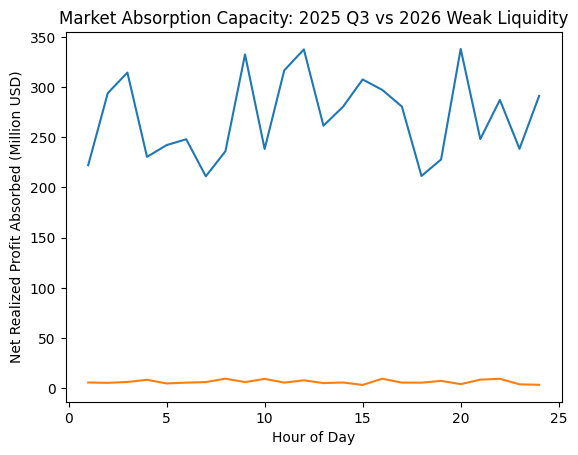
The difference is not incremental; it is exponential.
This signals that Bitcoin is currently operating in a liquidity-thin regime rather than a demand-expansion regime.
3. Liquidity Depth and Breakout Sustainability
Price breakouts do not fail because of price alone. They fail because order book depth cannot support continuation.
When liquidity depth is shallow:
- Small market sells move price disproportionately.
- Stop-loss cascades accelerate.
- Traders front-run resistance instead of chasing it.
Figure 2 demonstrates the inverse relationship between liquidity depth and breakout rejection probability.
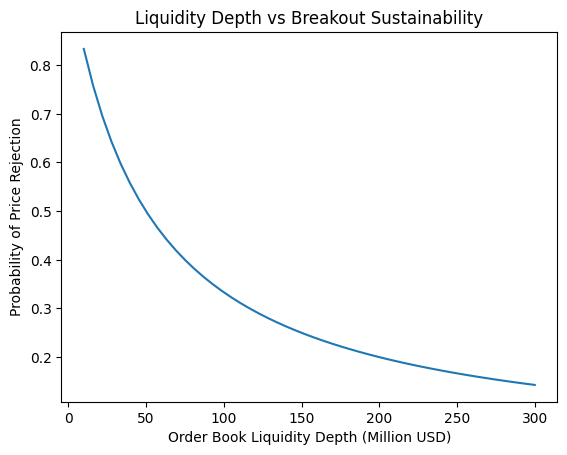
In practical terms:
- Below $100 million depth, breakout rejection probability rises sharply.
- Above $200 million depth, markets can sustain continuation.
Current BTC conditions resemble the former.
4. ETF Flows: Accumulation Without Speculative Mania
Spot ETF inflows have remained structurally positive. Institutional participation is not zero. However, the composition of capital matters.
Current inflows are:
- Allocation-based (portfolio balancing)
- Lower velocity
- Long-term oriented
They are not:
- Leveraged speculative flows
- High-frequency momentum flows
- Retail euphoria inflows
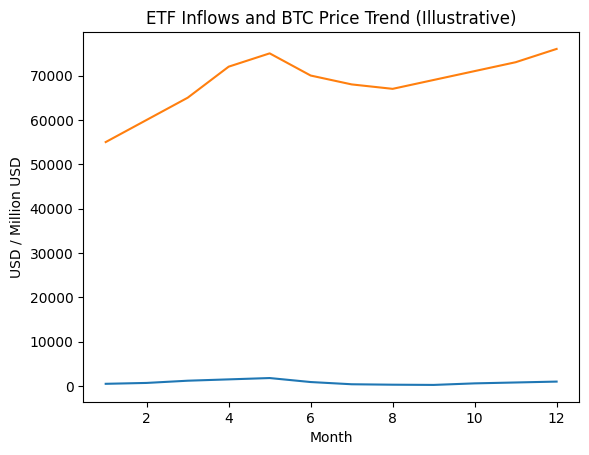
ETF inflows support price floors, but they do not generate vertical expansions unless accompanied by leverage and retail participation.
This explains why BTC can stabilize but not accelerate.
5. Demand Exhaustion: The Psychological Component
Liquidity is not just mechanical; it is psychological.
Demand exhaustion occurs when:
- Existing holders are in profit and begin distribution.
- New buyers hesitate at psychological resistance ($70,000).
- Macro uncertainty reduces risk appetite.
- Volatility compresses and discourages speculative traders.
This creates a feedback loop:
Low breakout conviction → Small selling → Rejection → Lower conviction.
6. Macro Conditions and Capital Allocation
Bitcoin does not exist in isolation. Macro risk appetite influences crypto liquidity.
Key macro variables include:
- US Treasury yields
- Dollar strength
- Equity volatility
- Monetary policy stance
If real yields remain elevated, capital allocation favors fixed-income over speculative digital assets.
Until macro conditions ease, liquidity expansion remains constrained.
7. Structural Capital Rotation: Where Is the Money Going?
Interestingly, capital is not leaving crypto entirely. It is rotating:
- Into selective altcoins with new narratives
- Into real-world asset (RWA) tokenization projects
- Into AI-integrated blockchain infrastructure
- Into yield-generating DeFi platforms
This suggests that Bitcoin is not rejected as an asset class. It is temporarily capital-efficiently inferior to narrative-driven alternatives.
For investors seeking new revenue streams, this is critical.
The opportunity is not only in BTC price appreciation but in:
- Infrastructure plays
- On-chain yield models
- Cross-chain liquidity layers
- Tokenized treasury protocols
8. What Would It Take for BTC to Break $70,000 Sustainably?
Three structural improvements are required:
1. Liquidity Expansion
Order book depth must increase substantially.
2. Realized Profit Absorption Capacity
The market must absorb $50–$100 million per hour without breakdown.
3. Narrative Catalyst
Examples:
- Sovereign adoption
- ETF expansion globally
- Regulatory clarity in major jurisdictions
- Macro easing cycle
Without at least two of these factors, breakouts remain vulnerable.
9. Is This Bearish?
Not necessarily.
Liquidity exhaustion often precedes expansion.
Markets contract before they expand.
Periods of fragility:
- Shake out weak hands
- Reset leverage
- Consolidate long-term holders
This can build the base for a stronger cycle.
10. Strategic Implications for Investors
For investors looking for:
- New digital assets
- Next revenue opportunities
- Practical blockchain adoption
This environment suggests:
- Accumulation on weakness rather than breakout chasing.
- Diversification into infrastructure and yield protocols.
- Monitoring liquidity metrics, not only price.
- Tracking ETF velocity, not just net flow.
- Watching order book depth data closely.
Conclusion: Bitcoin Is Not Failing — Liquidity Is
Bitcoin’s inability to decisively reclaim $70,000 is not a technical anomaly. It is a liquidity regime problem.
Demand exhaustion means:
- The market cannot absorb even modest profit-taking.
- Breakouts lack fuel.
- Institutional support is stabilizing but not accelerating price.
However, liquidity regimes change.
If capital inflows accelerate and macro conditions ease, Bitcoin can rapidly transition from fragility to expansion.
For now, the market remains in a structurally cautious phase — one that rewards discipline, liquidity awareness, and strategic capital allocation rather than emotional breakout trading.
