

Main Points :
- Bitcoin has no government backing, dividends, or deposit insurance — yet it continues to attract long-term holders.
- Its supply is mathematically capped at 21 million coins, creating absolute scarcity.
- The halving cycle mechanically reduces new issuance over time.
- Decentralization limits unilateral rule changes.
- The approval of U.S. spot Bitcoin ETFs accelerated institutional participation.
- Long-term holding (HODL) reduces trading friction but does not eliminate risk.
- Custody strategy is as important as price outlook.
Conclusion First: Why Bitcoin Is Supported Without “Institutional Guarantees”
Bitcoin does not have the structural protections of traditional financial instruments. It does not provide dividends like equities, does not yield interest like savings accounts, and is not guaranteed by a central bank or government deposit insurance scheme.
Yet despite this absence of institutional backing, Bitcoin continues to be widely held for the long term.
The reason lies not in promises made by authorities, but in the structure of its protocol: fixed supply, predictable issuance, decentralized verification, and increasing financial integration through regulated instruments such as exchange-traded funds (ETFs).
However, volatility and custody risks are real. Bitcoin long-term holding is not a guarantee of success — it is a strategic exposure decision. Investors should consider allocation size, security practices, and risk tolerance carefully.
What Does “No System” Actually Mean?
When people say Bitcoin has “no system” or “no institutional framework,” they typically mean:
- No government or central bank guarantee
- No dividend or interest mechanism for passive holders
- No deposit insurance equivalent
- No single authority controlling issuance or rules
In contrast to fiat currency or bank deposits, Bitcoin operates without a central guarantor.
But paradoxically, this lack of centralized authority is precisely why many investors trust it for the long term.
Its monetary policy is not subject to discretionary expansion. It is encoded in software and validated by a distributed network of participants.
Why Bitcoin Is Structurally Suited for Long-Term Holding
Bitcoin’s appeal as a long-term asset rests on five structural characteristics:
- Fixed supply of 21 million coins
- Halving cycle reduces new issuance
- Decentralized governance
- Institutional adoption via ETFs
- Narrative as “digital gold”
Let us examine each carefully.
1. Absolute Scarcity: 21 Million Coin Cap
Bitcoin’s supply cap is hard-coded at 21 million coins.
As of late 2025, approximately 19.96 million BTC had already been mined, meaning over 95% of total supply has been issued.
Unlike fiat currencies — which can expand through monetary policy — Bitcoin cannot be inflated without broad consensus among network participants, an extremely unlikely scenario.
This predictable scarcity underpins long-term conviction.
Bitcoin Supply Curve (Cumulative Issuance Over Time)
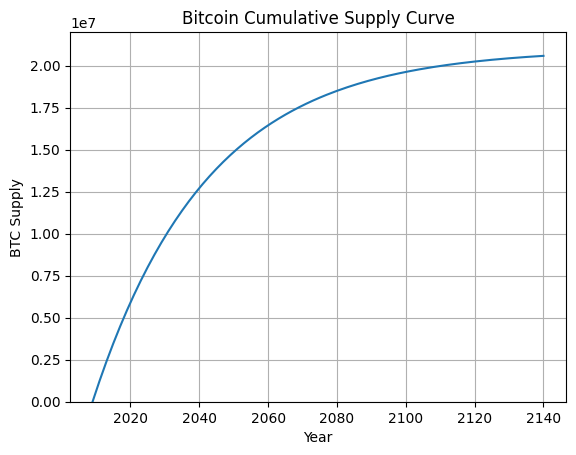
Graph shows gradual flattening curve approaching 21 million cap.
2. The Halving Cycle: Programmed Supply Reduction
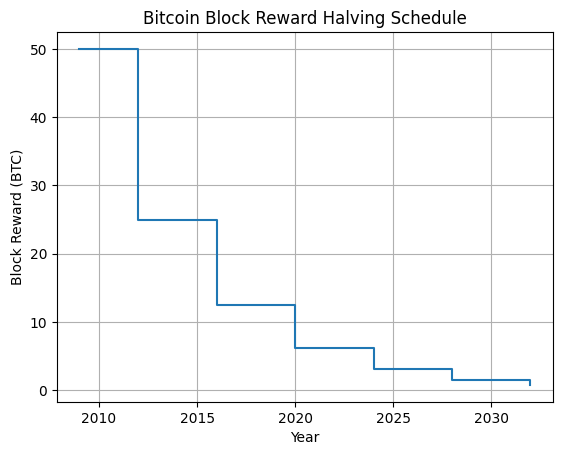
Approximately every four years, Bitcoin’s block reward is cut in half.
This “halving” reduces the rate of new BTC entering circulation. It does not guarantee price increases, but it reduces supply growth mechanically.
Historically, halving cycles have preceded major bull markets — although correlation does not imply causation.
The key structural insight is this: Bitcoin’s inflation rate trends toward zero over time.
Bitcoin Block Reward Halving Timeline
3. Decentralization: No Single Control Point
Bitcoin is not issued by a corporation or sovereign entity.
Transactions are validated by miners and nodes globally. Changes to protocol rules require broad consensus.
This makes arbitrary monetary expansion difficult.
However, decentralization does not eliminate regulatory risk. Governments can regulate exchanges, taxation, and custodial services.
Decentralization shifts responsibility to the holder.
4. ETF Approval: Institutionalization of Bitcoin Exposure
In 2024, U.S. regulators approved spot Bitcoin ETFs.
This allowed institutional investors to gain exposure to Bitcoin within traditional brokerage and compliance frameworks.
One notable example: Abu Dhabi’s sovereign wealth fund Mubadala reportedly increased its holdings of BlackRock’s iShares Bitcoin Trust (IBIT), with holdings valued at approximately $630 million as of late 2025 filings.
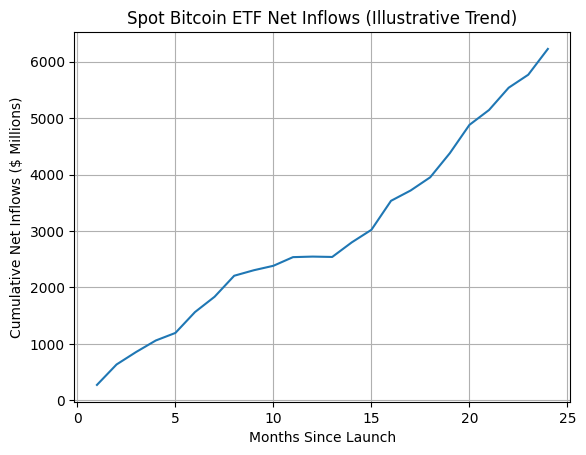
ETF flows fluctuate daily, but the structural implication is significant:
Bitcoin moved from speculative fringe asset to institutionally accessible macro asset.
Spot Bitcoin ETF Net Inflows Over Time
5. The “Digital Gold” Narrative
Bitcoin is often described as digital gold due to:
- Scarcity
- Divisibility
- Portability
- Verifiability
However, Bitcoin does not always behave like gold.
In risk-off macro environments, Bitcoin has sometimes traded like a high-beta risk asset.
The digital gold thesis is not a guarantee — it is a structural comparison.
Advantages of Long-Term Holding
Reduced Emotional Trading
Fewer decisions reduce behavioral mistakes.
Lower Transaction Costs
Frequent trading increases spreads and fees.
Tax Timing Efficiency
In many jurisdictions, taxable events occur upon realization (sale). Long-term holding reduces frequency of taxable triggers.
Note: Always verify current tax law.
The Risks: Why HODL Is Not Passive
Volatility
Bitcoin routinely experiences 30–50% drawdowns.
Exchange Risk
Holding assets on exchanges exposes investors to counterparty risk.
Self-Custody Risk
Losing private keys is irreversible.
Regulatory Shifts
Tax treatment, capital controls, and ETF regulations may evolve.
Minimum Risk Management Framework
- Allocate only surplus capital.
- Consider dollar-cost averaging (DCA).
- Diversify custody (exchange + hardware wallet).
- Enable 2FA and secure backups.
- Review macro and regulatory landscape periodically.
Market Context: 2026 Outlook
As of early 2026, Bitcoin trades within a volatile macro environment influenced by:
- U.S. interest rate expectations
- ETF inflow variability
- Institutional treasury allocations
- Increasing corporate balance sheet exposure
Supply is tightening structurally. Demand is increasingly institutional.
Yet macro liquidity remains a dominant variable.
Final Summary
Bitcoin’s long-term appeal does not depend on institutional guarantees.
It depends on mathematical scarcity, predictable issuance, decentralized validation, and growing integration into global financial infrastructure.
Long-term holding is not blind faith.
It is a calculated thesis:
That scarce, decentralized digital assets may preserve value across monetary regimes.
But discipline, custody design, and risk sizing matter more than conviction alone.
Bitcoin rewards patience — but only for those who understand both its power and its limits.
