

Main Points :
- Gold and silver have continued to rise over the past three months, while Bitcoin has remained locked in a high-level range.
- This divergence is driven by heightened geopolitical and policy uncertainty, expectations of lower real interest rates, and structural capital flows favoring precious metals.
- Silver amplifies gold’s move due to tighter supply constraints and speculative positioning.
- Bitcoin is still treated primarily as a high-beta risk asset rather than a pure safe haven.
- On-chain indicators from CryptoQuant show weakening apparent demand and persistent selling pressure from short-term holders.
- Unless Bitcoin’s demand structure improves, gold and silver are likely to remain more resilient in the current macro environment.
1. The Current Market Phase: Consolidation at Elevated Levels
The present market environment can be best described as a post-rally consolidation phase at historically high levels. After strong moves earlier in the year, multiple asset classes have entered a range-bound state, digesting previous gains while responding to shifting macroeconomic signals.
Over the past three months, however, a clear divergence has emerged. Gold and silver prices have continued to grind higher, reflecting steady inflows and a defensive allocation mindset. Bitcoin, in contrast, has largely moved sideways, unable to break decisively higher despite a macro backdrop that might superficially appear supportive for scarce assets.
This divergence is not accidental. It reflects differences in investor perception, capital structure, and time horizon between precious metals and digital assets.
2. Safe-Haven Demand and the Return of Geopolitical Premiums
One of the dominant forces behind gold and silver’s strength is the renewed rise in geopolitical and policy uncertainty. Ongoing regional conflicts, fragmented global trade policies, and concerns over fiscal sustainability in major economies have all contributed to a revival of safe-haven demand.
Gold, in particular, has historically benefited from such conditions. Central banks, sovereign wealth funds, and long-term institutional investors tend to increase gold allocations when uncertainty rises. These participants are generally price-insensitive buyers, focused on capital preservation rather than short-term performance.
Silver follows a similar path, but with an important twist. In addition to its monetary and safe-haven characteristics, silver has industrial demand exposure, particularly in energy transition technologies. This dual role often causes silver to outperform gold during bullish precious-metal cycles, as financial inflows interact with physical supply constraints.
3. Expectations of Lower Real Interest Rates
Another critical driver is the market’s expectation that real interest rates will decline over the medium term. Even if nominal rates remain elevated, slowing inflation and economic deceleration raise the probability that central banks will eventually ease policy.
Lower real rates reduce the opportunity cost of holding non-yielding assets such as gold and silver. As a result, precious metals tend to attract capital well before actual rate cuts materialize.
Bitcoin is sometimes described as “digital gold,” but in practice, its response to real-rate expectations has been less direct and less consistent. This is because Bitcoin’s investor base is more heterogeneous, spanning long-term believers, speculative traders, leveraged participants, and algorithmic strategies.
4. Structural Capital Flows Favoring Precious Metals
There is also a structural reason why capital flows into gold and silver more smoothly during risk-off phases. Large institutional portfolios often have pre-approved mandates for precious metals exposure. Increasing gold allocation is operationally simple, compliant, and well understood by risk committees.
Bitcoin, by contrast, still faces institutional friction. Even where spot ETFs exist, many institutions treat Bitcoin exposure as part of a broader risk or alternative bucket rather than a core defensive asset. As a result, when risk aversion rises, capital tends to flow first into government bonds and gold, not into Bitcoin.
This structural asymmetry helps explain why gold and silver can trend higher even as Bitcoin stalls.
5. Silver as a Volatility Amplifier
Silver deserves special attention. Compared to gold, the silver market is smaller, less liquid, and more sensitive to marginal flows. Supply constraints, including limited mine expansion and strong industrial demand, exacerbate price movements.
When speculative capital enters the precious-metal space, silver often acts as a volatility amplifier, rising faster than gold. This dynamic has been evident in the recent three-month period, with silver outperforming both gold and Bitcoin on a relative basis.
6. Bitcoin’s Position as a High-Beta Risk Asset
Despite its fixed supply and decentralized design, Bitcoin continues to be classified by many investors as a high-beta risk asset. In practical portfolio construction, it behaves more like a technology-linked speculative asset than a traditional safe haven.
During risk-off phases, investors typically de-risk in stages. First, they reduce exposure to high-volatility assets. Only later, if confidence stabilizes, do they reallocate into growth-oriented alternatives. This sequencing often leaves Bitcoin temporarily sidelined, even as gold and silver benefit.
7. On-Chain Evidence: Weakening Demand Signals
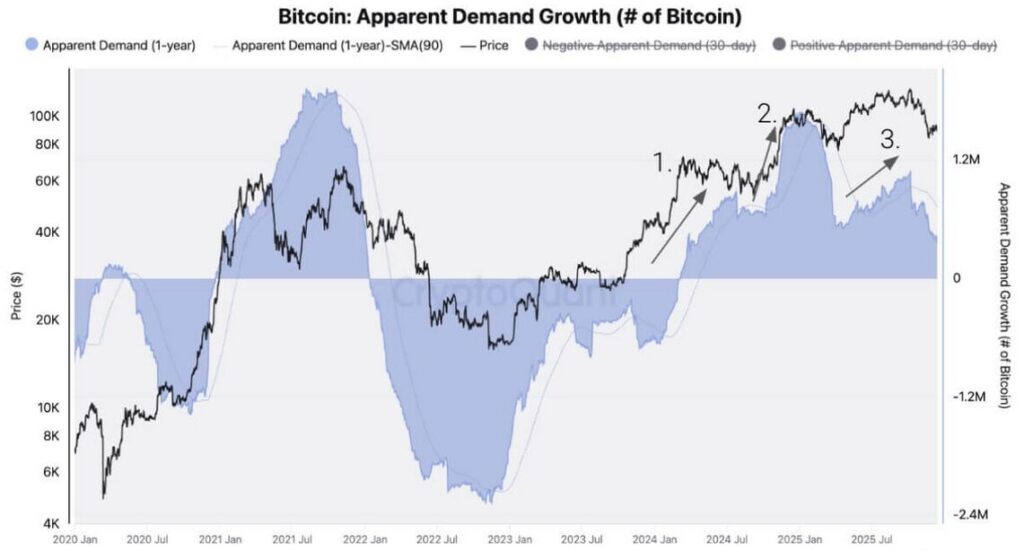
On-chain data reinforces this interpretation. According to CryptoQuant, Bitcoin’s apparent demand has recently turned negative, indicating that new demand is not keeping pace with supply at current price levels.
This metric measures the balance between new coin issuance and changes in long-term holder behavior. A negative reading suggests that incremental buyers are insufficient to absorb available supply without downward or sideways price pressure.
Bitcoin Apparent Demand (USD-adjusted, rolling average)
8. Short-Term Holder SOPR and Persistent Selling Pressure
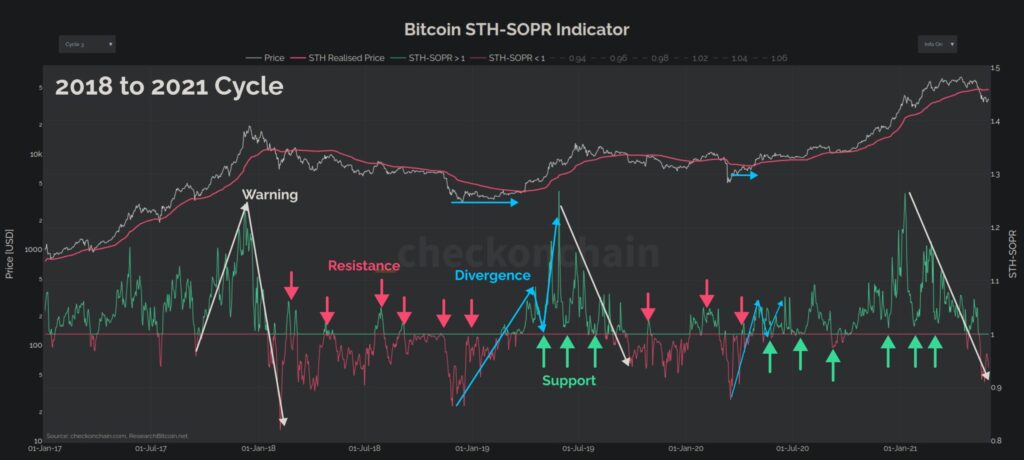
Another key indicator is the Short-Term Holder Spent Output Profit Ratio (STH SOPR). Recently, this metric has spent increasing time below 1, meaning that short-term holders are often selling at a loss or near break-even.
When STH SOPR remains below 1, it signals a fragile market structure. Rallies tend to be sold into, as traders seek to exit positions and reduce exposure. This behavior places a ceiling on upside momentum, particularly when competing assets like gold and silver are attracting defensive capital.
Short-Term Holder SOPR vs Bitcoin Price
9. Base Scenario and Conditions for Reversal
The current base scenario is therefore relatively clear:
- Gold and silver are likely to remain supported by safe-haven flows, institutional demand, and real-rate expectations.
- Bitcoin is likely to remain range-bound unless demand conditions materially improve.
- Short-term holder selling pressure will continue to cap upside unless sentiment shifts.
However, this outlook is conditional, not permanent. If Bitcoin’s apparent demand turns sustainably positive and STH SOPR stabilizes above 1, it would indicate healthier demand absorption and renewed confidence. Under such conditions, Bitcoin could begin to reassert itself as a macro-relevant asset rather than a purely speculative one.
10. Implications for Investors and Builders
For investors searching for new digital assets or alternative revenue sources, the current environment highlights the importance of timing and positioning. Bitcoin’s long-term narrative remains intact, but short-term capital dynamics matter.
For builders and operators focused on practical blockchain use cases, the divergence underscores a broader truth: macro narratives alone are insufficient. Adoption, utility, and sustainable demand structures ultimately determine resilience.
Conclusion: Divergence as a Signal, Not a Contradiction
The divergence between rising gold and silver prices and a range-bound Bitcoin is not a contradiction—it is a signal. It reflects how different forms of scarcity are priced under uncertainty, and how capital flows respond to perceived risk.
Gold and silver are benefiting from their established roles as defensive assets with deep institutional acceptance. Bitcoin, while structurally scarce, is still evolving in how it is perceived and utilized within global portfolios.
As on-chain data and macro conditions evolve, this balance may shift. Until then, understanding these distinctions is essential for anyone seeking opportunity at the intersection of traditional finance and blockchain-based assets.
