
Main Points :
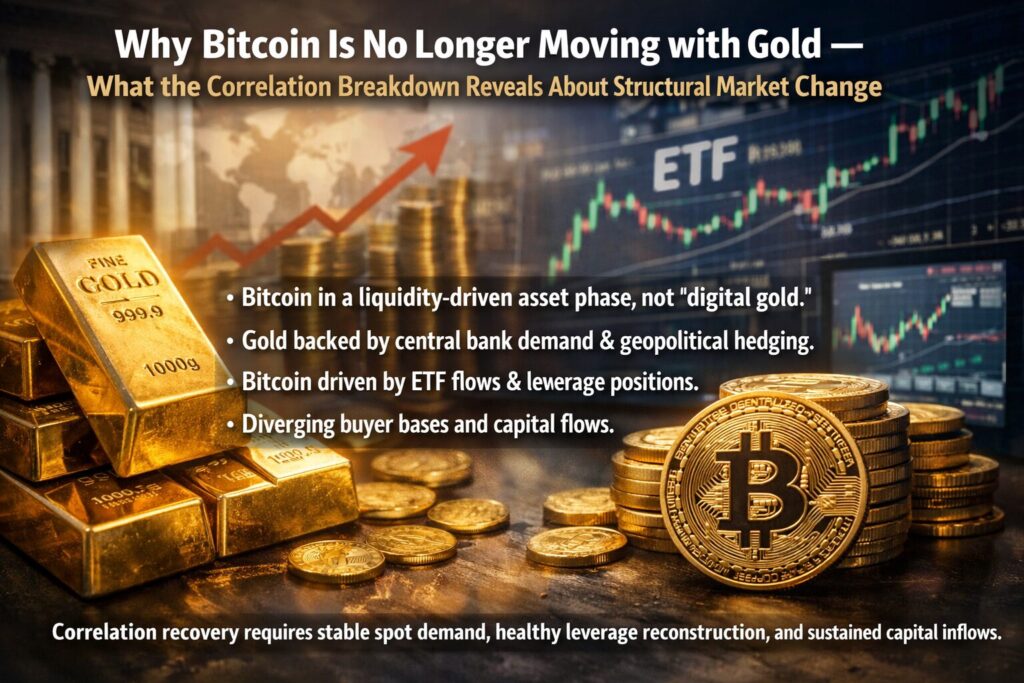
- Bitcoin is currently in a liquidity-driven financial asset phase rather than a “digital gold” phase.
- Gold is supported by structural demand such as central bank accumulation and geopolitical hedging.
- Bitcoin is increasingly driven by ETF flows, derivatives positioning, and leverage adjustments.
- The divergence reflects different buyer bases and different types of capital flows.
- Correlation recovery requires stable spot demand, healthy leverage reconstruction, and sustained capital inflows.
1. A Structural Shift, Not a Price Anomaly
The recent breakdown in correlation between Bitcoin and gold is not merely a short-term statistical fluctuation. It reflects a deeper structural transformation in how capital interacts with both assets.
According to Ki Young Ju, CEO of CryptoQuant, Bitcoin is currently in a “not digital gold period.” This statement is consistent with observable market data. The 90-day rolling correlation between Bitcoin and gold has fallen into negative territory, indicating that the two assets are increasingly moving in opposite directions under the same macroeconomic environment.
This divergence is critical. It forces us to move beyond narrative and examine structure.
In past cycles, Bitcoin was frequently framed as “digital gold,” especially during periods of monetary expansion or geopolitical stress. However, the current market phase suggests that Bitcoin is behaving less like a store of value and more like a liquidity-sensitive financial instrument.
The issue is not price level — it is demand composition.
2. Defining the Current Market Phase
We are currently in a post-bear-market validation phase. Prices have rebounded from prior lows, yet full liquidity restoration has not been confirmed. The dominant structure remains fragile.
In such an environment:
- Capital is selective.
- Leverage is unstable.
- Flows are tactical rather than structural.
Bitcoin’s movement is increasingly influenced by:
- ETF inflow/outflow volatility
- Derivatives liquidation cascades
- Hedge fund risk rebalancing
- Funding rate shifts
- Short-term speculative positioning
Gold, on the other hand, is supported by long-horizon accumulation, particularly from sovereign entities.
The divergence stems from this fundamental difference in capital quality.
3. The Nature of Gold Demand: Structural and Sovereign
Gold’s current rally is heavily influenced by:
- Central bank accumulation
- Geopolitical hedging
- Reserve diversification strategies
- De-dollarization trends
Central banks purchase gold not for short-term gain but for balance sheet stability. These flows are:
- Persistent
- Price-insensitive
- Long duration
- Structurally defensive
When geopolitical risk rises, gold benefits from safe-haven demand. The buyers are states, monetary authorities, and institutions seeking long-term capital preservation.
This creates a steady demand floor.
4. The Nature of Bitcoin Demand: Financial Flow-Driven
Bitcoin’s demand profile is fundamentally different.
Bitcoin flows today are dominated by:
- Spot ETF subscriptions and redemptions
- Perpetual futures leverage adjustments
- Options hedging
- Arbitrage desks
- Macro hedge funds
These participants are:
- Return-seeking
- Risk-managed
- Highly reactive
- Sensitive to volatility
When macro uncertainty rises, gold is accumulated. Bitcoin, however, may experience position reduction due to risk management constraints.
This asymmetry explains why the correlation has turned negative.
5. Historical Precedents of Correlation Breakdown
This is not the first time correlation has weakened.
2023 Banking Stress
During the regional banking instability of 2023, gold rallied strongly as a safe asset. Bitcoin initially followed but later decoupled as leveraged positions were unwound.
Late 2024 Central Bank Accumulation Phase
In late 2024, gold rose on sustained sovereign buying, while Bitcoin’s price action was dominated by ETF flows and derivatives positioning. Correlation weakened again.
The common factor in both cases was buyer composition.
Gold was purchased by structural holders.
Bitcoin was traded by financial participants.
6. Visualizing the Divergence
[Insert Figure 1 here – Bitcoin vs Gold Price Divergence]
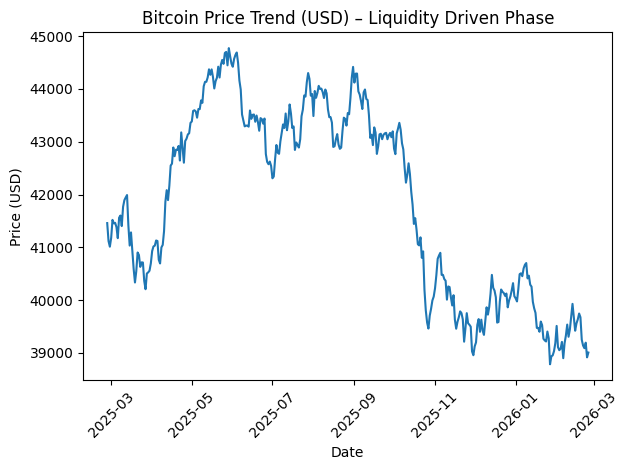
Figure 1 illustrates the structural divergence in price behavior. Gold exhibits relatively smoother upward accumulation patterns, while Bitcoin demonstrates volatility consistent with liquidity-driven repositioning.
[Insert Figure 2 here – 90-Day Rolling Correlation]
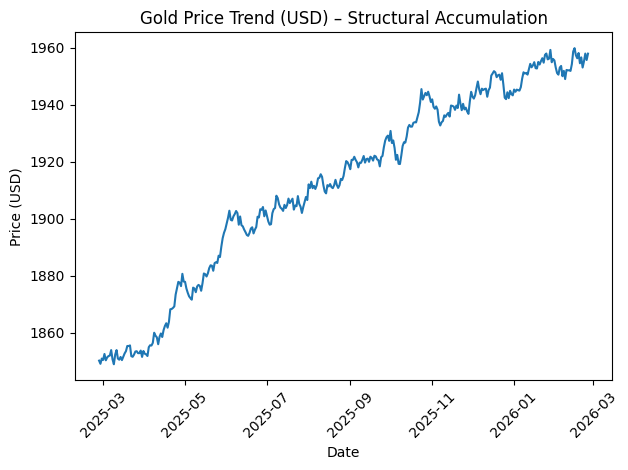
Figure 2 shows the simulated 90-day rolling correlation entering negative territory. Negative correlation indicates opposite directional responses under shared macro stress.
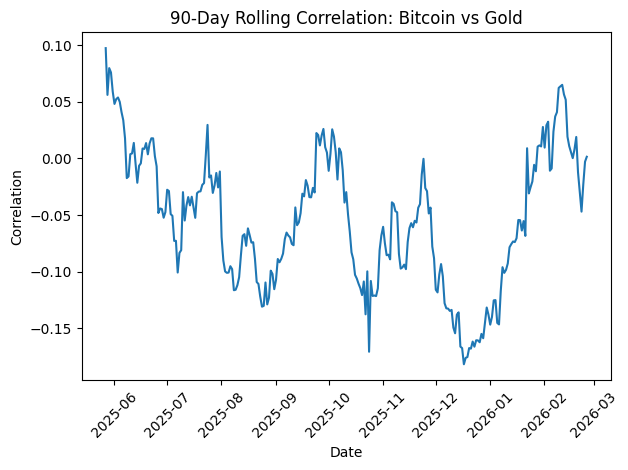
This supports the thesis that the two assets are currently governed by different flow regimes.
7. What Would Restore the “Digital Gold” Narrative?
For Bitcoin to regain digital gold status, three structural conditions must materialize:
1. Sustained Spot Demand Recovery
Organic spot demand — not leverage — must dominate. This includes:
- Long-term wallet accumulation
- Declining exchange balances
- Reduced speculative turnover
2. Healthy Leverage Reconstruction
Leverage must rebuild gradually without destabilizing liquidation cascades. Funding rates should stabilize, and open interest growth must be sustainable.
3. Stable ETF Net Inflows
Consistent ETF inflows signal institutional adoption beyond tactical trading.
If these elements align, Bitcoin may regain a store-of-value profile and correlation with gold may recover.
8. Implications for Investors Seeking Yield and Opportunity
For readers exploring new crypto assets, yield strategies, and practical blockchain applications, this structural divergence offers insight.
If Bitcoin behaves as a financial asset rather than digital gold, opportunities emerge in:
- Volatility trading
- Options premium capture
- Arbitrage strategies
- Tactical allocation models
Meanwhile, gold’s structural demand profile suggests capital preservation characteristics rather than growth asymmetry.
Understanding which phase dominates allows strategic positioning rather than narrative-driven exposure.
9. The Base Scenario and the Alternative Scenario
Base Scenario
Bitcoin and gold remain structurally decoupled.
Gold continues sovereign accumulation.
Bitcoin remains flow-driven and volatility-sensitive.
Alternative Scenario
Spot demand strengthens.
Leverage stabilizes.
ETF inflows normalize.
Bitcoin regains value-preservation perception.
Under that environment, correlation may recover.
10. Conclusion
The breakdown in Bitcoin-gold correlation is not accidental. It is structural.
Gold is currently supported by sovereign, defensive, price-insensitive demand.
Bitcoin is governed by tactical, leveraged, liquidity-sensitive capital.
Until demand composition converges, correlation recovery remains limited.
Bitcoin is not failing.
It is transitioning between identity phases.
Recognizing this transition allows investors to move beyond slogans and engage with market structure.
