
Main Points :
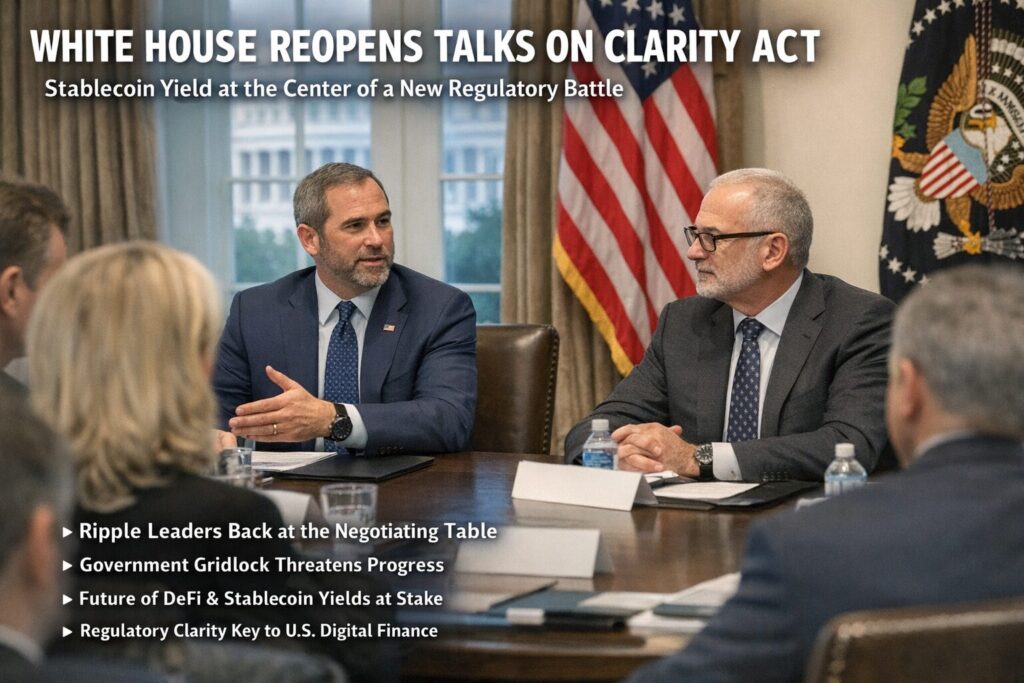
- The White House has reconvened crypto and banking leaders to resolve disputes over the stablecoin yield provision in the CLARITY Act.
- Ripple executives, including CEO Brad Garlinghouse and CLO Stuart Alderoty, are directly engaged in high-level discussions.
- Political gridlock, including a 43-day government shutdown, has delayed Senate progress despite House passage.
- Tensions revolve around DeFi, tokenized equities, and whether stablecoins should be allowed to offer yield.
- Industry leaders argue that regulatory clarity is critical to preserving U.S. competitiveness in digital finance.
- The outcome could reshape stablecoin economics, DeFi structures, and institutional blockchain adoption in 2026 and beyond.
White House Reengages Industry Over Stablecoin Yield Clause
The White House has resumed high-level discussions concerning the Digital Asset Market Structure bill, widely known as the CLARITY Act, currently under consideration in the U.S. Senate. The central issue dividing policymakers and industry participants is the proposed restriction on yield-bearing stablecoins — a clause that could significantly impact the economics of digital dollar products.
According to statements made during a Fox News interview, Ripple CEO Brad Garlinghouse confirmed that Ripple’s Chief Legal Officer, Stuart Alderoty, attended an early-morning meeting with senior White House officials. The meeting follows earlier reports that the Trump administration convened stakeholders on February 10 to address unresolved issues surrounding the bill. No agreement had been reached at that time.
The renewed talks indicate that stablecoin yield remains one of the most contentious elements of the legislation. While the House passed the CLARITY Act in July, Senate deliberations have stalled amid broader political disruptions and competing regulatory visions.
Political Gridlock and Regulatory Uncertainty
The legislative environment surrounding digital assets in 2025 has been volatile. The United States experienced a historic 43-day government shutdown — the longest in its history — contributing to delays in committee work and Senate floor scheduling.
In addition, Democratic lawmakers have raised concerns about conflicts of interest and the scope of regulatory authority over decentralized finance (DeFi) and tokenized equities. These concerns have intersected with broader debates about how to regulate stablecoins — particularly whether issuers should be permitted to offer yield on reserves.
The question is not merely technical. It strikes at the heart of how stablecoins compete with traditional bank deposits and money market funds.
Why the Stablecoin Yield Clause Matters
To understand the controversy, one must examine how stablecoins generate value.
The Economic Structure of Stablecoins
Most fiat-backed stablecoins — such as USD Coin and Tether — hold reserves in short-term U.S. Treasury bills and cash equivalents. These instruments currently yield approximately 4–5% annually.
Under current models, stablecoin issuers retain this yield as revenue. The proposed clause in the CLARITY Act seeks to limit or prohibit direct yield distribution to holders, arguing that yield-bearing stablecoins may resemble unregulated securities or deposit substitutes.
However, critics argue that banning yield would:
- Reduce innovation
- Push capital offshore
- Reinforce banking oligopolies
- Limit DeFi integration
Competitive Implications
If U.S.-regulated stablecoins cannot distribute yield, global competitors may step in. For example:
- Offshore platforms could issue yield-bearing dollar tokens.
- DeFi protocols may migrate to jurisdictions with more flexible frameworks.
- Tokenized money market products may fill the vacuum.
In short, yield is not a minor technical detail — it determines whether stablecoins function as passive payment rails or active financial instruments.
Industry Mobilization: Ripple and Others Step In
Ripple has become increasingly vocal in Washington. CEO Brad Garlinghouse and CLO Stuart Alderoty have positioned the company as a bridge between traditional finance and digital asset markets.
Ripple’s own dollar-backed stablecoin initiatives and cross-border settlement services depend heavily on regulatory clarity. If stablecoins are constrained from offering yield, it could alter corporate treasury adoption strategies and limit blockchain-based financial product design.
The Crypto Council for Innovation, led by CEO Ji Hun Kim, characterized the discussions as “constructive,” emphasizing the need to strengthen U.S. competitiveness while protecting consumers.
The Mar-a-Lago Crypto Forum: Political Signaling
The meeting followed a crypto forum hosted at Mar-a-Lago, organized by World Liberty Financial — a venture reportedly associated with members of the Trump family.
Attendees included:
- Michael Selig
- U.S. Senators
- Crypto industry executives
Senator Bernie Moreno suggested that the CLARITY Act could advance through Congress and be ready for signature by April.
This timeline may be optimistic, but the event signals growing political alignment between pro-crypto lawmakers and industry stakeholders.
Broader Market Context: Institutional Accumulation and Stablecoin Expansion
While legislative debate continues, the digital asset market is evolving rapidly.
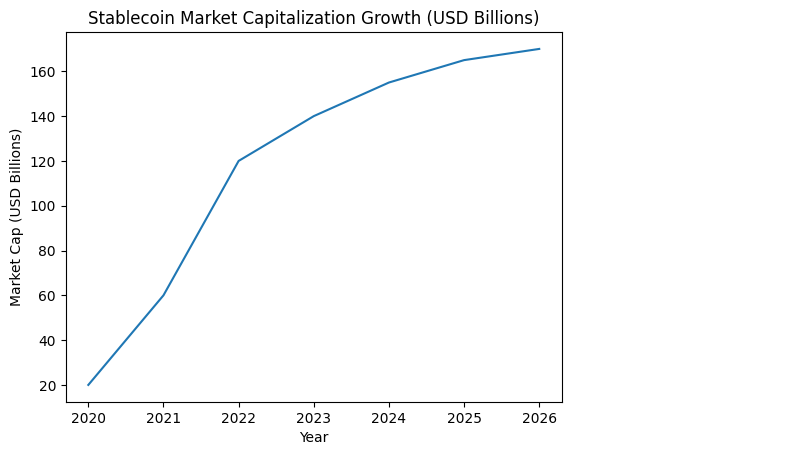
Stablecoin Market Capitalization Growth
As of early 2026:
- Total stablecoin market cap exceeds approximately $170 billion.
- USDC and USDT account for the majority share.
- Institutional demand for tokenized dollars continues to rise.
Below is a conceptual chart illustrating stablecoin market growth:
[INSERT IMAGE 1 HERE: Stablecoin Market Capitalization Growth Chart – 2020–2026]
The expansion reflects increasing use in:
- Cross-border settlements
- On-chain trading
- DeFi collateralization
- Corporate treasury management
Yield Comparison: Stablecoins vs Traditional Deposits
[INSERT IMAGE 2 HERE: Yield Comparison Bar Chart – Stablecoin Reserves vs Bank Savings vs Treasury Bills]
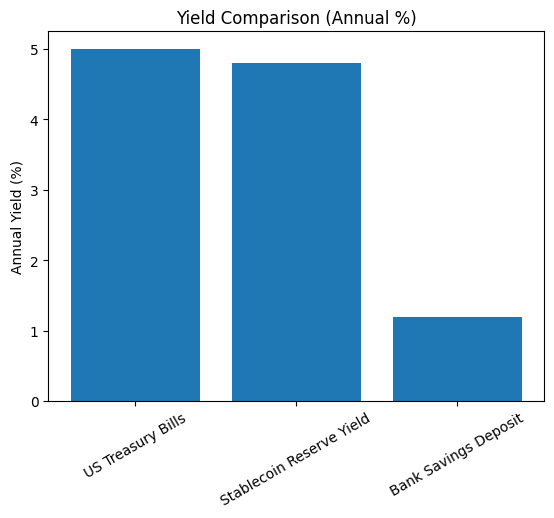
This comparison demonstrates why yield distribution matters. When Treasury bills yield approximately 5% annually:
- Banks offer retail deposit rates often below 1–2%.
- Stablecoin issuers capture yield unless distributed.
- Yield-sharing could democratize access to risk-free rates.
If regulated properly, yield-bearing stablecoins could compete directly with money market funds — but regulators fear shadow banking risks.
DeFi, Tokenized Equities, and the Next Financial Layer
The CLARITY Act debate extends beyond stablecoins.
Decentralized Finance (DeFi)
DeFi protocols rely heavily on stablecoins as base collateral. If yield mechanisms are constrained, it could:
- Reduce liquidity in lending pools
- Alter automated market maker spreads
- Increase reliance on synthetic yield models
Tokenized Equities
Tokenized stock trading platforms aim to offer fractionalized, 24/7 settlement securities on blockchain infrastructure. Regulatory clarity is necessary to define custody, compliance, and investor protections.
Stablecoins serve as the settlement currency in these ecosystems.
Strategic Implications for Crypto Investors and Builders
For readers seeking new digital assets or revenue streams, several themes emerge:
1. Stablecoin Infrastructure Plays
Companies building compliance-friendly yield mechanisms may gain first-mover advantage.
2. Tokenized Treasury Protocols
On-chain T-bill tokenization could bypass stablecoin yield restrictions by offering regulated wrappers.
3. Cross-Border Payment Networks
Firms leveraging regulated stablecoins for global settlement may benefit if U.S. clarity attracts institutional capital.
4. Offshore Arbitrage
If U.S. regulation becomes restrictive, non-U.S. jurisdictions could capture market share.
Conclusion: A Defining Moment for Digital Dollar Policy
The White House’s renewed engagement signals recognition that digital asset policy cannot remain in legislative limbo. The stablecoin yield clause is not merely a technical amendment — it defines whether digital dollars become static payment instruments or dynamic financial tools.
If lawmakers achieve balanced regulation, the U.S. could solidify leadership in tokenized finance. If not, innovation may migrate offshore, and regulatory fragmentation could intensify.
The coming months will determine whether the CLARITY Act becomes a catalyst for institutional blockchain adoption — or a missed opportunity in the global race for digital financial infrastructure.
