

Key Takeaways :
- Corporate investor relations (IR) announcements are now primary drivers of crypto price movements
- Institutional participation has reshaped crypto into a macro + corporate-driven market
- Five companies to watch: Coinbase, Strategy, Metaplanet, Circle, CoinShares
- Market reactions are increasingly instant and event-driven
- Preparation (liquidity, exchange readiness) matters more than prediction
1. The Structural Shift: Why Corporate IR Now Moves Crypto Markets
The cryptocurrency market has undergone a fundamental transformation. What was once dominated by retail traders reacting to price charts and sentiment has evolved into a hybrid financial system influenced heavily by institutional capital, corporate treasury strategies, and regulatory developments.
Three major structural shifts explain this transition:
- Institutional Capital Inflows
Large asset managers, ETFs, and hedge funds now allocate capital to Bitcoin and other digital assets. These players operate on information asymmetry and react quickly to corporate disclosures. - Corporate Bitcoin Accumulation
Public companies are now holding Bitcoin as treasury reserves. Their balance sheet decisions—whether to buy, sell, or hold—directly affect market supply. - Regulatory Clarity
Frameworks in the U.S., Europe, and parts of Asia have legitimized crypto exposure, enabling pension funds and institutions to participate.
As a result, corporate IR announcements (earnings, capital raises, treasury updates) have become real-time catalysts for price movement.
Unlike traditional crypto cycles driven by halving narratives or retail speculation, today’s market reacts to earnings calls, funding rounds, and governance updates.
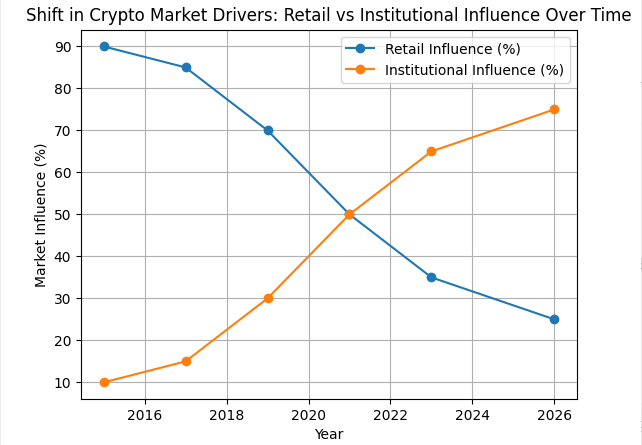
(Graph: Shift in Crypto Market Drivers — Retail vs Institutional Influence Over Time)
2. The Five Companies That Could Move the Market
2.1 Coinbase — The Market Thermometer
Coinbase acts as the clearest real-time indicator of market health.
Its metrics reflect:
- Trading volume trends
- Institutional inflows (especially via ETFs)
- Growth of its Layer-2 ecosystem “Base”
If Coinbase reports strong engagement or rising institutional flows, markets typically shift into risk-on mode. Conversely, weak activity signals caution.
Recent geopolitical tensions have not halted ETF inflows, suggesting structural demand remains strong—a bullish signal.2.2 Strategy — The Bitcoin Whale
Formerly known as MicroStrategy, Strategy is the largest corporate Bitcoin holder globally.
- Holdings: ~762,099 BTC
- Average acquisition price: ~$75,694
Its actions can move Bitcoin by several percentage points within hours.
Key factors to watch:
- Whether BTC accumulation resumes after a pause
- New financing mechanisms (convertible debt, equity issuance)
- Commentary from Michael Saylor
Strategy represents a leveraged bet on Bitcoin, making it one of the most influential entities in the ecosystem.2.3 Metaplanet — Japan’s Bitcoin Proxy
Metaplanet is emerging as Japan’s equivalent of Strategy.
Recent developments include:
- Governance restructuring to global standards
- Completion of a large capital raise (~$2.5B equivalent capacity)
- Reduced dilution risk in the near term
With over $2.4B in Bitcoin holdings, its accumulation pace and capital strategy could significantly impact Asian market sentiment.2.4 Circle — Stablecoin Infrastructure Play
Circle, issuer of USDC, represents the bridge between traditional finance and crypto liquidity.
- USDC supply exceeds ~$320B
- Benefiting from regulatory clarity under new U.S. frameworks
Stablecoins are the lifeblood of DeFi and trading liquidity. Any shift in Circle’s issuance or regulatory outlook affects:
- Market liquidity
- Institutional participation
- DeFi ecosystem stability
2.5 CoinShares — Institutional Flow Indicator
CoinShares provides weekly reports on capital flows into crypto ETPs.
This data answers one critical question:
Are institutions buying or selling?
- Sustained inflows → bullish continuation
- Outflows → early warning signal
Unlike price charts, this reflects actual capital allocation behavior, making it one of the most reliable indicators.
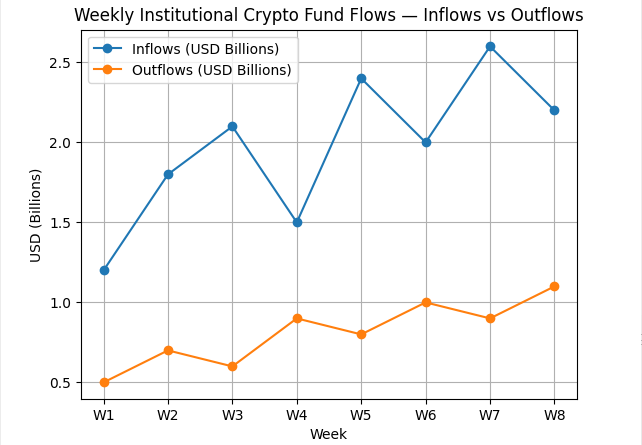
(Chart: Weekly Institutional Crypto Fund Flows — Inflows vs Outflows)
3. Market Behavior Around IR Events
A key dynamic in today’s crypto market is event-driven volatility.
Typical pattern:
- Pre-announcement rally (expectation-driven)
- Post-announcement reaction
- Strong results → sharp rally
- Neutral/expected → sell-off (“sell the news”)
- Weak → rapid decline
This creates a paradox:
Even “good news” can lead to price drops if already priced in.
For traders, this means:
- Timing matters more than direction
- Execution speed is critical
- Liquidity readiness determines profitability
4. Strategy for Investors: Preparation Over Prediction
In this new market structure, success depends less on predicting which asset will rise and more on being operationally ready when movement occurs.
Key preparation steps:
- Maintain funded exchange accounts
- Monitor IR calendars and announcements
- Track institutional flow data
- Set predefined execution strategies
Delays in funding or account setup can result in missed opportunities or poor entry prices.


(Diagram: Event-Driven Trading Flow — IR Announcement → Market Reaction → Execution Window)
5. Broader Trends Shaping the Market (2026 Outlook)
Beyond the five companies, several macro trends are reinforcing this shift:
5.1 Bitcoin as Corporate Treasury Asset
More companies are adopting Bitcoin as a hedge against fiat depreciation.
5.2 ETF Expansion
Spot Bitcoin ETFs continue to absorb capital, tightening supply.
5.3 Stablecoin Regulation
Clear frameworks are accelerating institutional adoption.
5.4 On-Chain Execution Models
Platforms increasingly move toward transparent, blockchain-based settlement systems, reducing reliance on centralized intermediaries.
6. Conclusion
The cryptocurrency market is no longer a purely speculative playground driven by retail sentiment. It has matured into a corporate and institutionally influenced financial system, where company-level decisions can move billions of dollars in minutes.
Next week’s market direction will likely be shaped not by technical indicators, but by corporate IR events and institutional flows.
The key takeaway is simple:
The winners in this market are not those who predict perfectly—but those who are ready to act instantly.
