
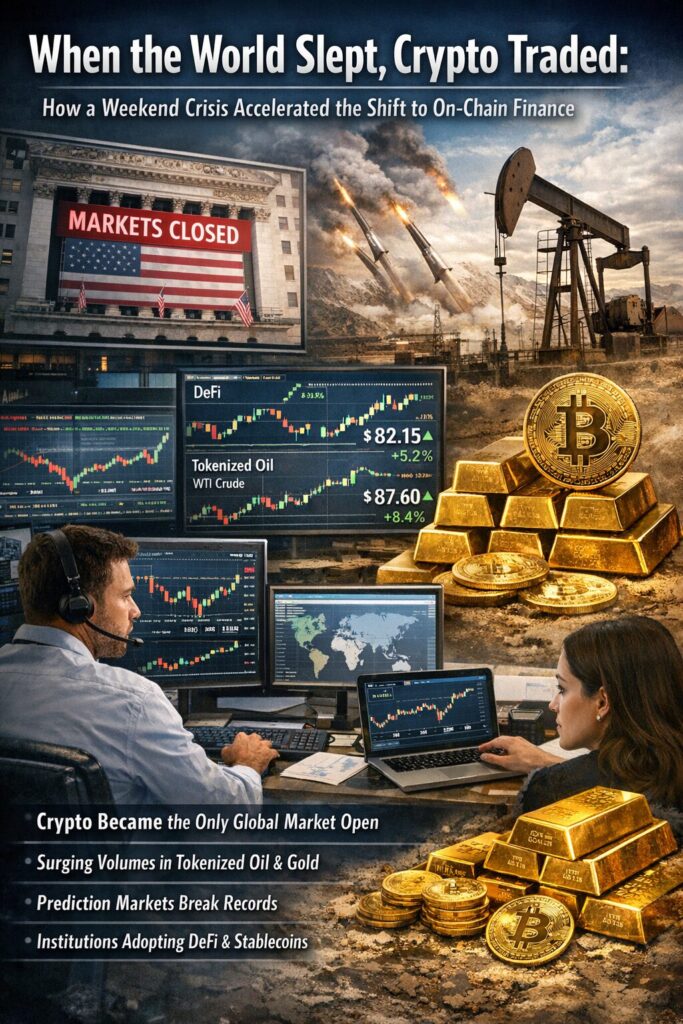
Main Points :
- During a geopolitical shock involving Iran, traditional financial markets were closed while cryptocurrency markets continued trading.
- Crypto markets effectively became the only functioning global financial market during that time window.
- Decentralized exchanges and on-chain derivatives platforms saw dramatic activity, including trading in tokenized commodities like oil.
- Tokenized gold and prediction markets experienced record volumes.
- Institutional investors are increasingly expected to adopt stablecoin wallets and DeFi access to remain competitive.
- The event may signal a faster-than-expected transition from traditional finance to on-chain financial infrastructure.
1. The Weekend When Crypto Became the Only Open Market
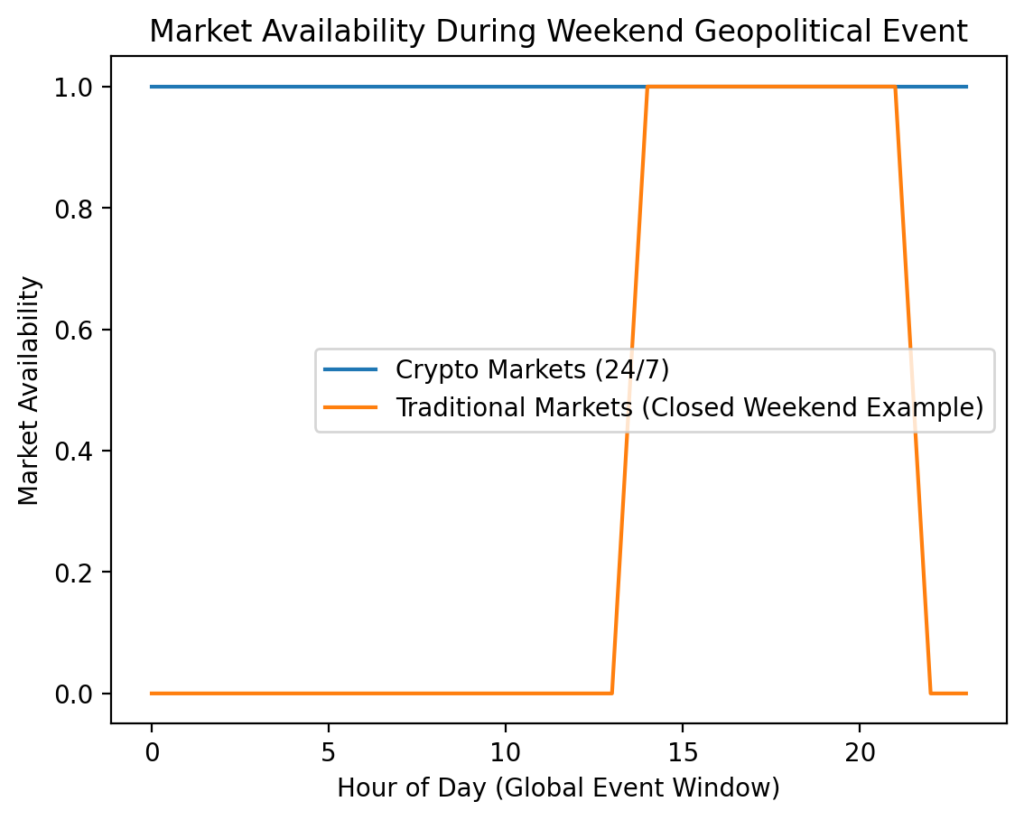
In late February, global financial markets experienced an unusual demonstration of how the financial system may evolve in the coming decade. A geopolitical escalation involving Iran occurred early on a Saturday morning, a moment when most traditional financial markets across the world were closed. U.S. stock exchanges, futures markets, and major foreign exchange markets were offline. European and Asian equity markets were also inactive. Under normal circumstances, investors would have had to wait until Sunday evening in the United States—when futures markets reopen—to react.
However, something different happened this time.
Cryptocurrency markets, which operate 24 hours a day, seven days a week, remained fully active. Traders, institutions, and retail investors immediately began pricing in the geopolitical event through digital asset markets. According to commentary released by Matt Hougan, Chief Investment Officer at crypto asset manager Bitwise, the weekend effectively became the first time that crypto markets served as the only active financial market in the world during a major global event.
This moment provided a glimpse into what the future of finance might look like when blockchain-based infrastructure operates continuously while legacy markets remain restricted by trading hours.
2. A Geopolitical Shock Hits During Market Closure
The incident that triggered the market reaction occurred at approximately 2:30 a.m. Eastern Time, when the U.S. president announced a military strike targeting Iran.
At that moment:
- U.S. equity markets were closed.
- U.S. futures markets were closed.
- Global foreign exchange markets were closed.
- European and Asian exchanges were closed.
Historically, this type of geopolitical announcement would create a significant information gap. Investors would know that the news could dramatically affect asset prices—especially oil, gold, and equities—but they would have no immediate venue to trade or hedge their exposure.
The result would normally be a period of uncertainty until markets reopened.
Yet cryptocurrency markets eliminated that gap.
Within minutes of the announcement, crypto trading platforms began reflecting market sentiment. Traders repositioned portfolios, adjusted risk exposure, and speculated on macroeconomic consequences—all through blockchain-based markets.
This ability to trade continuously created what Hougan described as a real-time price discovery mechanism during a period when traditional finance was effectively frozen.
3. The Rise of On-Chain Derivatives Platforms
One of the most interesting developments during the weekend was the surge in activity on decentralized derivatives exchanges.
Among the most discussed platforms was Hyperliquid, a decentralized derivatives exchange that allows traders to access perpetual futures markets not only for cryptocurrencies but also for tokenized representations of traditional assets.
The platform reportedly saw a dramatic spike in trading activity. In particular, traders were using perpetual futures contracts tied to crude oil prices.
In fact, market observers noted that some financial media outlets began referencing the platform’s pricing data when discussing oil market reactions to the geopolitical event. This highlighted a remarkable shift: a decentralized blockchain platform briefly became one of the only available indicators of real-time commodity sentiment.
The native token of the platform, HYPE, reportedly surged approximately 30% during the weekend, reflecting the sudden influx of traders and liquidity.
This surge illustrates a broader trend within decentralized finance (DeFi): the rapid expansion of permissionless derivatives markets that operate independently of traditional exchange infrastructure.
4. Tokenized Commodities and Digital Safe Havens
Another important trend during the event was the increased demand for tokenized safe-haven assets.
Tokenized gold issued by Tether, known as XAUT, experienced a surge in trading activity. The asset is backed by physical gold reserves and allows traders to gain exposure to gold through blockchain tokens.
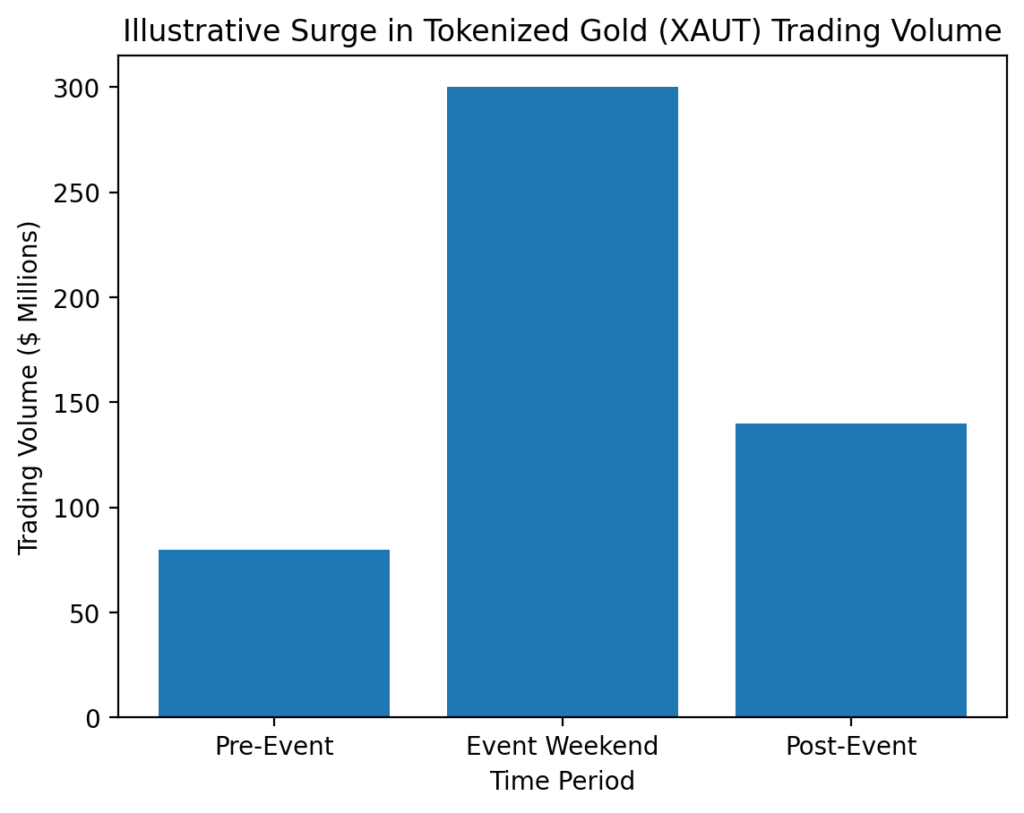
Within a 24-hour period, trading volume reportedly exceeded $300 million, demonstrating that investors were actively seeking protection from geopolitical risk using digital asset markets.
This is notable for several reasons.
First, tokenized commodities represent a bridge between traditional financial assets and blockchain infrastructure. They allow investors to gain exposure to real-world assets without needing to access legacy financial markets.
Second, the ability to trade tokenized commodities continuously—without weekend closures—means these assets can serve as global macro hedging instruments.
In the future, tokenized versions of oil, gold, government bonds, and equities may become increasingly important components of on-chain financial ecosystems.
5. Prediction Markets Break Records
Another sector of the crypto ecosystem that experienced rapid growth during the weekend was the prediction market sector.
Platforms such as Kalshi and Polymarket allow users to place bets on real-world outcomes ranging from elections to geopolitical events.
As news of the Iran strike spread, users rushed to prediction markets to speculate on possible scenarios, including:
- Whether further military escalation would occur
- The potential duration of geopolitical tensions
- The likelihood of broader regional conflict
Trading activity on these platforms reportedly reached record levels during the weekend.
Prediction markets are particularly suited to real-time global events because they allow participants to express probabilistic beliefs about future outcomes. Unlike traditional markets, which price assets indirectly, prediction markets explicitly price probabilities.
This creates a powerful mechanism for collective intelligence and information aggregation.
6. Institutional Investors Face a Strategic Decision
Perhaps the most significant takeaway from the weekend’s events is what it means for institutional investors.
According to Bitwise CIO Matt Hougan, hedge funds, banks, and asset managers may soon face a fundamental shift in how financial markets operate.
Historically, institutions could rely on traditional exchanges for liquidity and price discovery. But if crypto markets continue to operate continuously and expand into tokenized real-world assets, institutions that remain outside the ecosystem could find themselves unable to react during critical moments.
Hougan warned that institutions seeking to remain competitive may need to take several steps:
- Establish stablecoin wallets capable of interacting with on-chain financial systems.
- Learn to trade on decentralized exchanges such as Hyperliquid.
- Develop internal infrastructure for interacting with DeFi protocols.
These capabilities could become essential tools for risk management in a financial system that increasingly operates beyond traditional market hours.
7. The Acceleration of On-Chain Finance
The broader implication of the weekend’s events is that the transition toward blockchain-based finance may arrive faster than previously expected.
For years, proponents of decentralized finance have argued that blockchain networks offer structural advantages:
- Continuous trading (24/7 markets)
- Global accessibility
- Programmable financial instruments
- Reduced reliance on intermediaries
However, critics often argued that these systems lacked the scale or credibility to replace traditional financial infrastructure.
The weekend event provided a powerful counterexample.
For several hours, blockchain markets effectively served as the only operational global trading infrastructure. Investors seeking real-time price discovery had little choice but to turn to crypto markets.
This dynamic could accelerate institutional adoption and encourage further development of tokenized assets and decentralized exchanges.
8. The Expanding Role of Stablecoins
Stablecoins also played an important role during the weekend.
Because stablecoins function as digital representations of fiat currency on blockchain networks, they provide the primary liquidity layer for on-chain trading.
Investors used stablecoins to move capital between exchanges, enter derivatives positions, and purchase tokenized assets.
The rapid growth of stablecoin ecosystems in recent years—including USDT, USDC, and other dollar-pegged tokens—has made it possible for large trading volumes to occur entirely within blockchain environments.
Stablecoins effectively act as the settlement layer for decentralized finance.
If adoption continues, they may become one of the most important pillars of future financial infrastructure.
9. A Glimpse of the Financial System’s Future
The events surrounding the Iran strike illustrate an emerging reality: financial markets are no longer limited to traditional exchanges.
Instead, a parallel financial system is developing on blockchain networks.
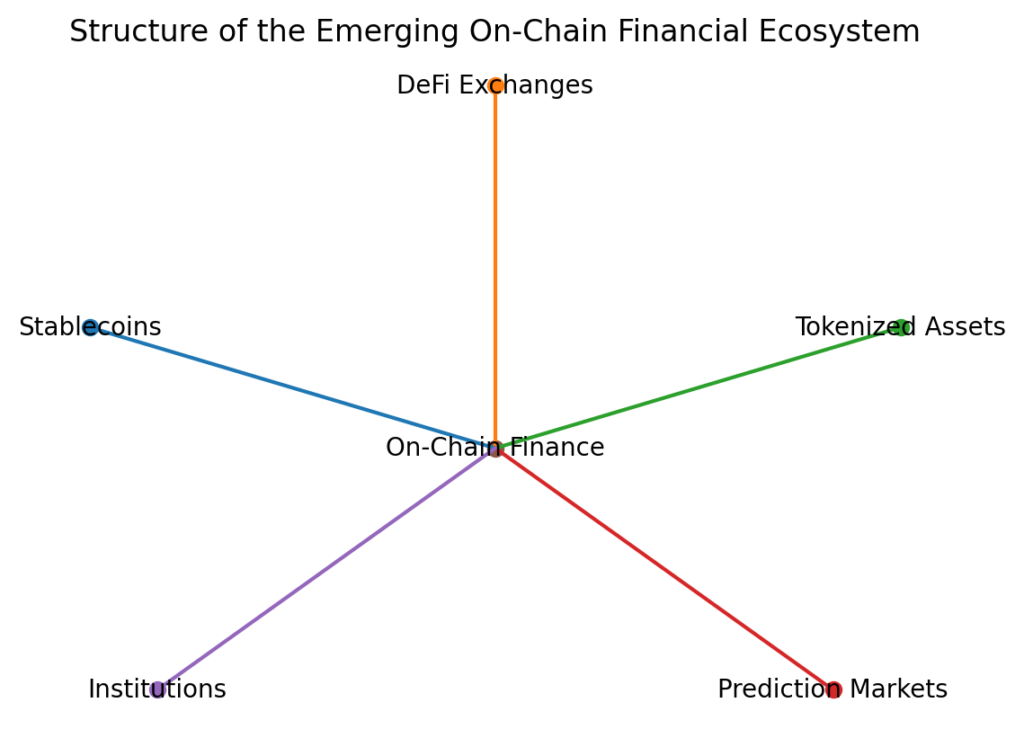
This system includes:
- Tokenized commodities
- Decentralized derivatives exchanges
- Prediction markets
- Stablecoin settlement layers
- Automated liquidity pools
As these components mature, they could gradually integrate with traditional finance—or even replace certain functions entirely.
The weekend demonstrated that blockchain infrastructure is already capable of performing some of the most critical roles in financial markets: price discovery, liquidity provision, and global risk transfer.
Conclusion: A Turning Point for Global Finance
The weekend geopolitical event may ultimately be remembered as a symbolic turning point for financial markets.
For the first time, during a major global news event, cryptocurrency markets effectively became the only functioning trading venues available to investors worldwide.
Decentralized derivatives exchanges, tokenized commodities, prediction markets, and stablecoins all played key roles in enabling real-time financial activity while traditional markets remained closed.
For investors seeking new opportunities, this shift carries important implications.
Blockchain-based markets are evolving beyond speculative digital assets into a full financial ecosystem capable of supporting global trading, hedging, and capital allocation.
As geopolitical uncertainty, technological innovation, and institutional adoption converge, the transition toward on-chain finance may accelerate rapidly.
And if the events of that weekend are any indication, the next era of global finance may operate not on Wall Street trading floors—but on blockchain networks that never close.
