

Main Points :
- The U.S. government moved 0.3346 BTC (about $23,000) from a confiscated wallet linked to Miguel Villanueva.
- The funds were split into three separate transactions sent to newly created addresses.
- The original labeled wallet balance became effectively zero after the transfer.
- The move appears to be internal custody management rather than a market sale.
- Government policy toward seized digital assets in the U.S. is shifting from immediate liquidation toward strategic holding.
- The handling of confiscated crypto increasingly influences market perception, institutional adoption, and the concept of national Bitcoin reserves.
Introduction: A Small Transaction With Large Implications
In early March 2026, blockchain observers noticed something subtle but meaningful: the U.S. government moved 0.3346 Bitcoin (approximately $23,000) from a confiscated wallet associated with an individual identified as Miguel Villanueva.
The transaction was not large. In the context of global Bitcoin markets, $23,000 is negligible. Yet the movement attracted attention among analysts because any movement of government-controlled Bitcoin has become an important signal for market participants.
Blockchain intelligence platform Arkham Intelligence tracked the transaction and reported that the funds were transferred in three separate transactions to previously inactive addresses. Following the transfers, the wallet labeled “Villanueva” held essentially no remaining balance.
For cryptocurrency investors, developers, and regulators, such transactions provide insights into how governments manage seized digital assets, a topic that has evolved significantly over the past decade.
This article explores the implications of the transaction, the broader trend of government-held Bitcoin, and what it means for investors searching for new opportunities in the digital asset ecosystem.
The Villanueva Wallet Transfer: What Actually Happened
According to blockchain data, the U.S. government executed three individual transfers totaling 0.3346 BTC.
The Bitcoin was moved from a wallet labeled as holding assets confiscated from Miguel Villanueva, although the precise details of the criminal investigation or legal case have not been publicly disclosed.
The transfers were structured in a way that suggests internal asset management rather than liquidation.
Key observations from the blockchain:
- The funds were split into three separate transactions.
- Each transaction went to a new address with no prior activity.
- The originating wallet was fully emptied.
This pattern typically indicates custody reorganization rather than preparation for a sale on exchanges.
Government wallets are often reorganized to:
- improve security
- distribute assets across multiple custodial addresses
- prepare assets for long-term storage
- transfer assets to institutional custodians
Because no immediate transfers to exchanges were observed, the move does not appear to represent a market sale. How Governments Acquire Bitcoin Through Seizures
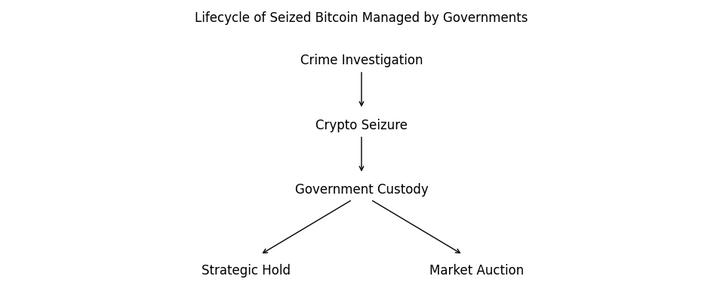
Government holdings of Bitcoin usually originate from criminal investigations and asset forfeiture proceedings.
These seizures occur in cases involving:
- darknet marketplaces
- ransomware attacks
- hacking operations
- fraud schemes
- money laundering networks
Over the years, several high-profile cases have led to large crypto confiscations.
Examples include:
- Silk Road seizure (2013) – Over 144,000 BTC confiscated.
- Bitfinex hacker recovery (2022) – More than 94,000 BTC recovered.
- Various darknet operations tied to illegal marketplaces.
Historically, governments—particularly the United States—have auctioned seized Bitcoin relatively quickly.
The U.S. Marshals Service famously sold confiscated BTC in public auctions, including sales to venture capitalist Tim Draper, who purchased large amounts of Silk Road Bitcoin.
At the time, Bitcoin was still considered volatile and experimental. Governments preferred converting confiscated assets into fiat currency quickly.
However, this policy has begun to change.
The Emerging Concept of a Strategic Bitcoin Reserve
One of the most interesting developments in digital asset policy is the emerging idea that governments may treat Bitcoin as a strategic reserve asset rather than something to liquidate immediately.
Since around 2025, discussions in U.S. policy circles have increasingly referenced the concept of a Strategic Bitcoin Reserve.
The idea is loosely inspired by the Strategic Petroleum Reserve, where governments maintain reserves of critical resources.
Advocates argue that Bitcoin may function as:
- a digital commodity reserve
- a financial hedge against monetary instability
- a tool for geopolitical financial competition
Under this view, seized Bitcoin would remain under government control rather than being auctioned immediately.
This shift in thinking explains why analysts closely monitor movements from government wallets.
If Bitcoin is increasingly treated as a reserve asset, the implications for supply and long-term market structure could be substantial.
Government Bitcoin Holdings Around the World
The United States is not the only government with significant Bitcoin holdings.
Due to law enforcement actions and seizures, several governments now hold large crypto reserves.
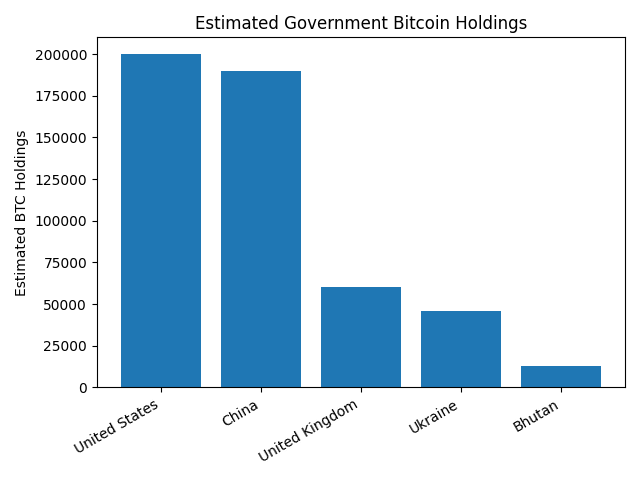
Estimated government Bitcoin holdings (approximate):
| Country | Estimated BTC Holdings |
|---|---|
| United States | ~200,000 BTC |
| China | ~190,000 BTC |
| United Kingdom | ~60,000 BTC |
| Ukraine | ~46,000 BTC |
| Bhutan | ~13,000 BTC |
Many of these holdings originated from confiscations tied to criminal investigations.
However, different governments manage these assets differently:
- Some sell immediately
- Some hold temporarily
- Some retain Bitcoin long-term
Bhutan, for example, has reportedly accumulated Bitcoin through state-backed mining operations powered by hydroelectric energy.
Why Small Government Transfers Matter to the Market
Even minor transactions from government wallets can influence the cryptocurrency market.
There are several reasons for this sensitivity.
1. Market Supply Signals
Large government holdings represent a potential future supply shock.
If governments suddenly sell large amounts of Bitcoin, markets could react quickly.
Even small transfers can spark speculation about whether a larger sale is coming.
2. Transparency of Blockchain Data
Unlike traditional asset management, blockchain transactions are publicly visible.
This allows analysts to track:
- government wallets
- exchange inflows
- custody transfers
This transparency means that even small movements quickly attract attention.
3. Institutional Behavior Signals
Government asset management practices often signal institutional attitudes toward Bitcoin.
If governments increasingly treat Bitcoin as a long-term reserve asset, it reinforces the narrative that Bitcoin has matured into a legitimate financial instrument.
Institutional Adoption Continues to Accelerate
The broader context surrounding this government transaction is a wave of institutional adoption across the cryptocurrency industry.
Over the past several years, several major developments have reshaped the market:
- Bitcoin spot ETFs launched in the United States.
- Major asset managers integrated digital asset custody services.
- Banks began offering crypto trading and settlement infrastructure.
This institutional shift has changed how Bitcoin is perceived.
Rather than a speculative technology experiment, Bitcoin is increasingly seen as:
- digital gold
- a macro hedge asset
- a programmable financial infrastructure layer
Government asset management strategies may gradually align with this institutional perspective.
Practical Implications for Crypto Investors and Builders
For readers interested in discovering new opportunities in crypto markets, government Bitcoin management trends provide several insights.
Monitoring Government Wallet Activity
Investors increasingly track government wallets to anticipate:
- potential market liquidity events
- exchange inflows
- asset auctions
On-chain analytics platforms make this monitoring easier.
Infrastructure Opportunities
The growing amount of government-controlled crypto creates demand for:
- institutional custody solutions
- blockchain analytics tools
- compliance and AML technology
- secure asset management platforms
These sectors represent emerging opportunities for startups and developers.
Policy-Driven Market Dynamics
Government policy shifts can significantly influence the digital asset ecosystem.
Regulatory clarity, custody frameworks, and asset management policies can shape:
- liquidity
- institutional participation
- long-term valuation trends
Suggested Chart Insertions
[Government Bitcoin Holdings Chart]
[Flow of Seized Bitcoin Management]
The Future of Government Bitcoin Management
The movement of 0.3346 BTC from the Villanueva wallet may ultimately prove insignificant in financial terms.
However, it highlights an important transformation in the digital asset ecosystem.
Governments are no longer merely confiscating and liquidating cryptocurrencies.
Instead, they are beginning to manage them as strategic financial assets.
As Bitcoin continues to integrate into the global financial system, the actions of governments—alongside institutional investors, asset managers, and fintech companies—will shape the next phase of market development.
Conclusion
The recent transfer of 0.3346 BTC (about $23,000) from a confiscated U.S. government wallet linked to Miguel Villanueva may appear minor at first glance. Yet the event provides a valuable glimpse into how digital assets are increasingly managed at the institutional level.
Rather than signaling an imminent sale, the transaction likely reflects internal custody restructuring. At the same time, it underscores the growing importance of government Bitcoin holdings in the global financial landscape.
For investors, developers, and entrepreneurs exploring the next generation of blockchain opportunities, these developments highlight a critical reality:
Bitcoin is no longer just an experimental digital currency.
It is rapidly becoming a strategic asset monitored, accumulated, and managed by governments themselves.
And as that transformation continues, even the smallest on-chain movement may carry signals about the future direction of the digital economy.
