

Main Points :
- RWA (Real World Asset) tokenization is emerging as a national-scale liquidity tool, potentially allowing countries to tokenize untapped resources such as water, minerals, and rare earth metals to raise capital immediately.
- Major traditional financial institutions including BlackRock and Fidelity are accelerating tokenized bond and fund products, validating RWA as a structural trend rather than a niche experiment.
- Prediction markets are merging with sports, elections, and entertainment, integrating real-time blockchain infrastructure into mainstream global events.
- Platforms like Polymarket and Crypto.com are expanding into live sports analytics and media, creating hybrid financial-entertainment ecosystems.
- Regulatory pressure is rising, but growth momentum suggests 2026 may mark a transition from speculative crypto cycles to real-world integration.
I. Introduction: From Speculation to Infrastructure
The cryptocurrency industry has long been characterized by cycles—DeFi summer, NFT mania, meme coin explosions. Yet according to comments by Changpeng Zhao, founder of Binance, the next wave may not be defined by purely crypto-native narratives.
Instead, two sectors are emerging as structural pillars:
- RWA (Real World Asset) tokenization
- Prediction markets
These are not merely new token categories. They represent a potential transition of crypto from speculative digital assets into integrated financial infrastructure connected to the real economy.
As on-chain speculation cools and major cryptocurrencies consolidate, capital and developer attention appear to be rotating toward sectors that bridge blockchain and physical-world value.
II. RWA: Turning Water into National Liquidity
1. The Strategic Vision
CZ highlighted the growing national-level interest in tokenizing untapped resources. Examples include:
- Unmined gold
- Rare earth metals
- Salt reserves
- High-altitude freshwater sources
Water, in particular, offers a symbolic example. Premium bottled water can trade at higher per-liter prices than crude oil. If such assets were tokenized, governments could:
- Issue tokens backed by future delivery rights
- Raise immediate liquidity without physically extracting resources
- Build parallel economic ecosystems around asset classes
This is not merely theoretical. It suggests a model where sovereign balance sheets become partially on-chain.
2. Institutional Capital Is Already Moving
Major traditional asset managers have accelerated RWA adoption:
- BlackRock launched tokenized treasury products.
- Fidelity Investments has expanded digital asset infrastructure.
- Coinbase has explored tokenized equities.
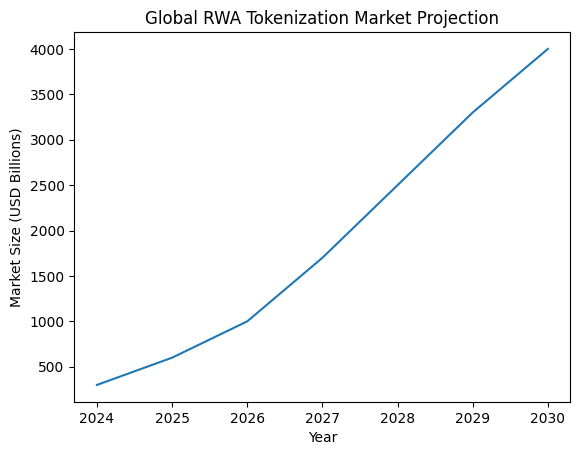
McKinsey has projected that tokenized RWA markets could reach up to $4 trillion by 2030.
This shift is significant. Unlike NFTs or meme coins, RWAs align directly with:
- Yield generation
- Collateralization frameworks
- Institutional-grade custody
- Regulatory clarity pathways
The industry survey conducted by CryptoTimes also identified RWA as one of the most frequently cited sectors for 2026 growth.
[Global RWA Market Growth Projection ($ billions, 2024–2030)]
Description:
A line graph showing estimated RWA market expansion from approximately $300 billion in 2024 to a projected $4 trillion by 2030.
3. Why Nations Might Adopt RWA
For emerging economies, RWA tokenization could:
- Monetize dormant assets without extraction costs
- Improve sovereign liquidity
- Attract global crypto-native capital
- Create transparent resource-backed financing
For developed economies, tokenization could:
- Increase bond market efficiency
- Enable programmable treasury distribution
- Reduce settlement friction
In both cases, blockchain becomes infrastructure—not speculation.
III. Prediction Markets: Finance Meets Reality
1. The Next Consumer Interface
Prediction markets allow users to trade on the probability of real-world outcomes:
- Elections
- Sports championships
- Economic indicators
- Award ceremonies
CZ suggested that global events—such as the upcoming FIFA World Cup—could catalyze rapid growth.
The difference from traditional betting platforms lies in:
- Transparent on-chain settlement
- Liquidity pools
- Global access
- Programmable financial instruments
2. Polymarket and the Entertainment Convergence
The largest player, Polymarket, has:
- Signed an exclusive agreement with Ultimate Fighting Championship
- Partnered with the New York Rangers
- Displayed live win probabilities during matches
- Acquired infrastructure tools such as Dome API
Meanwhile, Crypto.com has expanded prediction products into Hollywood award forecasts.
This creates a hybrid sector: financialized entertainment.
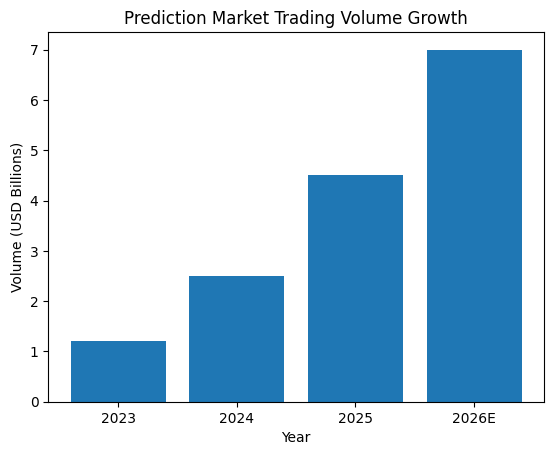
[Prediction Market Volume Growth ($ billions, 2023–2026E)]
Description:
Bar chart showing market volume growth from $1.2 billion in 2023 to an estimated $6–8 billion by 2026.
3. Regulatory Headwinds
However, growth is not without friction:
- Alleged manipulation in election-related markets
- Reported losses of approximately $8 million (~$11 million USD equivalent) in platform incidents
- Access restrictions in Portugal and Hungary
Prediction markets sit at the intersection of:
- Gambling law
- Securities regulation
- Political oversight
Their future depends on regulatory harmonization.
IV. Why RWA and Prediction Markets Are Structurally Linked
At first glance, RWAs and prediction markets appear unrelated.
But structurally, both:
- Connect blockchain directly to real-world assets or events
- Expand crypto beyond native speculation
- Invite institutional participation
- Require regulatory frameworks
RWAs anchor crypto in tangible value.
Prediction markets anchor crypto in real-time global events.
Together, they form a bridge between digital finance and societal infrastructure.
V. Capital Rotation: Where the Smart Money Is Moving
As meme coin activity slows and layer-1 narratives mature, capital rotation is visible:
- On-chain liquidity shifting toward yield-bearing RWAs
- Derivatives traders moving toward event-driven volatility
- Institutional allocators seeking compliant tokenization frameworks
Crypto in 2026 may look less like 2021’s hype cycle and more like a hybrid financial layer integrated with sovereign systems and global culture.
VI. Strategic Implications for Investors and Builders
For Investors:
- Monitor tokenized treasury products
- Assess sovereign-backed RWA pilots
- Evaluate prediction market liquidity depth
- Consider regulatory jurisdiction risk
For Developers:
- Focus on compliance-ready architecture
- Build oracle reliability
- Design real-time settlement mechanisms
- Integrate API layers for media and sports partnerships
For Governments:
- Explore pilot tokenized bond issuance
- Assess resource-backed liquidity instruments
- Develop legal frameworks before private platforms dominate
VII. The 2026 Inflection Point
If the first phase of crypto was speculation, and the second phase was infrastructure experimentation, the third phase may be integration.
RWA tokenization suggests that:
- Water
- Minerals
- Government bonds
- Energy reserves
could exist simultaneously as physical assets and programmable digital instruments.
Prediction markets suggest that:
- Elections
- Sports
- Cultural milestones
could become financialized global liquidity events.
Crypto is evolving from “internet money” into a universal settlement layer for value and probability.
VIII. Conclusion: From Meme Cycles to Macro Architecture
The commentary by Changpeng Zhao signals something deeper than a trend forecast.
It reflects a structural pivot.
RWA tokenization brings sovereign assets into blockchain systems.
Prediction markets bring global events into programmable financial rails.
Both reduce the gap between digital assets and real-world economic systems.
For readers seeking new crypto assets, revenue opportunities, and practical blockchain applications, the signal is clear:
The next wave will not be defined by hype—but by integration.
The question is no longer whether crypto will connect to the real world.
It is how deeply, how quickly, and under whose regulatory architecture.
