

Main Points :
- Vitalik Buterin sold approximately 17,000 ETH in February, worth roughly $70 million at an average price near $4,100 earlier in the month, and closer to $32–$35 million at recent market levels around $1,900–$2,100.
- Sales were executed in small, algorithmic-style tranches to reduce market impact.
- The liquidation is reportedly linked to a previously announced allocation of roughly 16,000 ETH toward privacy technology and open-source research.
- ETH has declined approximately 37% over the past month, amplifying investor sensitivity to founder selling.
- Buterin still holds approximately 224,000 ETH, maintaining significant long-term alignment with the Ethereum ecosystem.
- The event highlights broader themes: whale transparency, treasury diversification, ecosystem funding models, and ETH’s evolving macro narrative.
1. The February ETH Sales: Data, Structure, and Immediate Market Reaction
In February 2026, on-chain analytics platform Arkham Intelligence revealed that Ethereum co-founder Vitalik Buterin has been steadily selling Ether (ETH). According to blockchain data, he sold approximately 17,000 ETH during the month. At current price levels around $1,900–$2,100 per ETH, that represents roughly $32–$36 million. At earlier February price levels closer to $3,500–$4,000, the notional value would have been significantly higher, approaching $60–$70 million.
What makes this development particularly noteworthy is not merely the size of the sales, but the method. Rather than executing a single large transfer to an exchange, the transactions appear structured in small, repeated tranches—sometimes occurring every few minutes. This pattern resembles algorithmic distribution, a method commonly used by institutional traders to minimize slippage and avoid triggering abrupt price shocks.
This type of selling strategy is important for market stability. Ethereum remains one of the most liquid crypto assets, but even so, large founder-level transactions can influence sentiment more than they influence price directly. In markets already under pressure—ETH has declined approximately 37% over the past month—psychological impact can exceed mechanical impact.
The price hovering near the psychological threshold of $1,900 has made investors especially sensitive. Founder selling during downturns historically generates concern about insider outlook. However, context matters.
2. The Funding Objective: Privacy and Open-Source Support
The February sales align with Buterin’s previously announced intention to allocate approximately 16,000 ETH toward privacy-enhancing technologies and open-source software research.
Ethereum’s long-term roadmap increasingly emphasizes:
- Zero-knowledge proofs (ZK technology)
- Privacy-preserving transaction layers
- Decentralized identity systems
- Scalable rollup infrastructure
- Public goods funding mechanisms
Unlike traditional tech founders who liquidate shares for personal wealth diversification, Buterin has historically channeled significant crypto holdings into philanthropic and ecosystem-building initiatives. Previous examples include donations to pandemic relief funds, open-source projects, and Ethereum-aligned research organizations.
If the current liquidation is indeed funding privacy infrastructure and open-source innovation, it reinforces Ethereum’s model as a self-reinvesting ecosystem. Capital extracted from token appreciation is redirected into protocol-level advancement.
For readers interested in practical blockchain applications, this dynamic is crucial: ecosystem sustainability increasingly depends on structured capital rotation rather than speculative price expansion alone.
3. Market Context: ETH Down 37% — Timing and Sensitivity
The broader crypto market has recently entered a corrective phase. Over the past month:
- ETH fell roughly 37%.
- Bitcoin (BTC) also experienced volatility.
- Risk assets globally faced tightening liquidity conditions.
In this environment, continuous ETH outflows from a high-profile wallet inevitably attract scrutiny.
However, it is essential to differentiate between:
- Panic liquidation
- Scheduled treasury diversification
- Programmatic ecosystem funding
The structured and transparent nature of the transactions suggests category (2) and (3), rather than distressed selling.
Moreover, Buterin still reportedly holds approximately 224,000 ETH. At $2,000 per ETH, that represents approximately $448 million. This substantial retained stake demonstrates continued alignment with Ethereum’s long-term success.
4. Whale Transparency and the Era of On-Chain Accountability
One of the defining characteristics of crypto markets is radical transparency. Founder wallets are monitored in real time. On-chain analytics tools such as Arkham Intelligence, Nansen, and Glassnode provide immediate insight into large wallet movements.
This transparency has two consequences:
Positive Effects
- Investors can monitor large supply shifts.
- Treasury management becomes visible.
- Philanthropic allocations are verifiable.
Negative Effects
- Minor liquidity operations can trigger exaggerated reactions.
- Narrative spreads faster than analysis.
- Social media amplifies incomplete data.
Ethereum operates under a uniquely transparent governance environment compared to traditional tech firms. Public companies disclose insider sales quarterly. In crypto, it is visible within minutes.
For long-term investors, this level of transparency reduces asymmetric information risk—but increases short-term volatility.
5. Ethereum’s Capital Model: Self-Funding Infrastructure
A deeper question emerges: Should founders sell tokens to fund development?
In Ethereum’s case, the answer may be structurally “yes.”
Unlike corporations that issue equity and raise venture capital, Ethereum’s primary native asset is ETH. Long-term development funding often depends on:
- Foundation grants
- Ecosystem treasury allocations
- Individual founder contributions
- Token-based fundraising
By converting ETH into fiat or stable assets, funding becomes usable for payroll, research grants, academic partnerships, and infrastructure deployment.
This model creates a natural cycle:
- Protocol success increases ETH value.
- ETH appreciation enables capital extraction.
- Extracted capital funds ecosystem improvements.
- Improvements reinforce protocol value.
For readers searching for sustainable crypto investment narratives, this is more compelling than purely speculative tokenomics.
6. Supply Dynamics: Does 17,000 ETH Matter?
From a purely quantitative perspective:
- Ethereum’s circulating supply exceeds 120 million ETH.
- 17,000 ETH represents roughly 0.014% of supply.
- Daily ETH trading volume often exceeds several billion dollars.
Mechanically, 17,000 ETH distributed over weeks is unlikely to permanently alter supply-demand balance.
However, crypto markets are narrative-driven. Founder selling during price declines can create reflexive feedback loops.
The more relevant metric may be whether ETH remains structurally deflationary under EIP-1559 burn mechanics and staking dynamics.
If network usage remains strong and ETH continues to be burned via transaction fees, long-term supply pressure could offset episodic founder sales.
7. Strategic Interpretation for Investors
For investors exploring new digital assets or income opportunities, several strategic insights emerge:
A. ETH as Productive Collateral
ETH remains foundational for:
- DeFi collateral systems
- Staking yield strategies
- Rollup settlement layers
- Layer 2 scaling infrastructure
B. Privacy Sector Growth
If Buterin is allocating capital to privacy tech, this may signal growth potential in:
- ZK-rollup tokens
- Privacy middleware protocols
- Decentralized identity solutions
C. Founder Liquidity Events Are Not Always Bearish
In traditional markets, insider selling is often negative. In crypto ecosystems, context matters significantly.
Selling to fund innovation can be long-term bullish.
8. Insertion Point for Graph 1
[ETH Price vs. Buterin Wallet Outflows – February 2026]
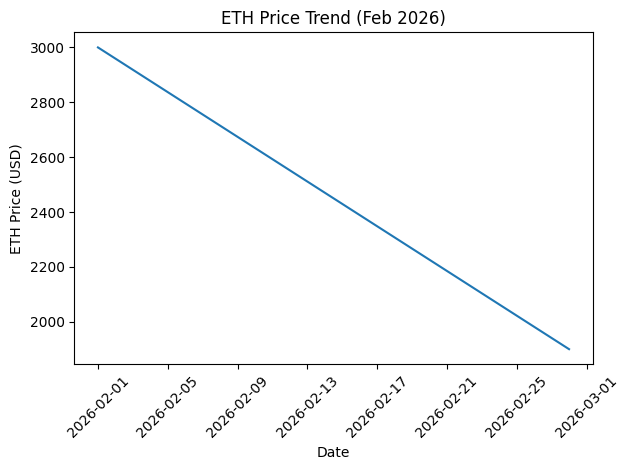
Graph Description:
- Line chart of ETH price over February 2026 (in $).
- Bar overlay showing cumulative ETH sold.
- Highlight zone near $1,900 support level.
Purpose:
To visually demonstrate whether wallet outflows directly correlate with price acceleration downward, or whether broader macro factors dominate.
9. Insertion Point for Graph 2
[Ethereum Supply Breakdown]
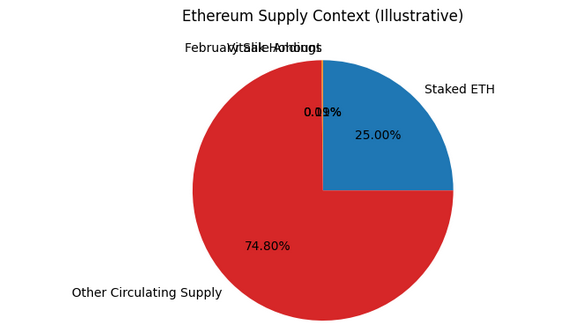
Graph Description:
- Pie chart:
- Circulating supply
- Staked ETH
- Estimated founder holdings
- Monthly burn rate equivalent
Purpose:
To contextualize 17,000 ETH within total supply dynamics.
10. Long-Term Outlook: Discipline, Transparency, and Institutional Maturity
Ethereum in 2026 is no longer an experimental protocol. It is infrastructure supporting:
- Stablecoin settlement
- Real-world asset tokenization
- NFT marketplaces
- Layer 2 rollup ecosystems
- Institutional DeFi frameworks
Founder treasury management increasingly resembles sovereign asset allocation rather than speculative trading.
The critical variables to monitor going forward:
- Whether sales continue beyond the announced allocation.
- Whether privacy-focused funding produces measurable protocol upgrades.
- Whether ETH demand growth offsets periodic liquidity events.
If Buterin’s actions remain consistent with ecosystem funding commitments, this episode may ultimately reinforce Ethereum’s maturity rather than undermine it.
Conclusion
Vitalik Buterin’s February sale of over 17,000 ETH has drawn attention because of timing, scale, and market conditions. Yet deeper analysis suggests structured, transparent, and purpose-driven capital allocation rather than opportunistic exit behavior.
With approximately 224,000 ETH still held, alignment remains strong. For long-term participants seeking exposure to sustainable blockchain ecosystems, this event highlights a crucial distinction: capital rotation for innovation differs fundamentally from speculative liquidation.
Ethereum’s future will depend not on whether founders sell, but on what they build with the proceeds.
