
Main Points :
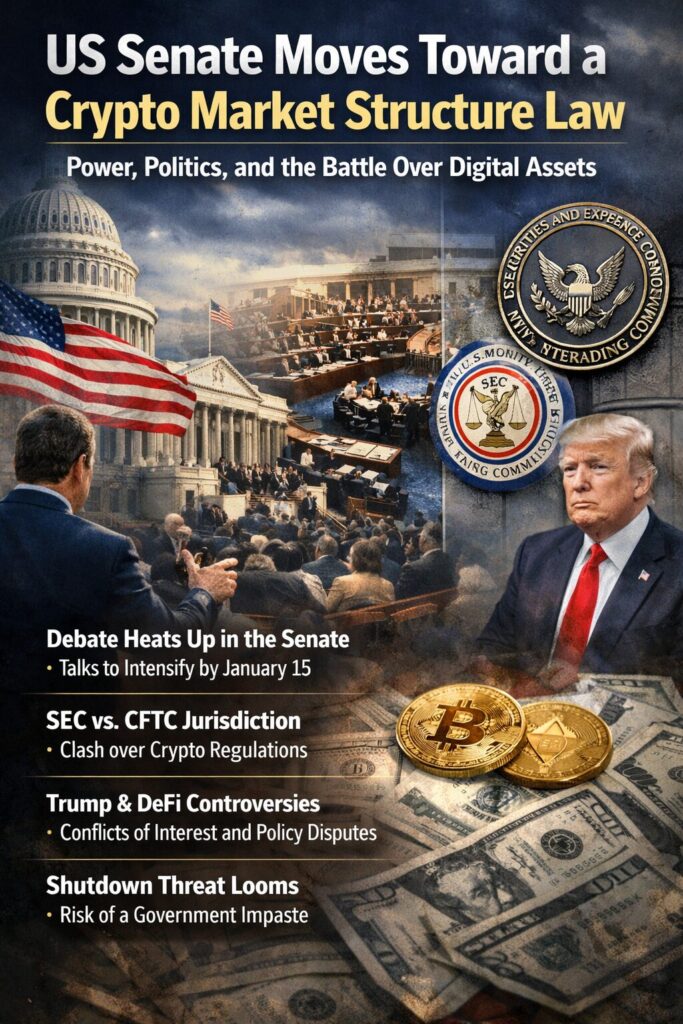
- The U.S. Senate is accelerating deliberations on a long-awaited crypto market structure bill, with discussions expected to intensify by January 15.
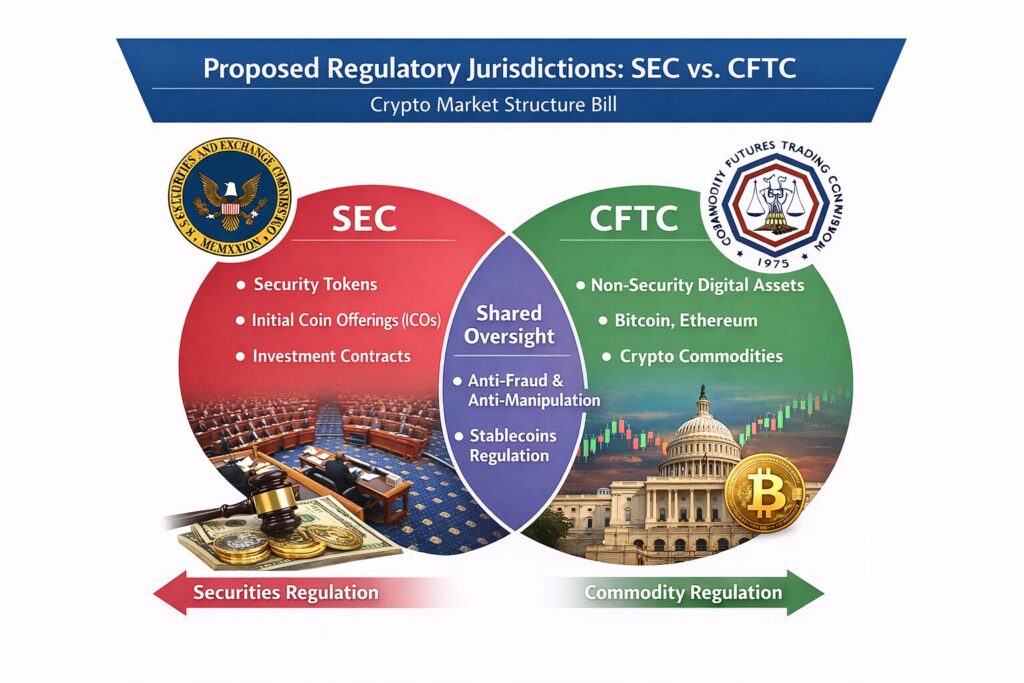
- The bill aims to clearly define jurisdictional boundaries between the SEC and the CFTC, particularly regarding which crypto assets are securities.
- Bipartisan support remains uncertain, with unresolved disputes over DeFi regulation and alleged conflicts of interest tied to former President Donald Trump’s crypto-related activities.
- Parallel legislative efforts in the Senate Agriculture Committee may complicate the regulatory landscape, requiring reconciliation between competing drafts.
- Political risk—including the possibility of a U.S. government shutdown—threatens to delay or derail progress.
1. The Senate’s Renewed Push Toward Crypto Market Structure Regulation
In early January 2026, multiple U.S. media outlets reported that Senator Tim Scott, Chairman of the Senate Banking Committee, informed lawmakers that revisions to the long-discussed crypto market structure bill would be reviewed by January 15. This announcement marked a notable acceleration in legislative momentum after months of stagnation.
The bill, which has been under various forms of discussion for more than a year, is designed to address one of the most fundamental issues in the U.S. digital asset industry: regulatory clarity. Specifically, it seeks to delineate which crypto assets fall under securities law—thus overseen by the Securities and Exchange Commission—and which should be treated as commodities under the jurisdiction of the Commodity Futures Trading Commission.
Originally, lawmakers and industry participants alike had hoped that such legislation could be finalized by the end of 2025. That timeline proved overly optimistic. Instead, disagreements over decentralized finance (DeFi), enforcement authority, and political ethics delayed progress well into the new year.
2. Why Market Structure Matters: SEC vs. CFTC and the Definition of “Non-Security” Crypto Assets
At the heart of the proposed legislation lies a deceptively simple question: What exactly is a crypto asset under U.S. law? For years, regulators have relied on enforcement actions rather than statutory definitions, creating uncertainty for exchanges, wallet providers, and token issuers.
The bill attempts to resolve this by:
- Establishing criteria for determining when a token is not a security.
- Assigning primary oversight of non-security digital assets to the CFTC.
- Creating clearer compliance pathways for exchanges and custodians operating in the spot crypto market.
For market participants, this distinction is not academic. Being classified as a security can dramatically increase compliance costs, limit liquidity, and restrict market access. Conversely, commodity classification under the CFTC is generally viewed as more compatible with the operational realities of blockchain-based assets.
3. Political Fault Lines: DeFi Regulation and Trump-Era Conflict-of-Interest Concerns
Despite broad agreement on the need for regulatory clarity, two major fault lines remain.
3.1 DeFi: Regulate the Protocol or the Interface?
Lawmakers continue to struggle with how—or whether—to regulate decentralized finance. DeFi protocols often lack a centralized operator, making traditional regulatory models difficult to apply. Some Democrats argue that failing to regulate DeFi creates systemic risk and opens the door to illicit finance. Republicans, meanwhile, warn that overregulation could stifle innovation and drive development offshore.
3.2 Trump-Linked Crypto Activities
A second, more politically charged issue involves alleged conflicts of interest tied to Donald Trump and his family. Democratic lawmakers have repeatedly raised concerns about meme coins and other crypto ventures associated with Trump-affiliated entities, arguing that any market structure law must include safeguards against self-dealing by public officials.
These concerns have complicated negotiations, even as many legislators privately acknowledge that the broader framework of the bill enjoys majority support.
4. Industry Perspective: A Willingness to Compromise
From the industry side, there is cautious optimism. The Digital Chamber CEO Cody Carbone has publicly stated that while unresolved issues remain—particularly around DeFi, conflict-of-interest provisions, and the confirmation process for CFTC commissioners—both parties fundamentally want the bill to pass.
According to Carbone, the core architecture of the legislation is already agreed upon. What remains is political bargaining rather than ideological opposition. This view is widely shared among institutional crypto firms, many of which see regulatory clarity as a prerequisite for large-scale capital deployment.
5. A Competing Track: The Senate Agriculture Committee’s Role
Complicating matters further is the involvement of the Senate Agriculture Committee, which oversees the CFTC. In December, the committee released its own draft legislation granting expanded authority to the CFTC over digital asset markets.
Reconciling the Banking Committee’s bill with the Agriculture Committee’s proposal will require careful coordination. Failure to align these efforts could result in overlapping mandates—or worse, renewed regulatory ambiguity.
6. Macro Risk: Government Shutdown and Legislative Time Pressure
The market structure bill also faces a more traditional Washington risk: government funding. Current funding has only been extended through January 30. If Congress fails to reach another agreement, a government shutdown could halt committee work entirely.
For the crypto industry, such a delay would be more than an inconvenience. It would prolong regulatory uncertainty at a time when other jurisdictions—such as the EU under MiCA and parts of Asia—are rapidly implementing comprehensive frameworks.
7. Implications for Investors, Builders, and the Next Wave of Crypto Assets
For readers seeking new digital assets or revenue opportunities, the implications are significant:
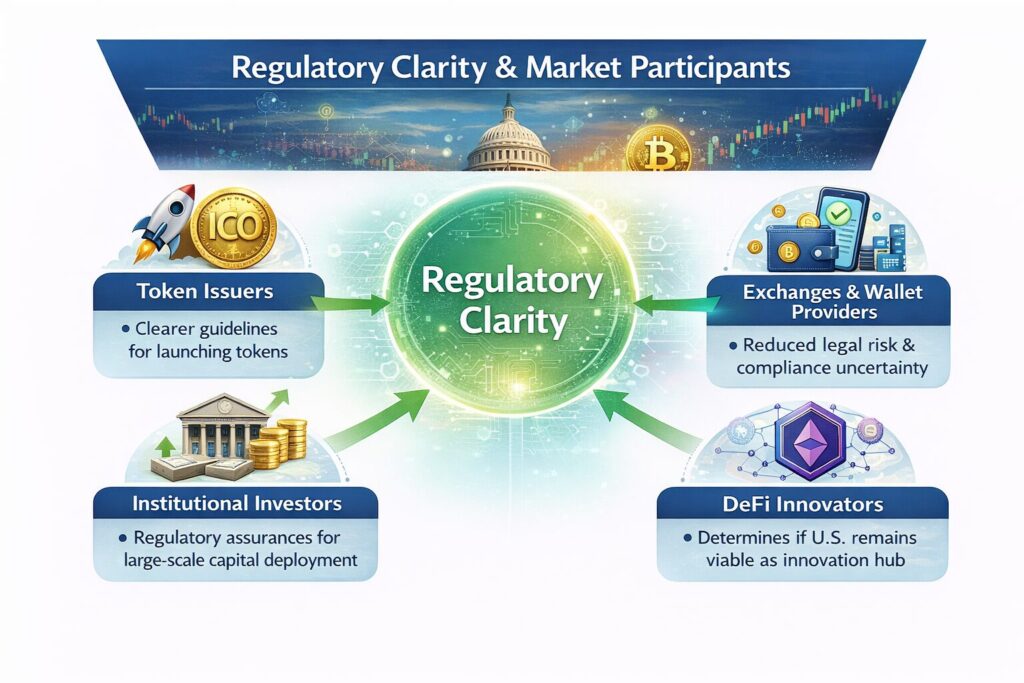
- Token Issuers may gain clearer guidance on how to structure launches without triggering securities violations.
- Exchanges and Wallet Providers could operate with reduced legal risk and lower compliance uncertainty.
- Institutional Investors may finally receive the regulatory assurances needed to deploy large-scale capital.
- DeFi Innovators face a critical moment that could define whether the U.S. remains a viable base of operations.
8. Conclusion: A Defining Moment for U.S. Crypto Regulation
The U.S. Senate’s renewed push toward a crypto market structure law represents a defining moment for the digital asset industry. While political disagreements—particularly around DeFi and conflicts of interest—remain unresolved, the underlying consensus is stronger than at any point in the past decade.
Whether this momentum results in a durable regulatory framework or yet another missed opportunity will depend on the coming weeks. For now, the industry watches closely, aware that the outcome will shape not only U.S. crypto markets, but global blockchain innovation for years to come.
