
Main Points :
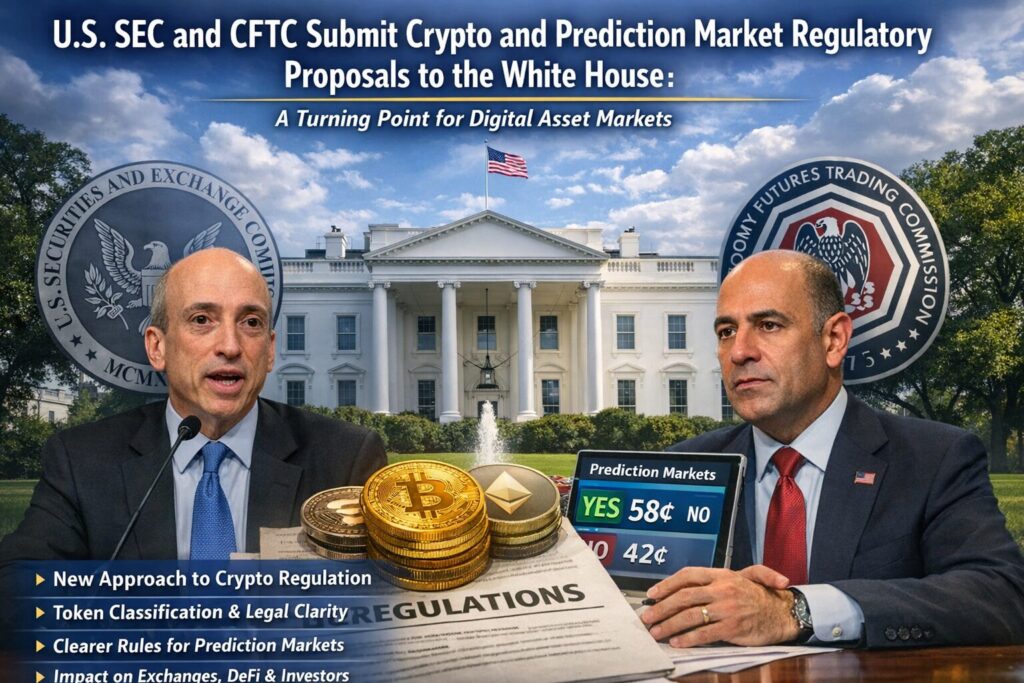
- SEC and CFTC simultaneously submitted regulatory proposals concerning cryptocurrencies and prediction markets to the White House Office of Information and Regulatory Affairs (OIRA).
- A major shift in regulatory posture is underway compared with the stricter approach taken during the Biden administration.
- Token classification and legal definitions are becoming central to U.S. crypto regulation.
- Prediction markets may receive clearer regulatory frameworks, potentially unlocking new blockchain-based financial products.
- Industry impact could be significant, influencing exchanges, token issuers, DeFi platforms, and investors searching for the next wave of crypto opportunities.
1. A Major Regulatory Milestone in the United States
The United States has entered a new phase in cryptocurrency and financial market regulation after the Securities and Exchange Commission (SEC) and the Commodity Futures Trading Commission (CFTC) simultaneously submitted regulatory proposals to the White House Office of Information and Regulatory Affairs (OIRA).
According to reports on March 5, the SEC submitted commission-level guidance titled “Application of Federal Securities Laws to Certain Crypto Assets and Related Transactions.” This guidance aims to clarify how existing securities laws apply to cryptocurrency tokens and related financial transactions.
At nearly the same time, the CFTC submitted its own proposal addressing prediction markets, a growing sector where traders bet on the outcome of events such as elections, economic indicators, or sports results.
The submission of both proposals to OIRA represents the most advanced bureaucratic step so far in shaping U.S. regulatory policy for crypto markets. While the process does not yet constitute formal legislation, it signals that regulators are accelerating their efforts to establish a coherent framework for digital assets.
For investors and blockchain entrepreneurs, this development is highly significant. Regulatory clarity has long been one of the largest barriers to innovation in the crypto industry, particularly in the United States.
The simultaneous actions by the SEC and CFTC suggest that Washington is beginning to treat crypto not as a fringe technology but as a strategic financial sector requiring coordinated oversight.
2. The Trump Administration’s Shift Toward Crypto-Friendly Regulation
One of the key drivers behind this regulatory momentum is the shift in policy direction under the Trump administration.
During the Biden administration, crypto regulation was widely viewed as restrictive. Several high-profile enforcement actions by the SEC targeted exchanges, token issuers, and DeFi platforms. Critics argued that regulators were relying heavily on enforcement rather than providing clear rules.
The new administration appears to be taking a different approach.
President Trump has publicly stated that he intends to make the United States a global hub for cryptocurrency innovation. This ambition requires a regulatory environment that balances investor protection with technological growth.
SEC Chairman Atkins has emphasized that the key policy priority is to create a clear legal definition and classification system for crypto tokens.
Currently, one of the biggest challenges facing crypto companies is determining whether a token should be classified as:
- a security (regulated by the SEC)
- a commodity (regulated by the CFTC)
- or a new digital asset category
Without clear definitions, companies often face legal uncertainty.
The SEC’s guidance proposal is expected to address this issue by outlining how existing securities laws apply to specific types of crypto assets and transactions.
If implemented successfully, such clarity could dramatically reduce compliance risks for blockchain startups and exchanges.
3. Increasing Cooperation Between the SEC and CFTC
Historically, the SEC and CFTC have often had overlapping jurisdictions and differing perspectives on crypto regulation.
The SEC traditionally views many tokens as securities, while the CFTC tends to treat digital assets such as Bitcoin as commodities.
However, recent developments suggest that the two agencies are moving toward greater cooperation.
In January 2026, the SEC and CFTC jointly hosted a “Project Crypto” summit, signaling a shift away from regulatory rivalry and toward coordination.
The simultaneous submission of regulatory proposals reinforces this cooperative trend.
Such coordination is crucial because the crypto market spans multiple asset classes:
- Spot markets
- Derivatives
- Decentralized finance
- Token issuance
- Prediction markets
Without regulatory coordination, companies face fragmented compliance requirements.
A joint regulatory approach could create a more unified framework that benefits both market participants and regulators.
4. The Emerging Regulation of Prediction Markets
While cryptocurrency regulation receives most of the attention, the CFTC’s proposal regarding prediction markets may prove equally transformative.
Prediction markets allow users to trade contracts based on the outcome of future events. For example, traders might speculate on:
- election results
- inflation rates
- corporate earnings announcements
- sports events
Platforms such as Polymarket and Kalshi have demonstrated the growing demand for this type of market.
However, prediction markets have faced regulatory uncertainty in the United States.
CFTC Chairman Selig recently announced that the proposal submitted to OIRA will move toward an Advance Notice of Proposed Rulemaking (ANPR), which is an early stage in the rulemaking process.
This step allows regulators to gather feedback from industry participants before drafting formal regulations.
For blockchain developers, prediction markets represent one of the most powerful use cases of decentralized technology.
These markets can aggregate information from thousands of participants and generate probability estimates that often outperform traditional forecasting methods.
Clear regulations could unlock new innovation in areas such as:
- decentralized prediction markets
- tokenized event contracts
- data-driven financial derivatives
- governance forecasting tools
5. Regulatory Guidance vs. Legislation
Although the SEC’s proposal represents an important step forward, it is important to note that it does not yet constitute a formal law.
Commission-level guidance carries more authority than statements from individual regulators, but it still falls short of a full legislative framework.
The crypto industry has long advocated for comprehensive legislation to define market structure.
One example is the Clarity for Digital Tokens Act, which has already passed the U.S. House of Representatives but remains stalled in the Senate.
Because of this legislative gridlock, regulators are moving forward with administrative measures.
This approach allows regulators to provide interim clarity while lawmakers continue to debate broader reforms.
However, administrative guidance can also change more easily with political shifts, meaning long-term certainty may still require Congressional action.
6. Why This Matters for Crypto Investors and Builders
For investors seeking the next generation of crypto opportunities, regulatory developments are often just as important as technological breakthroughs.
Regulatory clarity can unlock capital flows and encourage institutional participation.
When legal frameworks become clearer, several developments typically follow:
- Institutional investment increases
- New financial products emerge
- Liquidity improves across markets
- Startups receive more venture funding
For example, clearer token classifications could make it easier to launch compliant crypto projects in the United States.
Similarly, regulated prediction markets could lead to entirely new sectors within the blockchain ecosystem.
Investors should pay close attention to regulatory signals because they often determine where the next wave of innovation will occur.
7. Global Context: The Race for Crypto Leadership
The United States is not the only country attempting to shape the future of digital asset regulation.
Several regions have already introduced comprehensive crypto frameworks:
European Union
The EU’s Markets in Crypto-Assets (MiCA) regulation has established one of the world’s most detailed crypto regulatory regimes.
United Kingdom
The UK government has also proposed legislation aimed at integrating crypto into its financial services framework.
Singapore and Hong Kong
Both financial hubs are competing to attract crypto companies through regulatory clarity and licensing systems.
If the United States can provide clear rules for token classification and market structure, it could reclaim its position as a leading destination for blockchain innovation.
8. Visual Guide: U.S. Crypto Regulation Process
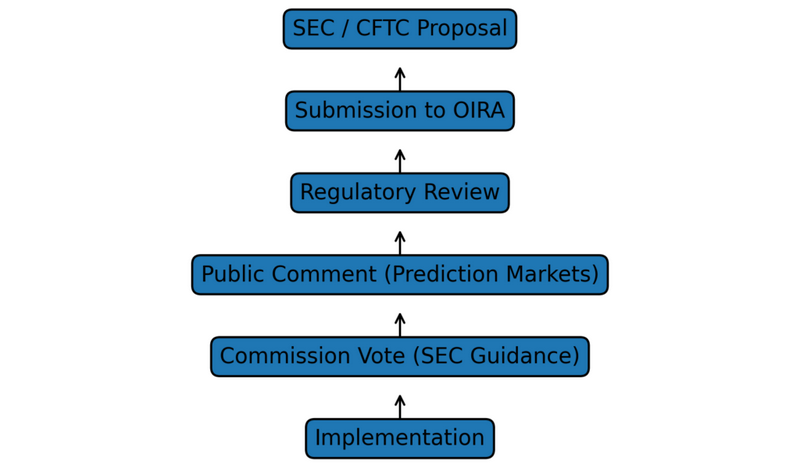
Regulatory Pathway for Crypto Rules in the United States
Suggested diagram structure:
SEC / CFTC Proposal ↓Submission to OIRA ↓Regulatory Review ↓Public Comment (CFTC Prediction Markets) ↓Commission Vote (SEC Guidance) ↓Implementation
This visual can help readers understand how regulatory proposals move through the U.S. administrative process before becoming enforceable policy.
9. Market Impact Scenarios
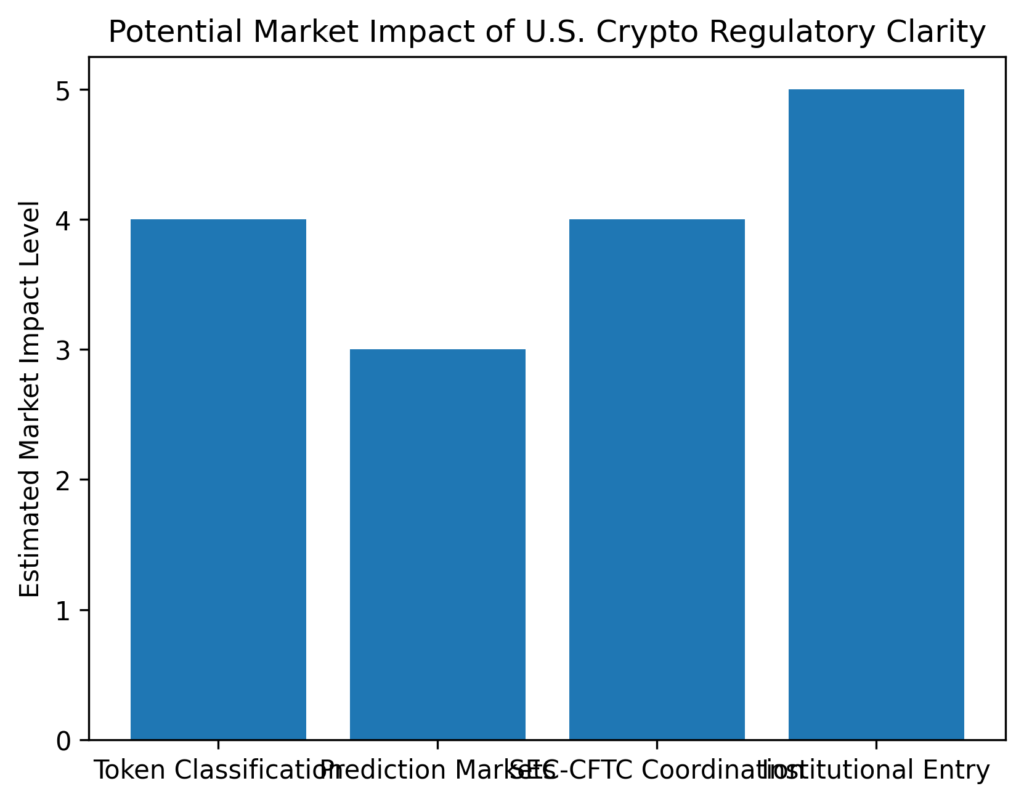
Potential Market Impact of Regulatory Clarity
Suggested visual format:
| Scenario | Impact on Market |
|---|---|
| Clear Token Classification | Surge in U.S. token issuance |
| Regulated Prediction Markets | Growth of event-based derivatives |
| SEC–CFTC Coordination | Reduced compliance uncertainty |
| Institutional Participation | Increased liquidity |
Conclusion: A New Chapter for Crypto Regulation
The simultaneous submission of regulatory proposals by the SEC and CFTC marks a significant turning point for the cryptocurrency and prediction market industries.
Although the measures do not yet represent final legislation, they signal that the U.S. government is accelerating its efforts to create a structured regulatory framework for digital assets.
The key themes emerging from these developments include:
- clearer token classification
- greater cooperation between regulators
- recognition of prediction markets as legitimate financial instruments
- increased political interest in positioning the United States as a crypto innovation hub
For investors and entrepreneurs searching for the next frontier in blockchain technology, regulatory clarity may become the catalyst that unlocks new markets, new products, and new sources of revenue.
If these initiatives lead to comprehensive market rules, the United States could soon enter a new era where digital assets become fully integrated into the global financial system.
