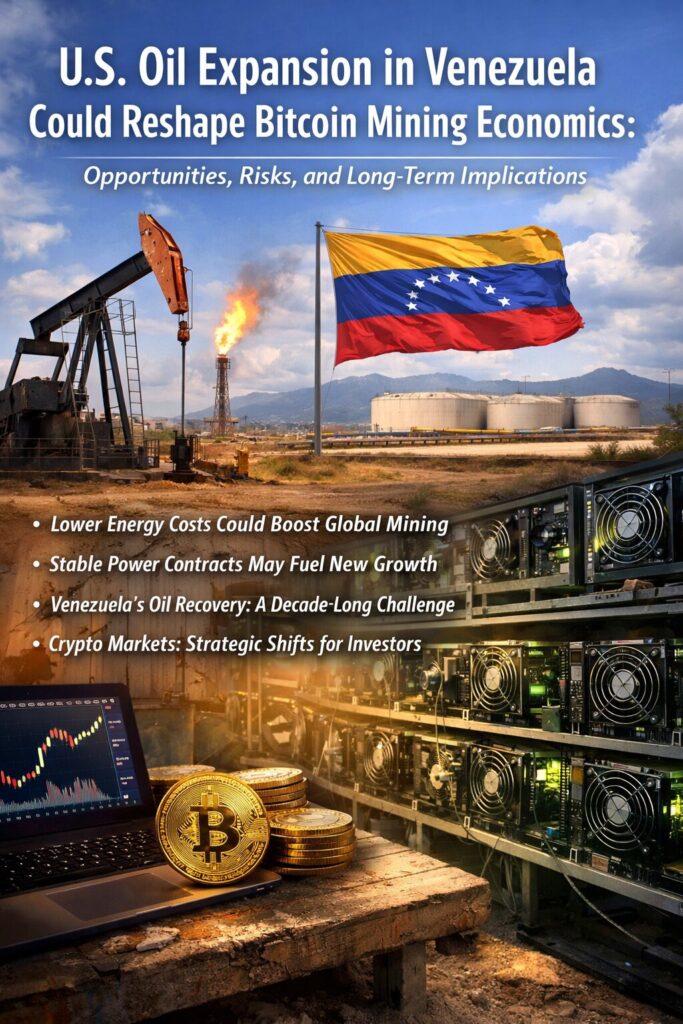
Potential U.S. involvement in Venezuelan oil development could lower global energy prices, indirectly reducing Bitcoin mining costs.
Cheaper and more stable electricity contracts may open new expansion phases for global mining operations.
Venezuela’s vast oil reserves represent a structural energy shock, but recovery will likely take over a decade.
The impact on crypto markets is secondary but strategically significant, particularly for capital-intensive miners.
Long-term investors should distinguish between short-term speculation and structural energy-driven advantages.
1. Energy Costs as the Hidden Variable in Bitcoin Mining Profitabilit
Bitcoin mining has always been a business of energy arbitrage. While market participants often focus on hash rate, mining difficulty, and Bitcoin price cycles, electricity cost remains the single most decisive factor in long-term mining profitability.
According to analysis by Bitfinex, any structural shift in global energy supply—especially one involving oil-rich regions—can have cascading effects on Bitcoin miners worldwide. Energy accounts for an estimated 60–75% of operational expenditure for large-scale mining facilities, making miners extremely sensitive to electricity price fluctuations.
This is why geopolitical developments in energy-producing nations, even those seemingly unrelated to crypto, deserve close attention from miners and digital asset investors alike.
2. Venezuela’s Oil Reserves: A Dormant Energy Superpower
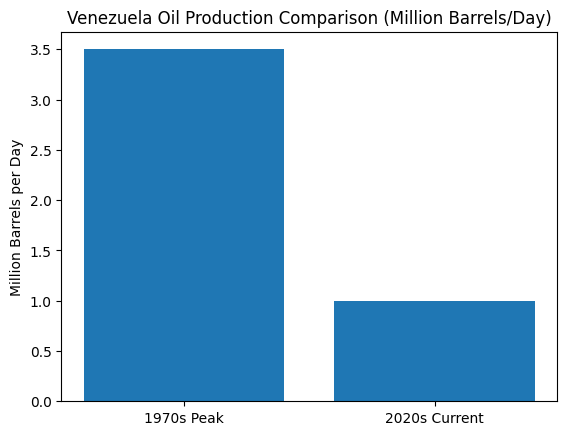
Venezuela holds the world’s largest proven oil reserves, estimated at 303 billion barrels. In the 1970s, the country produced approximately 3.5 million barrels per day, accounting for nearly 7% of global supply.
Today, production has collapsed to roughly 1.0 million barrels per day, or about 1% of global output, due to years of underinvestment, sanctions, political instability, and infrastructure decay.
[“Venezuela Oil Production: 1970s vs 2020s”]
This dramatic decline represents not just a national economic tragedy but also a massive inefficiency in the global energy market.
3. U.S. Strategic Interest and the Return of Energy Geopolitics
Recent reports indicate that the United States is reassessing its stance toward Venezuelan oil development. Following the seizure of Venezuelan oil tankers and increased pressure on President Nicolás Maduro, Washington appears to be exploring conditional pathways for U.S. companies to re-enter Venezuela’s energy sector.
Former U.S. President Donald Trump has publicly encouraged American energy firms to consider Venezuelan oil development, arguing that even partial recovery of production could exert downward pressure on global energy prices.
From a macroeconomic perspective, this signals a potential supply-side energy shock, one that could ripple far beyond traditional oil markets.
4. How Cheaper Energy Translates into Lower Bitcoin Mining Costs
Bitfinex analysts emphasize that Bitcoin miners do not require oil directly; instead, they benefit from secondary effects:
Lower oil prices reduce electricity generation costs in oil-linked grids.
Cheaper fuel lowers transportation and infrastructure expenses.
Long-term power purchase agreements (PPAs) become more affordable.
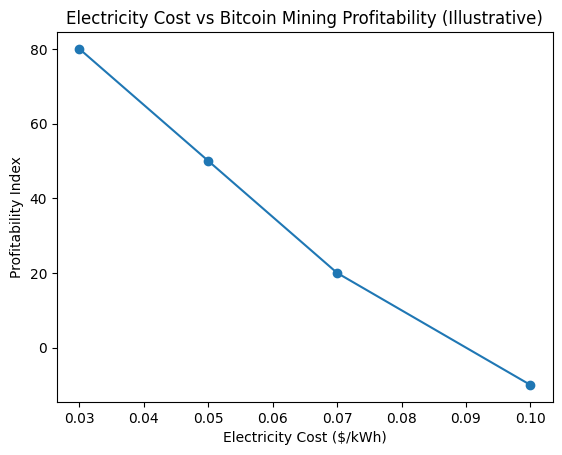
[“Electricity Cost vs Bitcoin Mining Profitability”]
In regions where miners can secure long-term fixed electricity contracts, even a $0.01 per kWh reduction can dramatically improve margins, especially at scale.
5. Mining Expansion Cycles and Capital Reallocation
Historically, periods of declining energy costs have preceded mining expansion phases. When margins improve, miners reinvest in:
New ASIC hardware
Geographic diversification
Grid-scale infrastructure partnerships
Lower energy costs could thus accelerate a new capital expenditure cycle, benefiting not only miners but also:
Hardware manufacturers
Data center operators
Grid infrastructure providers
This is particularly relevant for investors seeking second-order opportunities beyond simply holding Bitcoin.
6. Why the Impact Will Be Slow, Not Immediate
Despite its enormous reserves, Venezuela cannot rapidly increase production. Bitfinex analysts caution that meaningful output recovery will take years, not months.
Asset manager 21Shares, through strategist Matt Mena, estimates:
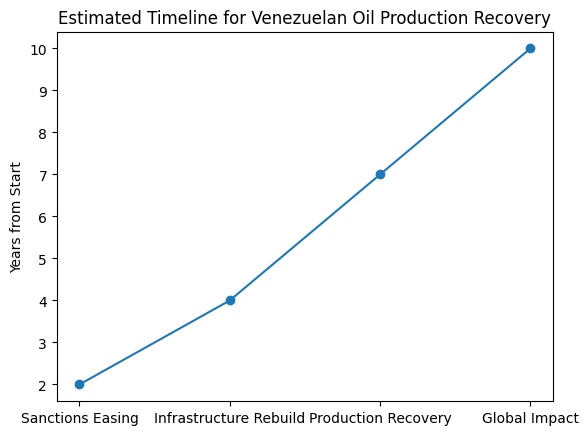
Over $100 billion in infrastructure investment required
A recovery timeline exceeding 10 years
Political transition and sanctions relief as key prerequisites
[“Estimated Timeline for Venezuelan Oil Recovery”]
This makes Venezuela a long-term structural thesis, not a short-term trading catalyst.
7. Secondary Effects on Crypto Markets
Even without immediate production increases, markets often price in expectations. The mere possibility of future energy abundance can influence:
Long-term mining investment decisions
Valuations of publicly listed mining companies
Jurisdictional competition for mining facilities
For crypto-native investors, this highlights the importance of monitoring energy geopolitics alongside blockchain metrics.
8. Practical Implications for Miners and Investors
For different market participants, the implications vary:
Miners
Monitor jurisdictions with oil-linked power grids
Explore long-term PPAs rather than spot electricity pricing
Prepare for future margin compression if hash rate rises
Investors
Distinguish between speculative narratives and structural trends
Evaluate mining equities and infrastructure plays
Consider energy-cost sensitivity as a valuation factor
9. Conclusion: Energy Is the Long Game in Crypto Mining
The potential re-entry of U.S. companies into Venezuelan oil development underscores a broader truth: Bitcoin mining is ultimately an energy business wrapped in cryptography.
While Venezuela’s production recovery will be slow and politically complex, even incremental progress could reshape global energy expectations. For the crypto sector, the implications are indirect but profound—lower structural energy costs could redefine mining economics over the next decade.
For those seeking new digital assets, revenue streams, or practical blockchain applications, understanding the energy–crypto nexus will be as important as understanding code, regulation, or tokenomics.
About Us and Media
Blockchain and cryptocurrency media covering and exposing the practical application development on the blockchain industry and undiscovered coins.
Click edit button to change this text. Lorem ipsum dolor sit amet, consectetur adipiscing elit
Manage Consent
To provide the best experiences, we use technologies like cookies to store and/or access device information. Consenting to these technologies will allow us to process data such as browsing behavior or unique IDs on this site. Not consenting or withdrawing consent, may adversely affect certain features and functions.
Functional Always active
The technical storage or access is strictly necessary for the legitimate purpose of enabling the use of a specific service explicitly requested by the subscriber or user, or for the sole purpose of carrying out the transmission of a communication over an electronic communications network.
Preferences
The technical storage or access is necessary for the legitimate purpose of storing preferences that are not requested by the subscriber or user.
Statistics
The technical storage or access that is used exclusively for statistical purposes.The technical storage or access that is used exclusively for anonymous statistical purposes. Without a subpoena, voluntary compliance on the part of your Internet Service Provider, or additional records from a third party, information stored or retrieved for this purpose alone cannot usually be used to identify you.
Marketing
The technical storage or access is required to create user profiles to send advertising, or to track the user on a website or across several websites for similar marketing purposes.