

Main Points:
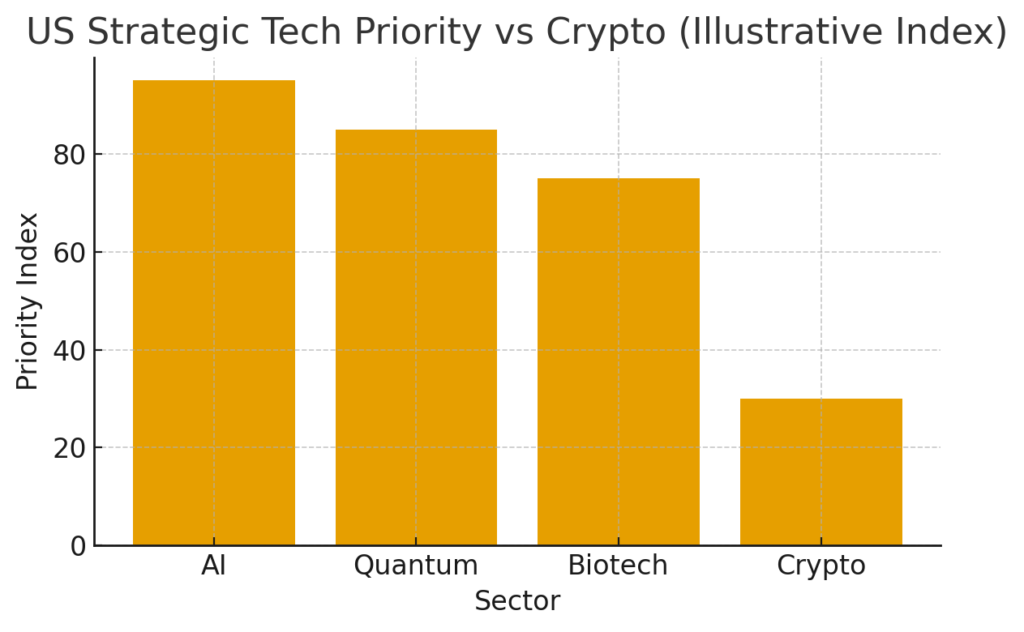
- The Trump administration’s newly released National Security Strategy (NSS) emphasizes AI, biotechnology, and quantum technology, but makes no direct mention of cryptocurrencies or blockchain.
- This omission contrasts with Trump’s campaign-era promises to become the “crypto president” and establish strategic Bitcoin reserves.
- Analysts debate whether the absence reflects:
- A strategic shift positioning crypto as finance, not national security, or
- An indirect inclusion under “digital finance competitiveness.”
- The U.S. rollback of Biden-era enforcement and push for new crypto legislation continues, but national security designation is notably absent.
- Market reactions remain modest, yet the policy silence may reshape global competition, particularly with China’s continued blockchain expansion.
- For investors, builders, and exchanges, the shift signals a regulatory direction toward financial innovation rather than defense-driven urgency.
- Recent developments—including ETF flows, stablecoin regulation momentum, and growing institutional adoption—continue to drive crypto growth even without national security attention.
Introduction
On December 6, the Trump administration released its latest National Security Strategy (NSS), outlining how the United States intends to protect its geopolitical and technological advantage over the coming decade. The document prioritizes artificial intelligence (AI), biotechnology, and quantum computing as critical strategic technologies.
But one thing is missing—cryptocurrency and blockchain.
This omission is striking. During the campaign, Trump repeatedly declared that he would be the “crypto president,” promised to create a strategic Bitcoin reserve, and argued that the U.S. must prevent China from dominating global crypto infrastructure and mining. His administration has already promoted influential pro-crypto legislation like the Genius Act (stablecoin rules) and the Clarity Act (market structure), dismantled several Biden-era crypto enforcement actions, and halted any movement toward a U.S. CBDC.
Yet the NSS gives zero direct acknowledgment that blockchain or digital assets play any role in national security strategy.
This article analyzes why crypto may have been excluded, what the administration’s strategic intentions may be, how the market is reacting, and what long-term implications this holds for investors, exchanges, miners, and blockchain developers.

Section 1 — What the National Security Strategy Says (and Doesn’t Say)
AI, Quantum, and Biotechnology Take Center Stage
The NSS describes AI as the “defining general-purpose technology of the century,” with quantum and biotechnology closely behind. These sectors are framed as core to U.S. defense readiness, cyber superiority, and future economic competition.
But Crypto Is Completely Omitted
Not a single section of the 50+ page document mentions:
- Bitcoin
- Cryptocurrency
- Blockchain
- Distributed ledgers
- Digital assets
This omission is not accidental. Past NSS documents under both Republican and Democratic administrations often referenced fintech, cyber-finance, or illicit finance. The decision to avoid the topic entirely raises questions about strategic intent.
Possible Interpretations
- Crypto Is Being Treated as a Financial Asset, Not a Strategic Technology
The administration may see crypto as primarily a market-driven financial instrument rather than a technological pillar of national defense. - Regulation Is Handled Elsewhere
Crypto may fall under Treasury, SEC, CFTC, and Congressional jurisdiction—not national defense agencies. - Indirect Mention Through “Digital Finance Competitiveness”
The NSS briefly mentions maintaining leadership in digital finance. Analysts argue this could implicitly include stablecoins, tokenized assets, and market infrastructure—but the absence of explicit language is still notable.
Section 2 — Why the Silence Matters for Crypto Policy
Contradiction With Campaign Promises
Trump’s campaign rhetoric leaned heavily pro-crypto:
- Creation of U.S. strategic Bitcoin reserves
- A promise to end anti-crypto regulation
- A pledge to bring Bitcoin mining fully onshore in the U.S.
- Strong statements against China’s blockchain dominance
Supporters expected these priorities to translate into national security language.
Legislative and Executive Actions Have Been Pro-Crypto
So far, the administration has:
- Supported the Genius Act (stablecoin regulatory clarity)
- Backed the Clarity Act (market structure rules)
- Reversed SEC enforcement actions launched under the Biden administration
- Opposed a U.S. CBDC
- Promoted the formation of a crypto task force
Yet none of this appears in the NSS.
Significance of the Missing National Security Label
If crypto is not a national security priority, then the government may:
- Allow market-driven growth without defense-led restrictions
- Avoid treating mining or blockchain infrastructure as critical assets
- Focus more on financial innovation and less on security risks
- Maintain distance from narratives linking crypto to adversarial nations
For markets, this suggests a lighter-touch approach than some had expected.
Section 3 — Global Context: China, Europe, and the Competitive Landscape
China Continues Expanding Blockchain Influence
China already leads in:
- Government-backed blockchain networks
- Tokenized trade platforms
- State-controlled mining policies (post-2021 restructuring)
- Digital yuan (e-CNY) international pilots
By not including blockchain in its NSS, the U.S. sends a mixed signal about whether it intends to challenge China in this arena.
Europe Pushes Forward With MiCA
While Europe established the MiCA framework, giving clear rules on crypto:
- licensing
- stablecoins
- exchange operations
…the U.S. still relies on fragmented agency interpretations.
Institutional Crypto Adoption Is Accelerating
Recent market dynamics include:
- Bitcoin ETFs consistently attracting inflows above $50 million/day
- Corporations increasing BTC and ETH treasury exposure
- Tokenization pilots by JPMorgan, Citi, and BlackRock
- Rapid stablecoin market expansion, now exceeding $140B, mostly USD-backed
These developments continue regardless of NSS language but signal that the geoeconomic importance of crypto is rising, even if not officially acknowledged.
Section 4 — Market Reaction and Forward-Looking Indicators
Market Reaction Has Been Neutral to Slightly Positive
Crypto markets showed no major decline following the NSS release. Some analysts even argue that:
- Lack of national security framing =
lower risk of restrictive surveillance regulation
Key Indicators for Investors
- Mining Policy
Trump previously emphasized U.S.-based mining; markets will watch for tax incentives or federal energy policy shifts. - Regulatory Clarity
The Genius Act and Clarity Act remain the most influential forthcoming legislation. - Stablecoin Competition
U.S.-regulated USD stablecoins continue dominating global payments. - Global ETF Expansion
Strong ETF inflows suggest durable institutional interest.
Exchange and VASP Perspective
For exchanges like the user’s environment (VASP/EMI ecosystem), the NSS omission likely means:
- No national-security-based restrictions
- Continued reliance on financial regulatory frameworks
- More predictable compliance pathways
- No sudden mining-territory nationalization policies
Overall, this creates stability, not uncertainty.
Section 5 — What This Means for Builders, Investors, and Policymakers
For Crypto Builders
- The U.S. is signaling that AI and quantum are strategic, while blockchain remains financial innovation.
- Builders in tokenization, payments, stablecoins, and DeFi may see regulatory clarity without defense-level barriers.
For Investors Searching for New Opportunities
Key sectors likely to grow:
- Real-world asset (RWA) tokenization
- Stablecoin settlement networks
- Mining efficiency technologies
- Layer-2 scaling for financial applications
- AI-integrated blockchain analytics
For Policymakers
The administration may pursue a dual approach:
- Strengthen AI/quantum for national security
- Encourage crypto innovation through legislation, not defense policy
This separation could shape the next decade of digital asset evolution.
Conclusion — The Strategic Silence Is a Signal Itself
The absence of crypto from the 2025 National Security Strategy does not indicate a retreat from pro-crypto policy. Instead, it reflects a strategic choice:
- AI, quantum, and biotech are treated as defense-critical
- Crypto is treated as finance
This division may ultimately empower the industry. Without national security framing, crypto avoids restrictive oversight while still benefiting from legislative momentum, institutional inflows, and global economic competition.
For investors and builders, the message is clear:
Crypto is not a battlefield of national defense—it is a frontier of economic innovation. And the U.S. intends to lead through markets, not militarization.
