
Main Points :
- The U.S. Department of Justice (DOJ) has reportedly begun investigating allegations that Iran used Binance to evade U.S. sanctions.
- More than $1 billion in crypto transactions are suspected to have flowed through networks linked to Iranian proxy organizations.
- The investigation was reportedly triggered after Binance halted an internal probe into Iran-related transactions.
- Binance has strongly denied the allegations and has filed a defamation lawsuit against Dow Jones, the parent company of the Wall Street Journal (WSJ).
- The case highlights growing global regulatory scrutiny on crypto exchanges, especially regarding sanctions compliance and anti-money laundering controls.
- For investors and builders, the situation underscores the importance of compliance infrastructure in the future of blockchain finance.
1. The Allegations: Iran Sanctions Evasion Through Binance
In March 2026, reports surfaced that the U.S. Department of Justice (DOJ) had begun investigating whether cryptocurrency transactions conducted through Binance were used by Iranian actors to evade U.S. sanctions. The report, based on internal documents and testimonies from individuals familiar with the situation, suggested that U.S. investigators were already gathering evidence and interviewing people with knowledge of Iran-related crypto transactions.
At the center of the investigation are allegations that more than $1 billion worth of cryptocurrency flowed through Binance to networks linked to Iranian-supported organizations. These alleged transactions are said to be part of a broader financial pipeline used to support groups aligned with Iran’s geopolitical interests, including proxy organizations operating in the Middle East.
According to previous reporting, approximately $1.7 billion in digital assets originating from Chinese-linked clients may have moved through Binance accounts. Of that amount, more than $1 billion was reportedly routed through a Hong Kong-based payment intermediary called Brelest Trust, before being transferred to entities allegedly connected to Iranian proxy groups such as the Houthi movement in Yemen.
These accusations, if proven true, could have serious implications for Binance and the broader cryptocurrency industry. The use of digital assets to bypass sanctions has long been a concern for regulators, and this case could become one of the most significant examples cited in global policy debates about crypto regulation.
2. A History of Regulatory Pressure on Binance
The current investigation does not occur in a vacuum. Binance has been under intense regulatory scrutiny for several years.
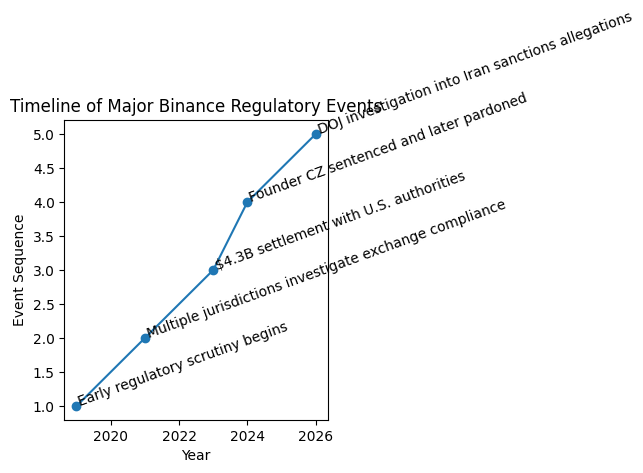
In 2023, the exchange reached a historic settlement with U.S. authorities after being accused of violating anti-money laundering laws and sanctions regulations. As part of that settlement, Binance agreed to pay $4.3 billion in penalties, one of the largest enforcement actions ever imposed on a cryptocurrency company.
The settlement also included criminal charges against the company’s founder, Changpeng Zhao (commonly known as CZ). Zhao pleaded guilty to violations related to financial compliance failures and served a four-month prison sentence. After completing his sentence, he later received a presidential pardon in October of the following year.
As part of the 2023 agreement, Binance also agreed to operate under strict regulatory supervision by U.S. authorities until at least 2029. Compliance monitors were appointed to oversee the company’s systems and ensure improvements in anti-money laundering procedures, sanctions screening, and transaction monitoring.
The new investigation therefore raises questions about whether the compliance measures implemented since the settlement are functioning effectively.
3. The Internal Investigation That Sparked the Probe
One of the most controversial elements of the story is the claim that the DOJ investigation may have been triggered by Binance’s decision to halt an internal investigation related to Iranian transactions.
According to reports, a Binance investigator who had raised concerns about Iran-related activity was suspended in November of the previous year. This move reportedly attracted the attention of U.S. regulators and lawmakers, who began questioning whether the company was adequately investigating potential sanctions violations.
Around the same time, a compliance monitor appointed by the U.S. Treasury Department reportedly requested additional documentation related to Iranian transactions. This request appears to have intensified scrutiny of the exchange’s internal processes.
The episode highlights a broader challenge faced by large crypto exchanges: managing internal compliance investigations while under global regulatory oversight. In traditional finance, banks often face similar tensions when internal investigations reveal potential regulatory risks.
4. Political Pressure in Washington
The issue has also drawn attention from U.S. lawmakers. In February 2026, Senator Richard Blumenthal and other Democratic lawmakers sent a formal letter to the DOJ and the U.S. Treasury Department requesting a thorough investigation into the allegations.
In their letter, the lawmakers expressed concern that nearly $2 billion in potentially sanction-linked transactions could have occurred without being detected earlier.
They argued that such a failure would raise serious questions about the effectiveness of compliance systems in major cryptocurrency exchanges.
Binance responded to the inquiry in writing, but according to reports, lawmakers considered the response evasive and insufficient, maintaining their concerns and urging regulators to continue their investigation.
Political pressure from Congress has increasingly become a driving force behind crypto regulation in the United States. When lawmakers become involved in investigations like this, regulatory agencies often face greater pressure to act aggressively.
5. Binance Fights Back: Lawsuit Against Dow Jones
While the investigation is ongoing, Binance has taken an aggressive stance against the media reporting that triggered the controversy.
On the same day the DOJ investigation was reported, Binance announced that it had filed a defamation lawsuit against Dow Jones, the parent company of the Wall Street Journal, in the U.S. District Court for the Southern District of New York.
The company argues that the February report published by the WSJ was false and defamatory and caused significant reputational damage.
Binance’s global head of litigation, Dugan Bliss, stated that the lawsuit seeks to hold the publication accountable for allegedly prioritizing website traffic over journalistic integrity.
Prior to filing the lawsuit, Binance CEO Richard Teng had already sent a letter to the WSJ editor-in-chief demanding the removal and correction of the article. The newspaper reportedly refused to retract the report.
This legal battle could become a significant test case regarding media coverage of crypto companies and the boundaries of investigative reporting in the digital asset industry.
6. Binance’s Defense: Denial of Sanctions Violations
Binance has categorically denied any direct transactions with sanctioned Iranian entities.
According to the company, internal investigations found that only $24 million worth of funds had reached wallets associated with Iran’s Islamic Revolutionary Guard Corps (IRGC), a figure far lower than the billions suggested in media reports.
The company also stated that accounts suspected of sanctions violations had already been identified and closed.
Binance maintains that it operates one of the most advanced compliance frameworks in the cryptocurrency industry, working closely with regulators and law enforcement agencies worldwide.
Furthermore, the company claims that the WSJ’s reporting triggered “unjustified government scrutiny” and harmed the reputation of its compliance program.
7. A Broader Trend: Crypto and Sanctions Enforcement
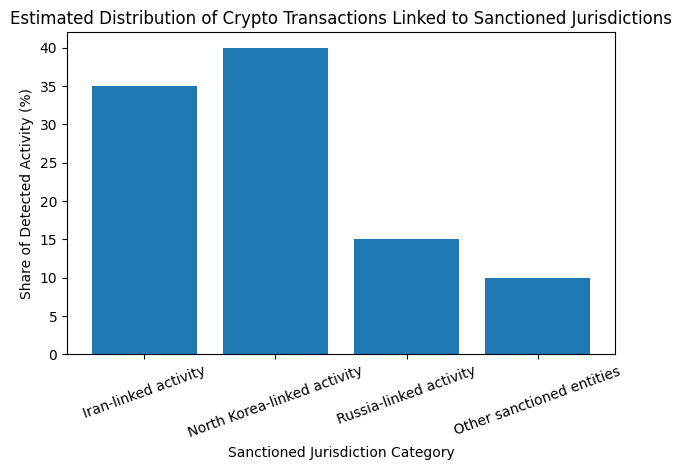
The investigation comes amid a broader global effort to prevent cryptocurrency from being used to evade sanctions.
Governments in the United States, Europe, and Asia have increasingly focused on the role of crypto exchanges in monitoring financial flows connected to sanctioned jurisdictions such as Iran, North Korea, and Russia.
Blockchain analytics firms have reported that sanctioned entities continue to explore digital assets as a means of bypassing restrictions in traditional banking systems.
However, blockchain technology also provides unprecedented transparency. Unlike traditional offshore banking, many crypto transactions can be traced using public ledger analysis.
As a result, regulators are pushing exchanges to adopt more sophisticated monitoring tools and identity verification systems.
8. Implications for Crypto Investors and Builders
For investors, this case highlights the regulatory risks associated with centralized exchanges.
While crypto markets are often discussed in terms of technological innovation and investment opportunities, regulatory enforcement can have significant impacts on market sentiment and liquidity.
Major investigations into large exchanges can trigger market volatility, especially when they involve sanctions or anti-money laundering issues.
For blockchain entrepreneurs, the lesson is clear: compliance infrastructure is becoming a core component of the crypto industry.
Projects that integrate strong compliance mechanisms—such as transaction monitoring, identity verification, and regulatory reporting—may gain a competitive advantage as institutional capital enters the digital asset space.
Conclusion: The Future of Crypto Compliance
The DOJ investigation into alleged Iranian sanctions evasion through Binance represents more than just a legal challenge for one exchange. It reflects the broader transformation of the cryptocurrency industry as it matures and integrates into the global financial system.
Over the past decade, cryptocurrency markets have evolved from niche technology experiments into a multi-trillion-dollar financial ecosystem. As that transformation continues, regulatory scrutiny has become inevitable.
For companies operating in the crypto space, the message is increasingly clear: innovation alone is no longer enough. Sustainable growth will depend on the ability to combine technological advancement with rigorous compliance frameworks.
For investors and builders searching for the next wave of blockchain opportunities, the intersection between decentralized finance, institutional adoption, and regulatory alignment may ultimately define the future of the industry.
