

Key Takeaways :
- The U.S. “Crypto Market Structure” or “Clarity Act” may be delayed until 2027, with enforcement pushed to 2029, according to TD Cowen.
- The delay is driven by political conflict over conflict-of-interest provisions, particularly those affecting Donald Trump and his family’s crypto businesses.
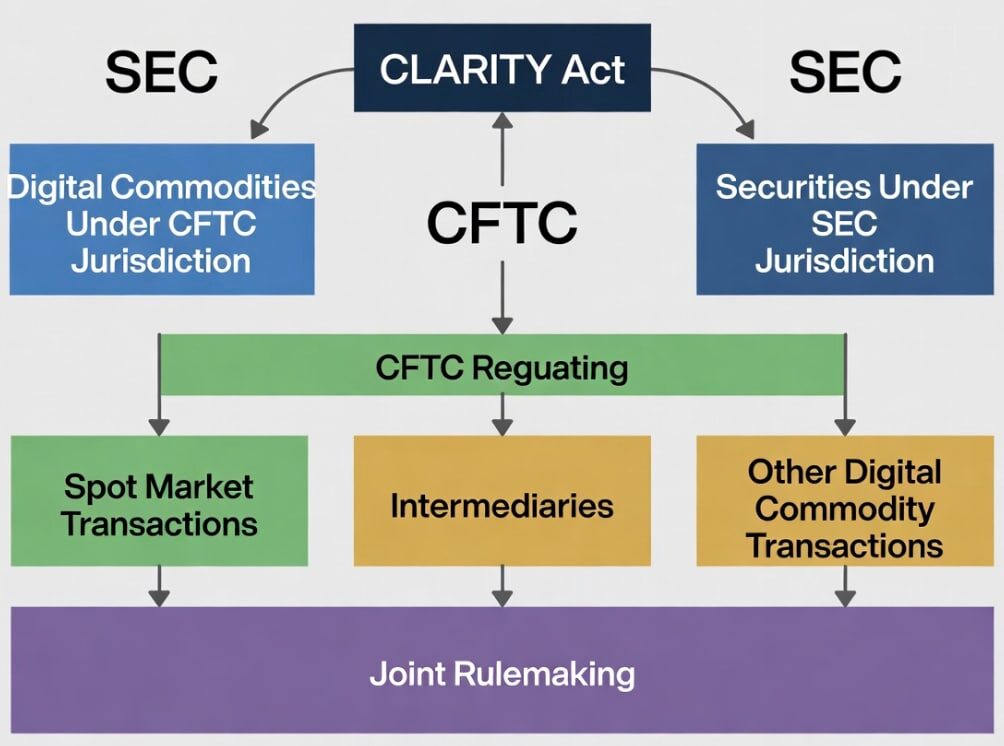
- The bill aims to clearly separate regulatory authority between the SEC and the CFTC.
- For crypto investors and builders, the prolonged uncertainty creates both regulatory risk and strategic opportunity, especially outside the U.S.
- Institutional capital, DeFi projects, and stablecoin initiatives will continue to adapt under a fragmented global regulatory landscape.
1. Introduction: A Long Road to Regulatory Clarity
The United States has long struggled to define a coherent regulatory framework for cryptocurrencies. While digital assets have grown into a multi-trillion-dollar global market, U.S. regulation has remained fragmented, reactive, and often driven by enforcement rather than clear legislation.
At the center of current debate is the so-called Crypto Market Structure Bill, often referred to as the Clarity Act. Designed to establish a comprehensive framework for digital assets, the bill is now expected to face significant delays—potentially not becoming law until 2027, with real enforcement beginning only in 2029.
This delay is not merely procedural. It reflects deeper political tensions, conflicts of interest at the highest levels of government, and competing visions for the future of crypto in the United States. For investors, founders, and institutions looking for the next revenue opportunities in blockchain, understanding this delay is essential.
2. TD Cowen’s Forecast: Why 2027 Is the Earliest Realistic Timeline
According to analysis by TD Cowen’s Washington Research Group, led by analyst Jaret Seiberg, political realities in Congress make passage of the bill in 2026 highly unlikely.
To pass the U.S. Senate, the legislation requires 60 votes. Even if all Republican senators support the bill, at least 7 Democratic votes would still be required. In practice, analysts believe 8–9 Democratic votes may be necessary due to expected defections among Republicans themselves.
The key obstacle is not technical regulation—it is politics.
Democrats have insisted on adding strict conflict-of-interest provisions that would prohibit senior government officials and their families from owning or operating crypto businesses. These provisions directly impact Donald Trump and his family’s crypto ventures, making compromise difficult.
As a result, TD Cowen predicts Democrats may deliberately delay the bill until after the 2026 midterm elections, hoping to regain control of the House and strengthen their negotiating position.
3. Trump, Crypto Businesses, and the Conflict-of-Interest Clause
The political deadlock is inseparable from Trump’s growing involvement in crypto.
Bloomberg estimates that as of mid-2025, Trump-related crypto ventures—including the DeFi and stablecoin project World Liberty Financial—had generated approximately $620 million in revenue.
Democrats argue that allowing a sitting president or senior officials to influence crypto regulation while profiting from crypto businesses creates an unacceptable conflict of interest. Proposed clauses would ban such ownership outright.
From Trump’s perspective, these clauses are “non-starters” unless their enforcement is delayed by several years. TD Cowen analysts suggest that if the law passes in 2027 with enforcement starting in 2029, the political conflict may effectively dissolve—either because Trump is no longer in office or because the economic impact becomes less immediate.
4. What the Crypto Market Structure Law Is Actually Designed to Do
Despite the political drama, the bill’s substance is critically important for the industry.
4.1 Ending “Regulation by Enforcement”
For years, the SEC and CFTC have clashed over who regulates which crypto assets. This has resulted in what many industry participants describe as “regulation by enforcement”—projects are sued first and defined later.
The Clarity Act aims to end this ambiguity.
4.2 Defining Digital Commodities vs Securities
Under the bill:
- Decentralized digital assets that do not constitute investment contracts would be classified as digital commodities, falling under exclusive CFTC jurisdiction.
- Assets resembling investment contracts would remain under SEC oversight.
This distinction is crucial for:
- Token issuance
- Exchange listing rules
- DeFi protocol design
- Institutional custody and settlement
5. Legislative Status: Progress and Gridlock
The bill passed the U.S. House of Representatives in July 2025 with a strong 294–134 majority—demonstrating bipartisan support at least in principle.
However, the Senate remains divided. Both the Banking Committee and the Agriculture Committee are working on separate drafts, requiring reconciliation before a unified version can move forward.
This procedural complexity alone could take years, even without political conflict.
6. Market Impact: What This Delay Means for Investors and Builders
6.1 Continued Regulatory Arbitrage
As U.S. clarity is delayed, crypto innovation continues to migrate:
- To Europe under MiCA
- To Asia (Singapore, Hong Kong, UAE)
- To offshore jurisdictions with clearer licensing regimes
For investors, this creates opportunities to identify projects building outside U.S. regulatory uncertainty.
6.2 Institutional Capital Remains Cautious
Large financial institutions prefer clear rules. Without them:
- Tokenized securities remain limited
- Stablecoin issuance faces uncertainty
- On-chain settlement is slowed
This does not stop growth—but it changes where growth happens.

7. Strategic Takeaways for Crypto Investors and Operators
For readers seeking new crypto assets and revenue opportunities:
- Jurisdiction matters more than ever
Projects incorporated outside the U.S. may scale faster. - Infrastructure beats speculation
Compliance-friendly wallets, settlement layers, and payment rails benefit from regulatory delays. - Stablecoins and real-world assets (RWA)
These sectors gain momentum regardless of U.S. legislative timing. - Prepare for 2029, not 2026
Long-term positioning matters more than short-term headlines.
8. Conclusion: Delay Does Not Mean Defeat
The delay of the U.S. Crypto Market Structure Law until 2027—and its enforcement until 2029—reflects political reality, not rejection of crypto itself.
While Washington debates conflicts of interest and electoral strategy, the global crypto economy continues to evolve. For serious investors and builders, the lesson is clear: regulation is coming, but innovation does not wait.
Understanding where clarity emerges first—and positioning accordingly—will define the next generation of crypto winners.
