
Main Points :
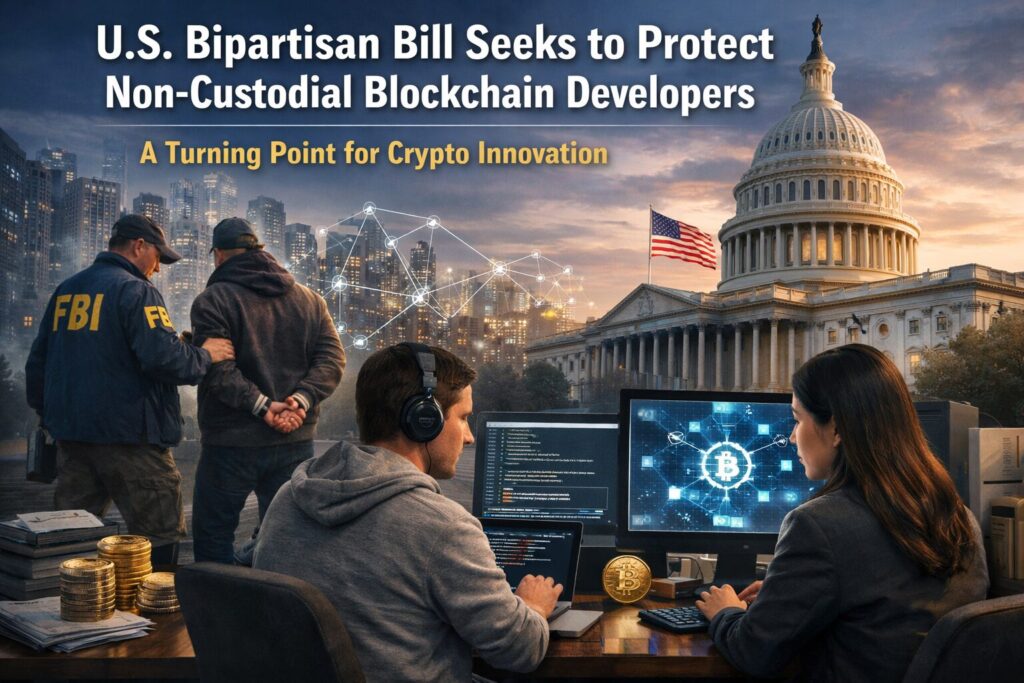
- A bipartisan U.S. bill aims to protect blockchain developers who do not custody customer funds.
- The proposal seeks to clarify regulatory boundaries between criminals and software creators.
- Law enforcement authority to pursue illicit actors will be preserved.
- Regulatory clarity could accelerate U.S. blockchain innovation and capital formation.
- The move reflects a broader global trend toward distinguishing infrastructure from intermediaries.
1. A Defining Moment for Blockchain Policy in the United States
In late February 2026, U.S. Representative Ben Cline publicly expressed support for a bipartisan bill designed to clarify regulatory treatment of blockchain developers. The core objective of the legislation is straightforward yet profound: protect software developers who do not directly manage or custody customer assets from being treated as financial intermediaries.
For years, regulatory ambiguity in the United States has created a chilling effect across the blockchain ecosystem. Federal enforcement actions, shifting interpretations of securities law, and uncertainty around compliance obligations have blurred the line between bad actors and builders of decentralized infrastructure. According to Representative Cline, excessive federal intervention has “obscured the distinction between malicious operators and innovators constructing next-generation technologies.”
The bill he supports aims to correct that imbalance. By explicitly shielding non-custodial developers—those who write code but never touch customer funds—the legislation seeks to provide legal certainty while maintaining robust enforcement tools against actual criminal conduct.
This proposal could represent one of the most consequential policy shifts for blockchain infrastructure since the early debates over digital asset classification.
2. Why Non-Custodial Status Matters
At the center of the debate lies a fundamental technical and legal distinction: custody.
In traditional finance, custody implies control over client funds. Banks, brokers, and exchanges hold assets on behalf of users and therefore assume regulatory responsibilities. However, much of blockchain innovation operates differently.
Many developers create:
- Open-source wallet software
- Smart contract protocols
- Layer-2 scaling networks
- DeFi infrastructure
- Blockchain analytics tools
In these cases, developers may publish code that enables peer-to-peer transactions, but they never possess or control user funds. The blockchain itself executes transactions autonomously once deployed.
Yet under certain interpretations of financial regulation, developers have faced potential liability simply for creating tools that others use. This regulatory overhang has discouraged U.S.-based development and pushed talent overseas.
The bipartisan bill aims to clarify that writing code is not equivalent to operating a financial institution.
3. Preserving Law Enforcement Powers
Importantly, the legislation does not seek to weaken law enforcement. Representative Cline emphasized that the bill ensures authorities retain the ability to pursue “true criminals.”
This distinction is crucial. Recent years have seen high-profile collapses and fraud cases in the crypto industry involving centralized custodial entities. Regulators and prosecutors have rightly pursued those cases.
However, conflating decentralized protocol developers with custodial intermediaries risks undermining both innovation and effective enforcement. If developers are burdened with compliance duties they cannot technically fulfill—such as implementing Know-Your-Customer (KYC) controls on autonomous smart contracts—the regulatory framework becomes impractical.
The proposed bill attempts to separate:
- Custodial actors who manage funds
- Non-custodial developers who create software
- Malicious operators engaging in fraud
Such separation aligns regulatory responsibility with actual operational control.
4. Global Context: A Broader Regulatory Shift
The U.S. debate is occurring within a global movement toward clearer digital asset frameworks.
In Europe, the Markets in Crypto-Assets (MiCA) regulation distinguishes between crypto-asset service providers (CASPs) and protocol developers. Similarly, jurisdictions such as Singapore and the UAE have developed licensing regimes focused primarily on custodial service providers rather than pure software authors.
This shift recognizes that blockchain networks resemble internet infrastructure more than traditional financial firms. Just as web developers are not liable for every misuse of websites built on open protocols, blockchain developers should not automatically be treated as money transmitters.
If enacted, the bipartisan bill could bring U.S. policy closer to international standards, reducing regulatory arbitrage and attracting capital back to American markets.
5. Implications for Innovation and Capital Formation
For investors and entrepreneurs seeking the next wave of opportunity, regulatory clarity is not merely academic—it is foundational.
Capital allocation depends on risk assessment. When developers face undefined regulatory exposure, venture capital retreats. When rules are predictable, innovation flourishes.
The bill could unlock:
- Increased U.S.-based protocol development
- Greater venture funding into non-custodial infrastructure
- Acceleration of decentralized finance (DeFi) tools
- Expansion of tokenized asset markets
If developers can build without fear of retroactive enforcement, experimentation increases. Historically, innovation clusters emerge where regulatory frameworks are supportive but disciplined.
The U.S. risks losing ground to Asia and Europe if it fails to provide similar certainty.
6. Market Reaction and Investment Considerations
While the bill itself does not directly impact token prices, regulatory signals often influence market sentiment.
In previous cycles, announcements of favorable regulatory developments have correlated with increased institutional participation. As of early 2026, Bitcoin trades around $68,000 and Ethereum around $3,900, reflecting continued resilience despite macroeconomic tightening.
If the bill advances, sectors likely to benefit include:
- Layer-1 protocol tokens
- Non-custodial wallet providers
- Decentralized exchange infrastructure
- Zero-knowledge proof networks
- Cross-chain interoperability platforms
Investors focused on long-term infrastructure plays may see this as validation of the decentralized model.
7. Practical Applications: Beyond Speculation
For readers interested in practical blockchain applications, this development reinforces a crucial theme: the infrastructure layer is becoming politically defensible.
Emerging use cases include:
- Tokenized real-world assets
- Supply chain verification systems
- Decentralized identity frameworks
- Stablecoin payment rails
- Cross-border settlement networks
These systems rely heavily on non-custodial smart contracts and open-source frameworks. If developers gain explicit protection, enterprise adoption could accelerate.
Corporations require legal predictability before integrating blockchain into mission-critical systems. A clear statutory boundary between software and financial intermediation lowers that barrier.
8. Insert Graph Here: Regulatory Impact Flowchart
[Regulatory_Clarity_Impact_Diagram.png]
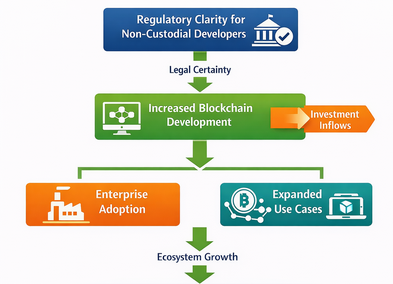
This diagram illustrates the flow from regulatory clarity to increased development, capital inflows, enterprise adoption, and ultimately ecosystem growth.
9. Insert Chart Here: Custodial vs Non-Custodial Distinction
[Custodial_vs_NonCustodial_Framework.png]
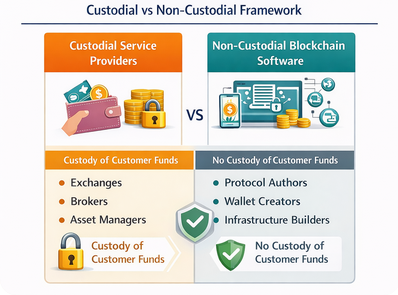
This chart visually separates custodial service providers (exchanges, brokers, asset managers) from non-custodial developers (protocol authors, wallet creators, infrastructure builders).
10. Strategic Outlook
The bipartisan nature of the bill is itself significant. Crypto regulation in the United States has often been politically polarized. Cross-party alignment suggests recognition that blockchain technology is becoming structural rather than speculative.
For innovators, this may mark a turning point. For investors, it signals potential long-term stability in the regulatory environment. For policymakers, it presents an opportunity to reassert U.S. leadership in digital infrastructure.
However, legislative processes are complex. Passage is not guaranteed. Amendments, committee reviews, and political negotiations remain ahead.
Still, the direction is clear: differentiation between software creation and financial custody is gaining acceptance.
Conclusion
The proposed bipartisan bill protecting non-custodial blockchain developers could reshape the regulatory landscape in the United States. By clarifying that developers who do not manage customer funds should not be treated as financial intermediaries, the legislation aims to restore balance between innovation and enforcement.
If enacted, it could accelerate infrastructure development, attract capital, and strengthen America’s position as a global leader in blockchain technology. For investors searching for emerging crypto opportunities, the message is unmistakable: regulatory clarity at the infrastructure layer may unlock the next phase of sustainable growth.
The evolution of blockchain policy is entering a new chapter—one where precision replaces ambiguity, and innovation regains its footing.
