
Key Takeaways :
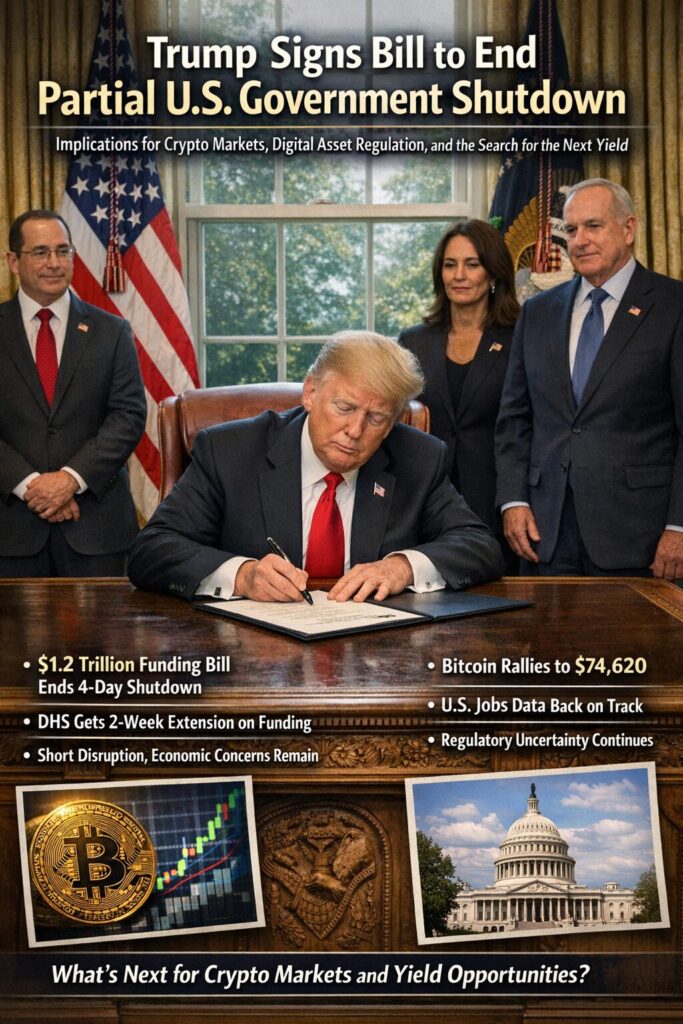
- The U.S. Congress passed a $1.2 trillion funding bill to end a four-day partial government shutdown, with President Donald Trump signaling his intent to sign it without amendments.
- While most federal agencies will be funded through September 30, the Department of Homeland Security received only a two-week extension, keeping immigration enforcement negotiations alive.
- Compared to the prolonged 43-day shutdown in 2025, this short disruption limited immediate economic damage but still highlighted regulatory fragility.
- Bitcoin reacted positively, rising about 2% to around $74,620, underscoring crypto’s sensitivity to U.S. political and macroeconomic signals.
- The reopening clears the way for delayed U.S. employment data, a key macro indicator for both traditional and digital asset markets.
- Digital asset market structure legislation remains in flux, with Senate committees divided and industry leaders pushing for clearer, innovation-friendly rules.
1. A Swift End to a Short but Symbolic Shutdown
After four days of partial closure, the U.S. federal government moved decisively toward reopening. On Tuesday, the House of Representatives approved a previously passed Senate funding package by a narrow margin of 217–214. The legislation allocates roughly $1.2 trillion in federal spending, ensuring that most government agencies remain funded through the end of the fiscal year on September 30.
Although the margin was tight and opposition within the Democratic caucus remained strong—particularly over immigration enforcement provisions—the bill secured enough bipartisan support to pass. President Donald Trump made it clear that he would sign the legislation as long as the Senate version remained unchanged, effectively ending the shutdown.
“Illustrative Timeline of the 4-Day Partial U.S. Government Shutdown.”
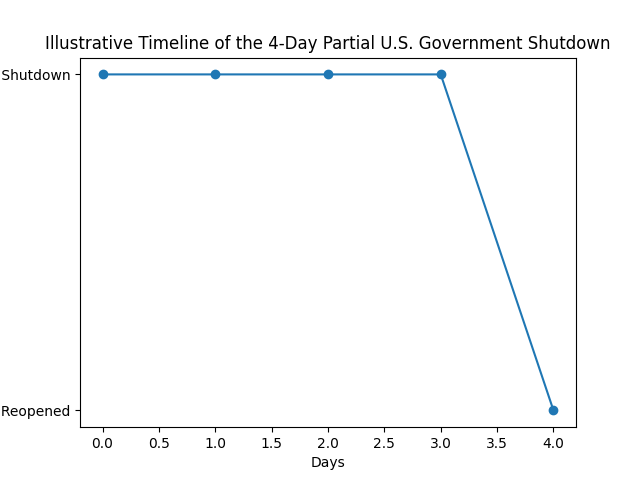
This brief shutdown, while limited in duration, carried symbolic weight. It reminded markets and policymakers alike how quickly political deadlock can disrupt administrative continuity, data publication, and regulatory momentum—factors that increasingly matter to fast-moving sectors like digital assets.
2. Immigration Policy as the Remaining Fault Line
One of the most notable features of the funding package is its treatment of the Department of Homeland Security (DHS). Rather than receiving full-year funding, DHS was granted only a two-week budget extension. This decision effectively punts unresolved debates over Immigration and Customs Enforcement (ICE) and U.S. border security back to the negotiating table.
For markets, this means that while the immediate shutdown risk has been neutralized, policy uncertainty has not disappeared. From a crypto and fintech perspective, this matters because DHS plays a role in cybersecurity, cross-border financial crime enforcement, and certain aspects of digital identity verification. Any renewed shutdown or budget standoff could again delay inter-agency coordination that underpins compliance and enforcement in digital finance.
3. Comparing 2026 to the 2025 Shutdown: Lessons for Digital Assets
The four-day shutdown stands in stark contrast to the 43-day government shutdown experienced in 2025. That earlier episode caused significant delays across multiple legislative initiatives, including efforts to clarify the market structure for digital assets in the United States.
In 2025, extended closures slowed committee work, postponed hearings, and effectively froze momentum on bills designed to define the regulatory perimeter between securities, commodities, and payment tokens. For crypto entrepreneurs and investors, the lesson was clear: regulatory risk is not only about the content of laws, but also about the political system’s capacity to function.
This time, the rapid resolution limited such damage. Still, even a short shutdown can disrupt data releases, stall negotiations, and inject volatility into markets that already operate on global, 24/7 cycles.
4. Bitcoin’s Market Reaction: A Signal of Political Sensitivity
Following news of the House’s approval, Bitcoin prices climbed approximately 2%, reaching around $74,620. While this move may appear modest in crypto terms, it is notable given the absence of any direct crypto-specific policy change.
“Illustrative Bitcoin Price Reaction to Government Funding Resolution.”
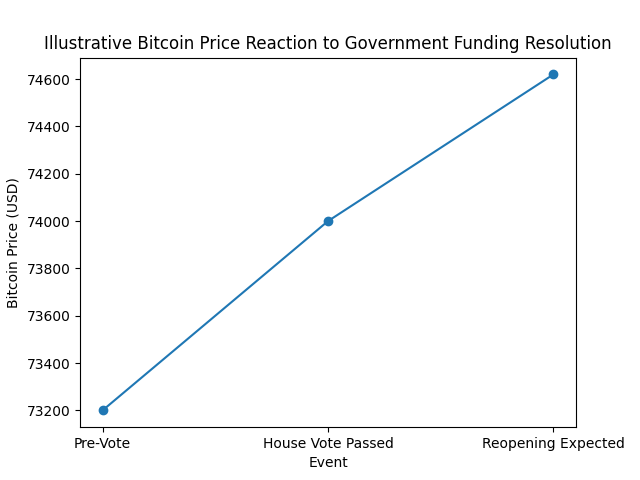
The price increase reflects a broader pattern observed in recent years: digital assets, particularly Bitcoin, often react positively to reductions in macro uncertainty. A functioning U.S. government implies resumed data flows, predictable regulatory timelines, and reduced tail-risk scenarios—all supportive of risk assets.
For investors searching for the “next yield,” this reinforces the idea that Bitcoin is increasingly traded not just as a speculative asset, but as a macro-sensitive instrument that responds to political stability, fiscal policy, and liquidity expectations.
5. The Importance of Delayed U.S. Employment Data
One immediate practical consequence of ending the shutdown is the release of delayed U.S. employment statistics. The January jobs report, originally scheduled for release during the shutdown period, is expected to be published once government operations fully resume.
These data—covering unemployment rates, job creation, and wage trends—are closely watched by both traditional financial markets and crypto traders. Strong employment figures can reinforce expectations of tighter monetary policy, while weaker data may revive hopes for rate cuts or liquidity support.
For blockchain-based businesses, macro data matter because they influence capital availability, investor risk appetite, and the relative attractiveness of yield-generating crypto strategies versus traditional fixed-income products.
6. Ongoing Senate Battles Over Digital Asset Market Structure
While the shutdown issue may be resolved, regulatory uncertainty in crypto remains very much alive. In the Senate, discussions over comprehensive digital asset market structure legislation continue to divide lawmakers and committees.
Recently, the Senate Agriculture Committee advanced a bill with significant implications for both the crypto and banking industries, approving it along party lines. Proposed amendments from Democratic members were rejected, highlighting ideological differences over consumer protection, systemic risk, and innovation.
At the same time, the Senate Banking Committee—responsible for provisions related to the Securities and Exchange Commission—postponed its markup of the bill. This delay followed public statements from Brian Armstrong, CEO of Coinbase, who declined to fully endorse the current draft.
The committee has yet to reschedule deliberations, underscoring how fragile legislative momentum can be—even outside periods of government shutdown.
7. What This Means for Crypto Builders and Yield Seekers
For readers interested in discovering new digital assets, identifying the next revenue stream, or applying blockchain in practical ways, several implications stand out.
First, political stability—however temporary—supports experimentation and capital deployment. Builders are more likely to launch products, and investors more willing to allocate funds, when regulatory timelines are predictable.
Second, the incomplete nature of the DHS funding highlights the importance of designing crypto businesses that are resilient to regulatory delays and policy shocks. Decentralized architectures, cross-jurisdictional strategies, and compliance automation are no longer optional—they are strategic necessities.
Third, the continued debate over market structure legislation suggests that regulatory clarity will arrive incrementally, not all at once. This favors teams that can adapt quickly, pivot business models, and engage constructively with regulators without relying on a single legislative outcome.
8. Broader Trends: Crypto at the Intersection of Politics and Macro Economics
Zooming out, the episode fits into a broader trend: digital assets are increasingly intertwined with political processes and macroeconomic policy. Government shutdowns delay data. Data influence monetary policy. Monetary policy affects liquidity. Liquidity drives crypto valuations.
For sophisticated participants, this chain of causality creates both risk and opportunity. Those who understand political mechanics and regulatory calendars gain an edge in timing market entry, product launches, and fundraising.
In this sense, the four-day shutdown—despite its brevity—served as a live stress test of the system’s resilience and a reminder that crypto markets do not exist in isolation from the state.
Conclusion: A Temporary Resolution, a Permanent Signal
The end of the partial U.S. government shutdown provides short-term relief to markets and policymakers, restoring administrative functionality and clearing the way for delayed economic data releases. Bitcoin’s positive reaction underscores how closely digital assets now track political and macroeconomic developments.
Yet the episode also highlights unresolved tensions—from immigration policy to digital asset regulation—that will continue to shape the investment landscape. For those searching for new crypto assets, the next yield opportunity, or practical blockchain use cases, the key takeaway is clear: success increasingly depends on understanding not just technology and markets, but the political systems that frame them.
In a world where a four-day shutdown can move billions of dollars in digital asset value, political literacy has become a core competency for the crypto economy.
