

Main Points :
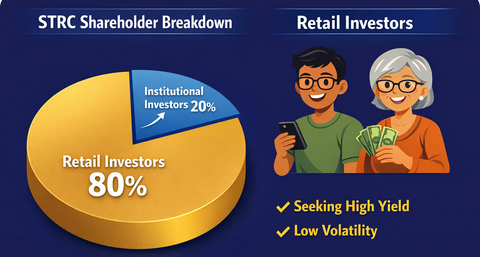
- About 80% of holders of Strategy’s perpetual preferred shares (STRC) are individual retail investors seeking stable Bitcoin exposure with high yield.
- STRC is pitched as “digital credit” – a hybrid income security with ~11.5% annualized dividends, offering a way to gain Bitcoin exposure with lower volatility than common shares or direct BTC holdings.
- Retail demand remains strong despite Bitcoin (BTC) trading ~45% below its all‑time high.
- Strategy has raised billions of dollars via STRC and common stock sales to fund Bitcoin purchases, part of a broader capital plan that could total ~$42–44 billion for BTC accumulation.
- STRC’s structure – perpetual, adjustable monthly dividends, and design to trade near a $100 par value – aims to resemble high‑yield savings while converting BTC holdings into recurring returns.
- Analysts point to enhanced risk‑adjusted returns (Sharpe ratios >3) for STRC versus traditional assets, highlighting broader institutional and retail investment shifts.
Introduction: Bitcoin’s Market Context and the Need for Yield
Bitcoin (BTC) has been one of the most closely watched assets across financial markets in recent years. Despite reaching new all‑time highs, the cryptocurrency has experienced significant volatility, including declines of roughly 45% from peak levels in recent months. This downturn has highlighted a key challenge for investors: how to maintain exposure to Bitcoin’s long‑term growth thesis while managing short‑term risk and generating income.
In this environment, Strategy Inc. (formerly MicroStrategy) has positioned a novel financial instrument – perpetual preferred shares known as STRC – as a bridge between direct Bitcoin investments and traditional yield‑oriented securities. Led by Executive Chairman Michael Saylor and CEO Phong Le, the company has dramatically expanded the use of STRC to raise capital and fund Bitcoin accumulation at scale.
What Is STRC? A New Asset Class Called “Digital Credit”
Strategy’s preferred shares, publicly traded under the ticker STRC, are structured as perpetual preferred equity. These securities pay monthly dividends that are designed to be stable and reflective of underlying Bitcoin performance, while also maintaining a target trading range near a $100 par value.
STRC has been branded by Saylor and Strategy management as “digital credit” – a hybrid between a bond and an equity security that aims to convert the long‑term appreciation of Bitcoin into regular income for holders. Unlike typical bonds with fixed maturities, STRC carries no end date; it distributes returns indefinitely, subject to periodic review and adjustment based on market conditions.
The instrument currently targets an annualized dividend yield around ~11.5%, which is significantly higher than yields on U.S. Treasury securities (~4%) or many fixed‑income alternatives. This is a central reason why retail investors have increasingly adopted STRC as part of their investment strategy.
Retail Demand Dominates STRC Holdings
In a recent disclosure, Strategy’s CEO Phong Le revealed that roughly 80% of STRC holders are retail investors – a relatively high concentration for a sophisticated financial instrument tied to Bitcoin.
Le and Saylor have stated that retail investors are drawn to STRC because it represents a way to gain exposure to Bitcoin with reduced volatility compared to direct BTC holdings or Strategy’s common stock (ticker MSTR). While the common shares offer theoretically unlimited upside tied to Bitcoin price movements, they also experience greater price swings and offer no yield. STRC, in contrast, delivers recurring income and a more predictable return profile that more closely resembles familiar yield products.
Market data suggest that this demand persists even while Bitcoin prices remain ~45% below all‑time highs, indicating a robust appetite for structured Bitcoin exposure among retail investors.
How STRC Funds Bitcoin Accumulation
One of the most distinctive aspects of STRC is its dual role as both an investment vehicle and a capital‑raising mechanism for Strategy’s Bitcoin accumulation strategy.
In March 2026, Strategy used roughly $1.2 billion raised through at‑the‑market (ATM) sales of STRC to fund Bitcoin purchases. The company also conducts ATM offerings of its common stock, and recent filings have outlined plans to raise as much as $42–44 billion through combined equity and preferred equity issuance.
The proceeds from these offerings are allocated directly to buying Bitcoin, effectively leveraging investor capital to expand Strategy’s BTC treasury. This approach allows the company to continue buying Bitcoin even when direct balance sheet cash is limited or when market conditions are less favorable for common stock issuance.
STRC’s structure – perpetual shares with adjustable dividends – provides a continuous funding source without the dilutive effects of issuing solely common shares.
STRC’s Yield and Risk‑Adjusted Metrics
STRC’s dividend yield of roughly 11.5% places it far above traditional fixed‑income instruments and has captured investor interest. Some analysts have focused not only on yield but on risk‑adjusted return profiles, with Sharpe ratio measurements reportedly exceeding 3.0 in some periods.
A Sharpe ratio above 3 is considered exceptional in financial markets, typically signaling that an asset delivers strong returns relative to volatility. STRC’s strong risk‑adjusted performance reflects its design to remain relatively stable in price while delivering elevated yields.
These characteristics make STRC attractive to investors seeking income‑centric Bitcoin exposure with lower volatility than direct BTC investment or equity proxies like MSTR.
Broader Industry Implications
STRC’s adoption among retail investors highlights broader shifts in the Bitcoin and crypto asset landscape:
- Maturation of Crypto Investment Products
Investors are increasingly seeking structured products that offer income and risk management, rather than pure speculative exposure. STRC’s popularity suggests that retail demand is evolving toward more sophisticated, yield‑oriented participation in Bitcoin’s long‑term thesis. - Corporate Treasury Strategies
Strategic use of perpetual preferred equity to fund Bitcoin purchases represents an innovative approach within the digital asset treasury management space. It provides companies a scalable way to deploy capital into Bitcoin without relying solely on debt or common equity issuance. - Bridging TradFi and Crypto Markets
By offering a hybrid investment product with characteristics similar to fixed‑income and equity securities, STRC bridges traditional finance structures with digital asset performance, making Bitcoin investment concepts more accessible to mainstream investors.
Risks and Considerations
While STRC offers compelling yield and a lower‑volatility profile, investors should consider several risks:
- Perpetual Structure: STRC has no maturity; dividend obligations may persist as long as the security trades.
- Dividend Adjustments: Monthly dividend rates can change based on market conditions, introducing variability in returns.
- Liquidity Considerations: Preferred shares may be less liquid than common shares or direct BTC markets in certain conditions.
- Market Sentiment: Despite structured returns, STRC remains linked to Bitcoin’s performance and reflects broader crypto market dynamics.
Conclusion: A New Bridge to Bitcoin Exposure
Strategy’s STRC perpetual preferred shares provide a compelling example of how structured financial innovation can broaden access to Bitcoin exposure while offering predictable income and lower volatility. The fact that roughly 80% of holders are retail investors highlights a practical investment trend: a shift toward products that balance yield, risk management, and exposure to digital assets.
For investors seeking new opportunities within blockchain‑linked financial products, STRC represents a case study in how traditional investment frameworks can be adapted to digital asset markets, potentially serving as a template for future yield‑oriented crypto instruments.
