
Main Points :
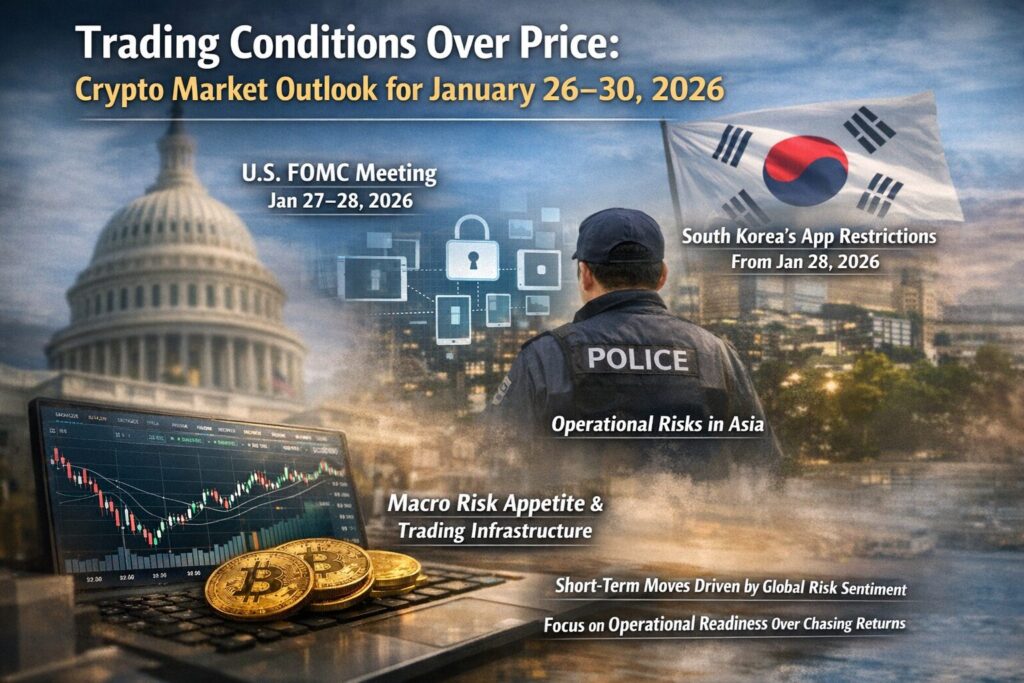
- The crypto market during January 26–30, 2026 is less about sudden new catalysts and more about how institutional and operational changes are being absorbed.
- The U.S. FOMC meeting (Jan 27–28) will shape global risk sentiment, indirectly influencing crypto through interest rate expectations.
- In Asia, South Korea’s enforcement of unregistered app restrictions (from Jan 28) highlights growing operational risks tied to app distribution and access.
- Short-term price movements are expected to depend more on macro risk appetite and trading infrastructure than on isolated crypto news.
- For investors, this is a week to strengthen operational readiness rather than aggressively chase returns.
1. Market Overview: A Week for Absorbing “Systems and Operations
The crypto market outlook for January 26–30, 2026 suggests a period of consolidation rather than explosive price discovery. Unlike weeks driven by sudden regulatory announcements, ETF approvals, or protocol-level breakthroughs, this week is characterized by the digestion of previously announced institutional and regulatory changes.
Market participants are not facing a clear, one-directional narrative. Instead, they are adjusting positions cautiously, prioritizing risk management while reassessing where and how crypto assets can be traded safely. This makes the environment particularly relevant for investors and operators focused on long-term sustainability rather than short-term speculation.
What stands out this week is the simultaneous pressure from macroeconomic policy and operational constraints. On one hand, global liquidity expectations hinge on U.S. monetary policy. On the other, access to trading infrastructure—apps, exchanges, and wallets—is becoming an increasingly visible risk factor, especially in Asia.
2. The United States: FOMC as the Central Risk Driver
Key Event
- U.S. Federal Open Market Committee (FOMC): January 27–28, 2026
- Policy statement and press conference scheduled for January 28
In the United States, the crypto market’s primary reference point is not a crypto-native event but the outcome of the Federal Open Market Committee meeting. While expectations of a policy rate hold are widely reported, markets care less about the decision itself and more about how the message is interpreted.
A more hawkish tone—suggesting prolonged tightening or limited room for rate cuts—would likely pressure equities. In such a scenario, crypto assets, particularly Bitcoin, tend to face upside resistance, as risk appetite contracts.
Conversely, a dovish interpretation—emphasizing economic slowdown risks or leaving room for future rate cuts—could support a broader risk-on rebound. In this case, Bitcoin often acts as the first responder among crypto assets, benefiting from renewed capital inflows.
Importantly, crypto does not react in isolation. Its short-term trajectory is tightly coupled with:
- U.S. Treasury yields
- Equity market performance
- Global investor risk tolerance
This reinforces the idea that macro context outweighs individual crypto headlines during this period.
3. Asia Focus: South Korea’s App Restrictions Enter the Operational Phase
Why South Korea Matters This Week
From January 28 onward, South Korea is expected to begin operational enforcement of restrictions on unregistered overseas crypto exchange and wallet applications in the Android ecosystem. While the regulatory framework itself is not new, this marks a shift from policy discussion to real-world execution.
Reports suggest that on Google Play in South Korea:
- New downloads of unregistered apps may be blocked
- Updates for existing installations may be restricted
The immediate impact is unlikely to be universal. Instead, it will be uneven and practical, affecting specific user segments:
- Traders who must update apps to continue trading
- Users required to reinstall apps due to device changes or 2FA resets
- Individuals whose KYC or withdrawal flows depend heavily on mobile apps
This is not a story about sudden bans but about friction—small operational obstacles that accumulate and alter user behavior.
4. Implications Beyond Korea: What This Means for Japan and Other Markets
It is important not to overstate the immediate spillover. There is no confirmation that Japan or other jurisdictions will replicate South Korea’s approach in the same timeframe. However, the situation highlights a structural vulnerability for users dependent on overseas, unregistered platforms.
The key lesson is visibility. Risks that were previously abstract—such as app distribution dependence—are becoming tangible. For investors and businesses alike, the priority should shift from finding workarounds to building resilient, compliant transaction pathways.
For Japanese users in particular, this underscores the importance of:
- Maintaining accounts with multiple domestically registered exchanges
- Ensuring fiat on-ramps and off-ramps are accessible without relying on foreign app ecosystems
- Testing end-to-end flows, from fiat deposit to crypto transfer, in small amounts
5. Market Dynamics: Will Risk-On Sentiment Return?
A full-scale market rebound should not be assumed. Instead, price action should be evaluated in the context of post-FOMC market conditions.
Expected Scenarios
- Rising prices with strong volume and capital inflows: More likely to sustain momentum
- Thin-volume rebounds: Vulnerable to profit-taking and pullbacks
Bitcoin remains the primary barometer, but altcoins may lag unless supported by genuine liquidity expansion.
6. Investor Strategy: January 26–30 as a “Preparation Week”
This is not an ideal week for aggressive positioning. Instead, it is a week to prepare and reinforce operational foundations.
Practical Checklist
- Maintain accounts with at least two domestically registered exchanges
- Test fiat deposits, small crypto purchases, and withdrawals end-to-end
- Monitor regulatory news not for headlines, but for operational impact—apps, banking rails, and withdrawal flows
7. Conclusion: Building Resilience Over Chasing Precision
The week of January 26–30, 2026 is shaped by overlapping pressures from U.S. monetary policy and Asian operational regulation. Markets are more sensitive to financial conditions and trading access than to isolated news events.
Rather than attempting to predict short-term price movements, investors are better served by ensuring that their trading infrastructure is robust, compliant, and tested. Small-scale transactions, multiple access routes, and firsthand confirmation of operational conditions offer far greater reliability than speculative positioning.
This week’s most reproducible strategy is not about being right on price—but about not being fragile.
