
Main Points :
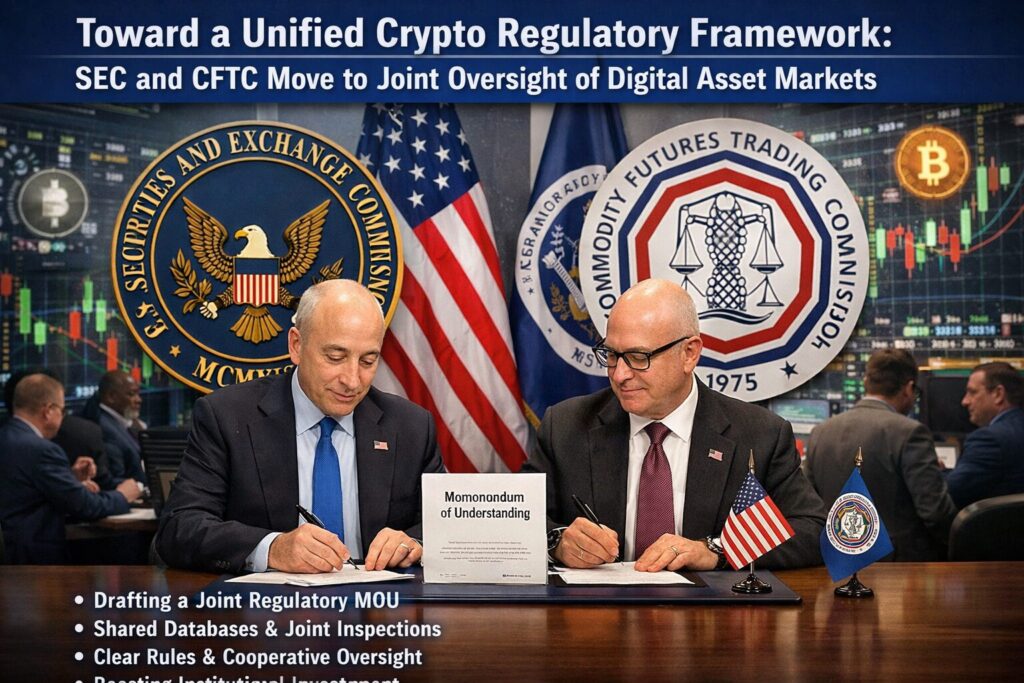
- The U.S. Securities and Exchange Commission (SEC) and the Commodity Futures Trading Commission (CFTC) are drafting a Memorandum of Understanding (MOU) to jointly oversee the cryptocurrency market.
- The initiative aims to resolve long-standing jurisdiction disputes between the two agencies.
- Regulators plan to shift away from “regulation by enforcement” toward clearer rules and cooperative supervision.
- Planned measures include shared regulatory databases, joint inspections, and structured information exchange.
- A unified regulatory approach could increase institutional investor participation in digital asset markets.
1. A Historic Shift in U.S. Crypto Regulation
The United States is approaching what may become one of the most consequential regulatory turning points in the history of the cryptocurrency industry. According to recent statements from U.S. regulators, the SEC and CFTC are currently developing a formal Memorandum of Understanding (MOU) aimed at coordinating the oversight of digital asset markets.
This announcement was made during the FIA International Conference in Florida, where SEC Chairman Paul Atkins emphasized the need for regulators to move beyond fragmented oversight and instead provide consistent regulatory expectations for market participants.
For more than a decade, one of the most significant obstacles facing the crypto industry in the United States has been the lack of regulatory clarity. Digital assets often fall into ambiguous categories that blur the traditional boundaries between securities and commodities. Because of this ambiguity, both the SEC and the CFTC have asserted varying degrees of jurisdiction over different parts of the market.
The proposed MOU represents an attempt to eliminate that ambiguity by creating structured cooperation between the two agencies. Instead of competing over jurisdiction, the SEC and CFTC would coordinate enforcement actions, regulatory standards, and market surveillance.
If implemented successfully, this cooperation could reshape the regulatory landscape not only in the United States but also globally, as many jurisdictions closely monitor U.S. policy developments when designing their own crypto frameworks.
2. The Long-Standing SEC–CFTC Jurisdiction Conflict
To understand the significance of this development, it is necessary to examine the historical conflict between the SEC and CFTC.
The SEC traditionally regulates securities markets, which include stocks, bonds, and investment contracts. In the crypto sector, the SEC has argued that many tokens qualify as securities under the Howey Test, a legal framework derived from a 1946 Supreme Court decision.
By contrast, the CFTC regulates commodity markets, including derivatives such as futures and options. The agency has historically considered Bitcoin and certain other cryptocurrencies as commodities, similar to gold or oil.
This difference in interpretation created a complex regulatory environment:
- Some tokens were treated as securities by the SEC
- Others were treated as commodities by the CFTC
- Many fell into an uncertain regulatory gray zone
The consequences of this ambiguity were significant. Crypto exchanges, token issuers, and decentralized finance (DeFi) projects often struggled to determine which regulatory rules applied to their activities.
This uncertainty also led to several high-profile enforcement actions, where companies were accused of violating securities laws after launching tokens without registering with the SEC.
The planned MOU seeks to reduce this confusion by establishing clear cooperation mechanisms between the agencies.
3. Moving Beyond “Regulation by Enforcement”
One of the most notable aspects of the new regulatory direction is the explicit commitment to move away from what critics have called “regulation by enforcement.”
In the past decade, the SEC in particular has been criticized for relying heavily on enforcement actions rather than issuing detailed regulatory guidelines for crypto markets.
Many industry participants argued that companies were often penalized after launching products, even though regulatory expectations had not been clearly defined beforehand.
Chairman Atkins acknowledged this concern during his remarks, emphasizing that regulators should prioritize dialogue, transparency, and clear rule-making.
The new regulatory strategy includes:
- Developing explicit guidelines for digital asset classification
- Creating communication channels between regulators and market participants
- Implementing cooperative supervisory structures
This approach reflects a broader recognition that the crypto industry has evolved from a niche experiment into a major component of global financial infrastructure.
4. Key Components of the Proposed Cooperation Framework

Although the full details of the MOU have not yet been released, regulators have outlined several key mechanisms that will likely be included.
Shared Regulatory Databases
One of the most important initiatives is the creation of a shared data infrastructure between the SEC and CFTC.
Such a database would allow both agencies to access:
- Market surveillance data
- Exchange transaction records
- Compliance reports from regulated entities
This shared system could significantly improve the ability of regulators to detect market manipulation, fraud, and systemic risks.
Joint Inspections
Another component under consideration is the implementation of joint regulatory inspections.
Rather than conducting separate examinations of exchanges or trading platforms, the SEC and CFTC could coordinate audits and compliance checks.
This would reduce regulatory duplication and provide companies with more predictable oversight processes.
Faster Asset Classification
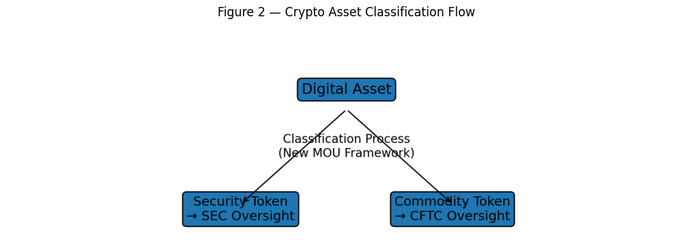
Perhaps the most critical issue for the crypto industry is determining whether a digital asset should be classified as a security or a commodity.
The MOU is expected to introduce procedures for rapid classification decisions, which could greatly accelerate innovation while ensuring regulatory compliance.
For example:
- Tokens representing investment contracts may fall under SEC supervision.
- Tokens functioning primarily as trading commodities may fall under CFTC oversight.
A clear framework could eliminate years of legal uncertainty.
5. Institutional Capital and Market Confidence

Another major motivation behind the cooperation effort is the growing interest from institutional investors.
Large financial institutions have increasingly explored the crypto market in recent years, but many remain cautious due to regulatory ambiguity.
Institutional asset managers often require:
- clear compliance rules
- stable regulatory oversight
- transparent market surveillance
Without these elements, large pools of capital remain on the sidelines.
A unified regulatory approach could therefore unlock significant capital inflows into digital assets.
For example, the rapid growth of Bitcoin exchange-traded funds (ETFs) in recent years demonstrated how regulatory clarity can dramatically expand investor participation.
If regulators provide a consistent framework across the crypto ecosystem, similar growth could occur in other areas such as:
- tokenized securities
- decentralized finance platforms
- blockchain-based payment networks
6. Global Implications for Crypto Regulation
The impact of this initiative could extend far beyond the United States.
Many jurisdictions around the world closely observe U.S. regulatory developments when shaping their own policies.
Regions such as:
- the European Union
- Singapore
- the United Arab Emirates
- Hong Kong
have already implemented structured crypto frameworks.
If the SEC and CFTC succeed in establishing a cooperative oversight model, it could become a template for international regulatory coordination.
Such alignment would be particularly important as blockchain technology increasingly supports cross-border financial infrastructure.
7. Opportunities for Builders and Investors
For entrepreneurs and investors seeking new opportunities in the crypto ecosystem, regulatory clarity can dramatically reshape the landscape.
A more predictable regulatory framework could encourage growth in several sectors:
Tokenized Real-World Assets (RWA)
Blockchain platforms are increasingly used to tokenize assets such as:
- real estate
- government bonds
- commodities
Clear regulatory classifications would make it easier for financial institutions to issue and trade these tokenized assets.
Stablecoins and Payment Infrastructure
Stablecoins are becoming a core component of digital financial infrastructure.
Improved regulatory coordination could accelerate the adoption of regulated dollar-backed stablecoins, particularly for cross-border payments.
Institutional DeFi
Decentralized finance platforms are gradually evolving toward compliance-friendly models that integrate identity verification and regulatory oversight.
Institutional-grade DeFi protocols could emerge as a major growth sector if regulators provide clear guidance.
8. Remaining Challenges
Despite the promising outlook, several challenges remain.
First, defining the boundary between securities and commodities in the context of decentralized networks remains legally complex.
Second, regulators must ensure that increased oversight does not stifle innovation.
Third, the global nature of crypto markets means that international regulatory coordination will still be necessary.
Even if the SEC and CFTC align domestically, differences between jurisdictions could continue to create fragmentation.
Conclusion: A Turning Point for the Crypto Industry
The decision by the SEC and CFTC to collaborate on a unified regulatory framework marks a potentially historic turning point for the digital asset industry.
For years, the crypto market has operated within an uncertain regulatory environment where overlapping jurisdiction and inconsistent enforcement created confusion for both companies and investors.
The proposed Memorandum of Understanding signals a shift toward structured cooperation, regulatory clarity, and transparent market oversight.
If successfully implemented, this initiative could produce several transformative outcomes:
- greater institutional participation in crypto markets
- improved market transparency and investor protection
- accelerated innovation in blockchain-based financial infrastructure
For entrepreneurs building blockchain applications and investors searching for the next wave of digital assets, regulatory clarity may prove to be one of the most powerful catalysts for growth in the coming decade.
The next few months—when the full details of the MOU are expected to be released—could therefore shape the future trajectory of the global cryptocurrency industry.
