
Main Points :
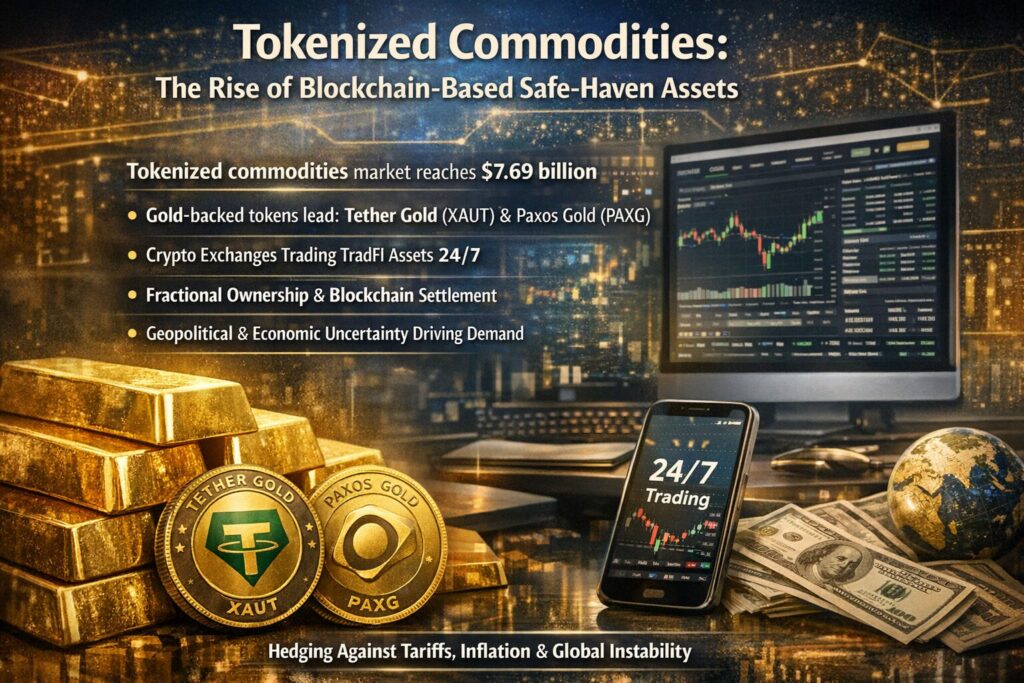
- The tokenized commodities market has grown to approximately $7.69 billion, reflecting rising investor demand for blockchain-based access to traditional safe-haven assets.
- Gold-backed tokens dominate the sector, led by Tether Gold (XAUT) and Paxos Gold (PAXG).
- Crypto exchanges are becoming new trading venues for traditional financial (TradFi) assets, particularly through derivatives markets.
- 24/7 trading, fractional ownership, and blockchain settlement are driving interest in tokenized real-world assets (RWAs).
- Macroeconomic uncertainty—tariffs, rising interest rates, and geopolitical instability—is accelerating demand for tokenized commodities.
Introduction: Why Tokenized Commodities Are Attracting Global Investors
In recent years, the convergence of blockchain technology and traditional financial assets has produced one of the fastest-growing segments of the digital asset industry: tokenized commodities. These blockchain-based representations of physical assets—such as gold, silver, oil, and other commodities—are increasingly attracting investors who want exposure to traditional safe-haven assets without leaving the crypto ecosystem.
According to data from RWA.xyz, the tokenized commodities market reached approximately $7.69 billion, representing about a 10% increase over the past month. Meanwhile, the number of holders has grown to roughly 189,390 users, reflecting rising interest from both institutional and retail investors.
Unlike traditional commodity markets, which operate on limited trading hours and often require complex brokerage infrastructure, tokenized commodities offer a radically different model. Investors can buy, sell, transfer, or collateralize commodities on-chain at any time, using decentralized infrastructure or centralized crypto exchanges.
This shift represents more than a technological innovation—it signals a structural change in how investors access safe-haven assets.
Gold-Backed Tokens Dominate the Tokenized Commodity Market
The Rise of Digital Gold
Among tokenized commodities, gold dominates the sector. Two tokens in particular—Tether Gold (XAUT) and Paxos Gold (PAXG)—account for the majority of the market.
- Tether Gold (XAUT): approximately $2.96 billion market capitalization
- Paxos Gold (PAXG): approximately $2.56 billion market capitalization
Both tokens represent physical gold stored in secure vaults, with each token typically backed by one troy ounce of gold. Holders effectively gain ownership of gold while benefiting from the portability and programmability of blockchain technology.
This structure enables several advantages:
- Instant global transfers
- Fractional ownership
- Integration with decentralized finance (DeFi)
- 24-hour liquidity
In traditional markets, purchasing physical gold often involves custody fees, delivery logistics, and settlement delays. Tokenized gold eliminates many of these frictions while maintaining exposure to the underlying asset.
As a result, many crypto investors now treat tokenized gold as a digital equivalent of bullion, combining the stability of precious metals with the flexibility of digital assets.
Real-World Assets (RWA) Are Becoming a Core Crypto Narrative
The growth of tokenized commodities is part of a broader trend known as Real-World Asset (RWA) tokenization.
RWA tokenization refers to the process of representing real-world financial or physical assets on blockchain networks. These assets include:
- commodities (gold, silver)
- government bonds
- real estate
- private credit
- equities
Over the past two years, RWAs have become one of the most important themes in the digital asset industry. Major blockchain ecosystems—including Ethereum, Avalanche, Polygon, and Stellar—are actively supporting tokenized asset platforms.
Several factors explain why RWAs are gaining momentum:
- Institutional adoption of blockchain technology
- Demand for yield-generating assets in crypto portfolios
- Increasing regulatory clarity around digital securities
- Improved custody and compliance infrastructure
Financial institutions such as BlackRock, Franklin Templeton, and JPMorgan have also begun experimenting with tokenized funds and securities, reinforcing the view that blockchain-based asset tokenization may become a foundational element of global finance.
Tokenized commodities represent one of the simplest and most intuitive forms of RWA tokenization, making them a gateway for investors entering the sector.
Crypto Exchanges Are Emerging as TradFi Trading Hubs
The Rise of TradFi Derivatives in Crypto Markets
In addition to on-chain tokenization, cryptocurrency exchanges are increasingly offering derivatives tied to traditional financial assets.
Platforms such as Binance now support perpetual futures contracts linked to commodities like gold and silver. These instruments allow traders to speculate on price movements without directly owning the underlying asset.
According to blockchain analytics platform CryptoQuant, derivatives trading activity tends to spike during periods of strong price momentum in commodities markets.
During a recent trading session:
- Gold derivatives trading volume reached approximately $3.77 billion
- Silver derivatives trading volume reached approximately $3.75 billion
These numbers highlight the growing role of crypto exchanges as alternative trading venues for traditional assets.
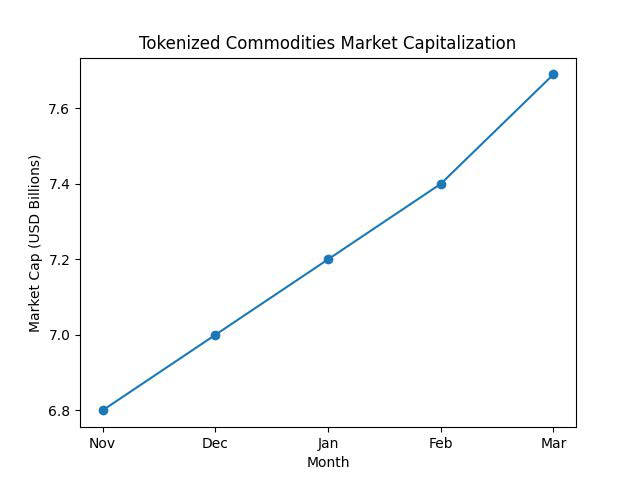
Description: Market capitalization growth of tokenized commodities over time.
TradFi Perpetual Futures Markets Are Expanding Rapidly
Another major development is the explosive growth of TradFi perpetual futures trading on crypto platforms.
Since launching its TradFi perpetual futures products in January, Binance has recorded:
- More than $130 billion in cumulative trading volume
- Approximately 90 million trades executed
These figures demonstrate that crypto infrastructure is increasingly being used for non-crypto assets.
The advantages are clear:
- Global access
- Lower barriers to entry
- Continuous trading
- Integration with crypto collateral
For traders in regions where commodity derivatives markets are difficult to access, crypto exchanges provide an alternative gateway to global macro trading.
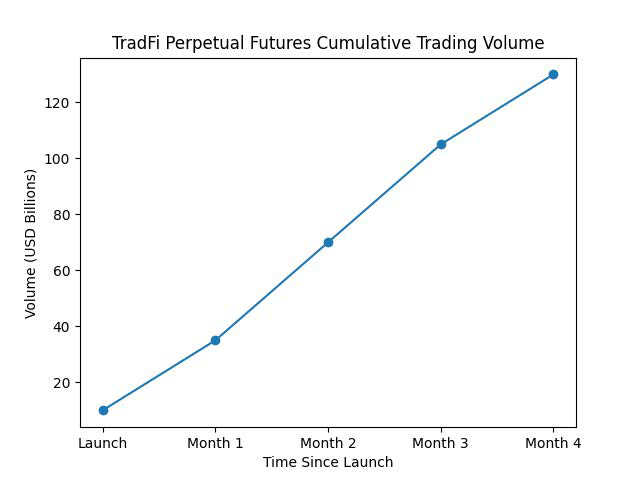
Description: Cumulative trading volume of TradFi perpetual futures on crypto exchanges.
Macro Uncertainty Is Driving Demand for Safe-Haven Assets
The recent surge in tokenized commodity activity is closely tied to global macroeconomic conditions.
According to analysts, several factors are pushing investors toward safe-haven assets:
1. Rising interest rates
Higher interest rates often increase market volatility and reduce liquidity in risk assets.
2. Trade tensions and tariffs
Global trade disputes create uncertainty in supply chains and international markets.
3. Geopolitical instability
Conflicts and political tensions historically drive demand for gold and other safe assets.
4. Currency volatility
When fiat currencies weaken, investors often turn to commodities as a store of value.
In such environments, tokenized commodities offer a hybrid solution—combining the stability of traditional safe-haven assets with the liquidity of digital markets.
The Strategic Role of Tokenized Commodities in Crypto Portfolios
For crypto-native investors, tokenized commodities provide an important portfolio diversification tool.
Unlike Bitcoin or altcoins, which often exhibit high volatility, commodities—particularly precious metals—tend to behave differently during market stress.
By holding tokenized commodities, investors can:
- hedge against crypto market downturns
- maintain exposure to inflation-resistant assets
- diversify risk across asset classes
Additionally, tokenized commodities can be integrated into DeFi ecosystems, allowing them to be used as collateral in lending platforms or liquidity pools.
This capability transforms traditionally passive assets like gold into productive financial instruments.
Challenges and Risks in Tokenized Commodity Markets
Despite rapid growth, the tokenized commodities sector still faces several challenges.
Custody and Transparency
Investors must trust that issuers actually hold the physical commodities backing their tokens.
Regulatory Uncertainty
Different jurisdictions treat tokenized assets differently, creating legal complexity.
Centralization Risks
Many commodity-backed tokens rely on centralized issuers and custodians.
Liquidity Fragmentation
Trading volume is still concentrated in a small number of tokens.
Addressing these issues will be critical for the long-term sustainability of the sector.
The Future of Tokenized Commodities
Looking ahead, many analysts believe tokenized commodities could expand far beyond precious metals.
Possible future developments include:
- tokenized energy markets (oil and natural gas)
- agricultural commodity tokens
- tokenized carbon credits
- integrated commodity-DeFi markets
Some forecasts suggest the RWA tokenization sector could reach trillions of dollars in value over the next decade if institutional adoption continues.
In such a scenario, blockchain networks could become the primary infrastructure layer for global asset trading.
Conclusion
The rapid expansion of the tokenized commodities market illustrates a broader transformation occurring across global finance.
Investors are increasingly seeking digital access to traditional assets, and blockchain technology provides the infrastructure to make that possible. With a market capitalization approaching $7.69 billion, tokenized commodities are emerging as a crucial bridge between crypto markets and traditional finance.
At the same time, cryptocurrency exchanges are evolving into multi-asset trading platforms, supporting derivatives tied to commodities and other traditional assets. Combined with macroeconomic uncertainty and rising demand for safe-haven investments, these developments are accelerating the adoption of blockchain-based commodity markets.
For investors searching for new crypto opportunities, diversified revenue streams, and practical blockchain applications, tokenized commodities represent one of the most promising sectors in the evolving digital asset landscape.
