
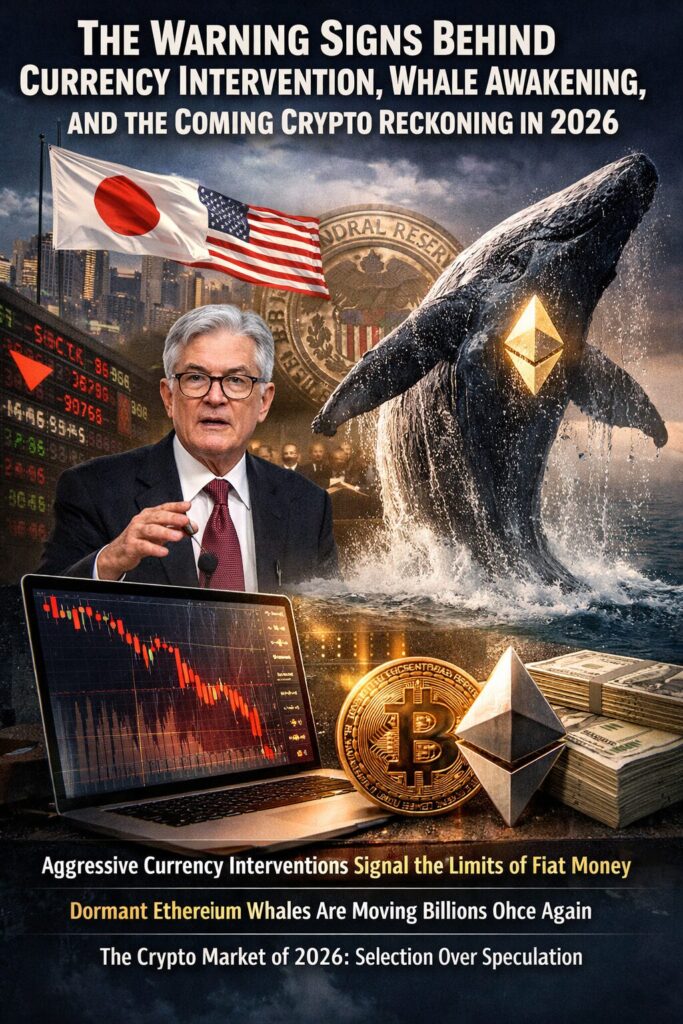
Main Takeaways :
- Aggressive currency intervention by Japan and the United States signals the structural limits of fiat money.
- Liquidity injections meant to “stabilize” markets often accelerate capital flight into scarce digital assets.
- The Federal Open Market Committee (FOMC) has become a psychological spectacle rather than a true market driver.
- Post-event market corrections are structural, algorithm-driven, and deliberately ruthless.
- Ethereum whales dormant for nearly a decade have begun moving billions of dollars, indicating a possible regime shift.
- Whale behavior remains one of the most reliable leading indicators of large-scale market transitions.
- The crypto market of 2026 is entering a phase of maturity defined by selection, not speculation.
1. Fiat Currency at Its Limits: Why Intervention Guarantees a Violent Repricing of Scarce Assets
When the monetary authorities of Japan and the United States step directly into foreign exchange markets, it is not a sign of strength—it is an admission of exhaustion.
Currency intervention is the final tool available when a fiat system can no longer stabilize itself organically. By forcibly distorting price discovery, central banks temporarily suppress volatility while quietly accumulating systemic risk. History shows that such actions do not eliminate instability; they merely delay and magnify it.
Arthur Hayes has repeatedly argued that aggressive intervention inevitably leads to excessive liquidity. Once liquidity exceeds productive economic absorption, capital searches for scarcity. This is not ideology—it is arithmetic.
As fiat supply expands, purchasing power dilutes. Investors are no longer debating whether inflation exists, but how to escape it. Bitcoin, Ethereum, and other digitally scarce assets increasingly function as exit valves from monetary debasement rather than speculative instruments.
In this context, intervention acts as a catalyst rather than a deterrent. Every attempt to “defend” a currency accelerates migration toward assets that cannot be printed, censored, or politically manipulated.
Japan’s struggle to stabilize the yen and the Federal Reserve’s contradictory signaling no longer inspire confidence. Instead, they reinforce a growing realization: nation-states are losing their monopoly over trust.
At that point, capital does not wait for permission. It moves.
This transition is not gradual. Once collective belief shifts, flows become nonlinear. Investors who fixate on policy announcements miss the deeper reality—the fiat system itself is signaling its own fragility.
2026 will not reward those who react emotionally to interventions. It will reward those who recognize that monetary dilution is structural, irreversible, and accelerating.
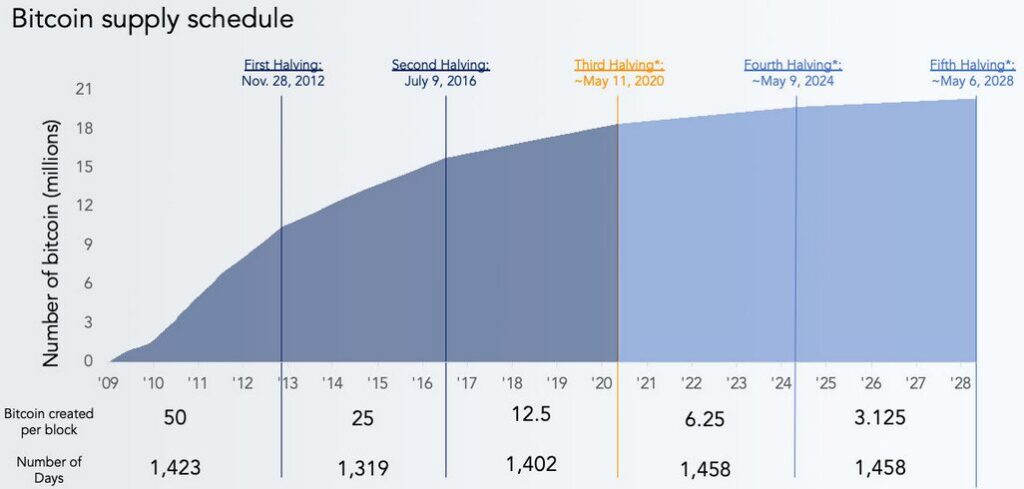
[Global Fiat Money Supply vs. Bitcoin Supply (Illustrative Concept Chart)]
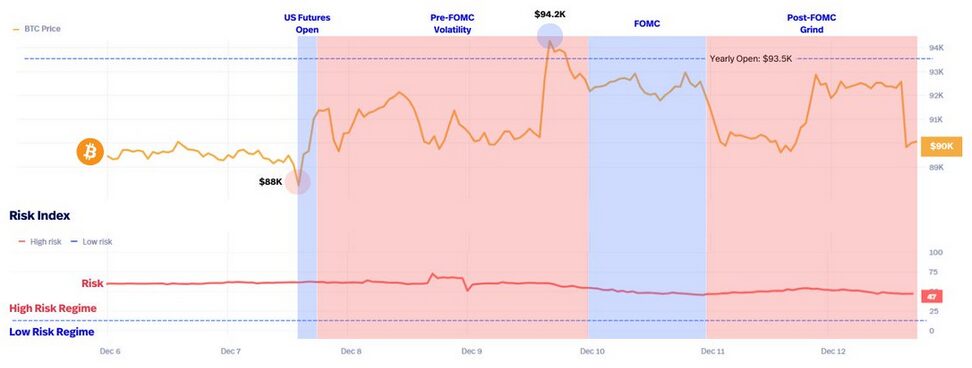
2. The FOMC Illusion: How Markets Use Events to Execute Cold, Mechanical Liquidation
Retail investors obsess over FOMC meetings as if they were sacred oracles. Rate decisions, dot plots, and press conferences are treated as market-defining moments.
In reality, the FOMC has become theater.
Markets today are dominated by leverage, algorithms, and structured positioning. Events like FOMC meetings serve primarily as excuses—timing mechanisms that allow large players to flush out excessive exposure.
Price action immediately after an FOMC announcement rarely reflects genuine macro reassessment. Instead, it reflects the systematic liquidation of crowded trades. The direction that feels “obvious” is usually the direction that will cause maximum pain.
This is not accidental. Liquidity hunts are engineered.
Post-event volatility exists to destabilize weak hands. Once leverage is cleared and emotions exhausted, the real trend quietly resumes. Those who trade headlines are consumed; those who study positioning survive.
The market’s cruelty is not personal—it is structural. Algorithms are indifferent to narratives. They respond only to imbalance.
Understanding this mechanism transforms trading from gambling into probability management. It requires emotional detachment and acceptance that markets exist to exploit predictable human behavior.
In 2026, complexity has increased, but psychology remains unchanged. Fear and greed are still the primary fuel—and still exploitable.
Professionals do not ask, “What will the Fed say?”
They ask, “Where is the crowd trapped?”
[Leveraged Position Liquidation Before and After FOMC Events]
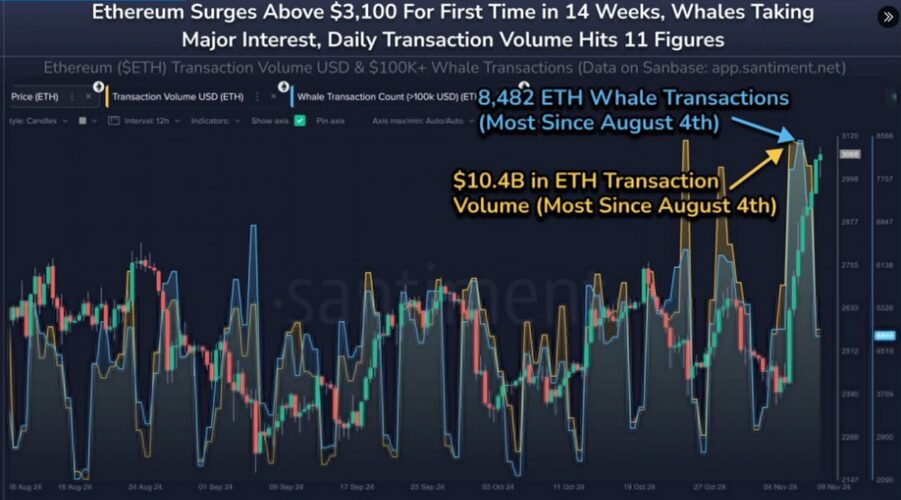
3. Ethereum Whales Awaken: What $4 Billion in Transfers After 9 Years Really Means
Perhaps the most unsettling signal in early 2026 is not macro policy—but silence breaking.
Ethereum wallets dormant for nearly nine years have suddenly moved approximately $4 billion, with weekly transfers exceeding $6 billion. These are not ordinary holders. These are early believers—participants who endured multiple cycles without selling.
When such entities move, markets should listen.
Whales are not emotional. Their actions reflect long-term strategic reassessment. This movement could indicate several possibilities: portfolio reallocation, preparation for new infrastructure, or anticipation of elevated systemic risk.
What it almost certainly does not indicate is random profit-taking.
Large-scale transfers of this magnitude disrupt supply-demand equilibrium instantly. Liquidity shocks cascade outward, impacting derivatives, funding rates, and retail sentiment.
Historically, whale activity precedes volatility—not necessarily tops, but transitions. Regimes change when old capital hands over influence to new structures.
The romantic era of crypto idealism is giving way to financial realism. As markets mature, they become less forgiving. Survivorship replaces enthusiasm.
For investors, ignoring whale behavior is no longer an option. It is equivalent to trading blind.
2026 will be shaped not by narratives, but by flows.
[Long-Dormant Ethereum Wallets Reactivated Over Time]
Final Conclusion: Selection, Not Speculation
The signals are converging.
Fiat currencies are revealing their limits. Central banks are reacting, not leading. Events like FOMC meetings have become tools for extraction rather than guidance. Meanwhile, crypto whales—once patient and silent—are repositioning.
This is not the end of crypto. It is the end of innocence.
The next phase will reward discipline, structural understanding, and respect for liquidity dynamics. Speculation alone will not survive.
Those seeking new digital assets, new revenue streams, or real-world blockchain applications must adapt to a harsher environment—one defined by selection.
In every cycle, capital migrates toward credibility.
In 2026, credibility is mathematical, scarce, and increasingly decentralized.
The opportunity remains enormous—but only for those who understand what is actually happening beneath the surface.
