

Main Points :
- Institutional capital has structurally transformed Bitcoin’s volatility profile.
- The “concrete floor” created by ETF inflows has reduced systemic downside risk.
- The $150,000 target reflects supply shock mathematics, not speculative euphoria.
- Fiat currency debasement is accelerating capital migration into scarce digital assets.
- Retail investors face a strategic shift: survival through alignment, not speculation.
1. The Concrete Floor Built by Institutions and the End of the Volatility Myth
The shallow corrections we are witnessing in 2026 represent a structural shift rather than a temporary anomaly. In previous market cycles, Bitcoin frequently experienced drawdowns of 30% to 50% within days. Volatility was not merely characteristic of the asset—it defined it.
Today, however, price retracements are increasingly limited in magnitude and duration. This change reflects a dramatic maturation of market structure, driven primarily by institutional participation through regulated spot ETFs.
Since the approval of U.S. spot Bitcoin ETFs in 2024, capital inflows have exceeded tens of billions of dollars annually. These inflows operate through a legally structured pipeline that continuously absorbs available supply. Every minor dip is algorithmically purchased by institutional desks deploying quantitative accumulation strategies.
This phenomenon has effectively constructed a “concrete floor” under the market. Retail panic selling no longer generates cascading liquidations at historical scale. Instead, corrections resemble controlled volatility compression phases.
Bitcoin’s market microstructure has changed. Liquidity depth has expanded. Custodial transparency has improved. Market participants now include pension funds, sovereign wealth funds, and insurance allocators—not just speculative traders.
The myth that Bitcoin requires violent collapses to reset leverage is fading. The shallow correction itself becomes the consolidation phase that precedes exponential expansion.
The structural implications are profound:
- Supply on exchanges continues to decline.
- Long-term holder accumulation remains steady.
- ETF custody wallets remove coins from liquid circulation.
In prior cycles, fear was the dominant force. In 2026, capital gravity is.
When trillions of dollars search for scarce, non-sovereign assets, the force of accumulation overwhelms short-term speculative flows. Waiting for a 50% crash may now represent the greatest investment risk of all.
The battlefield of speculation has evolved into a capital sanctuary.
[Sovereign Mining Expansion]
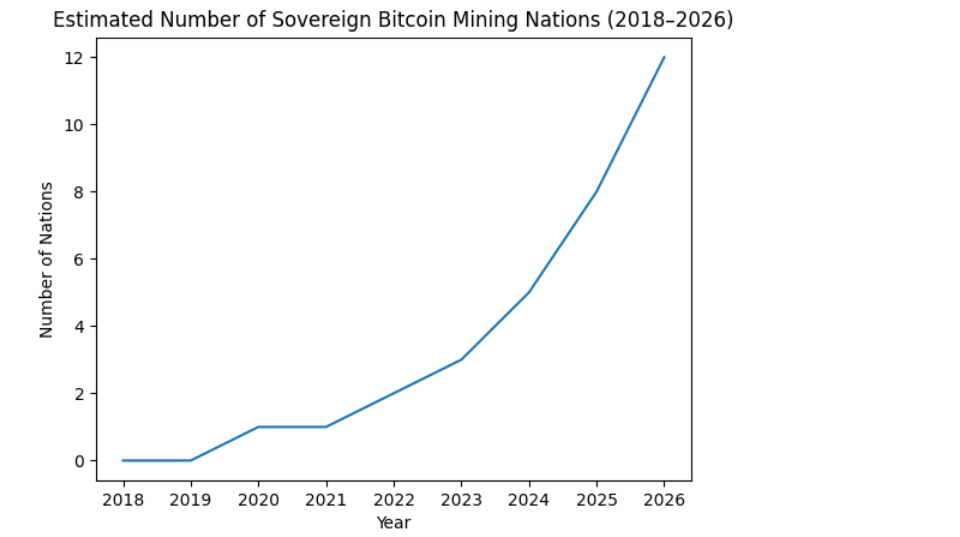
This graph illustrates the increasing number of sovereign entities exploring or deploying state-aligned Bitcoin mining strategies from 2018 to 2026. Energy-rich nations are converting stranded energy into Bitcoin reserves, further tightening supply.
2. The $150,000 Target: Mathematics of Scarcity and Fiat Debasement
The projection of $150,000 per Bitcoin within the year may appear aggressive, but it reflects structural capital migration rather than speculative optimism.
Consider the macroeconomic context:
- U.S. national debt has surpassed $35 trillion.
- Global sovereign debt exceeds $100 trillion.
- Persistent inflation erodes fiat purchasing power.
Bitcoin’s fixed supply of 21 million units represents a mathematically constrained alternative to inflationary monetary systems. With roughly 19.7 million coins mined and an estimated 3–4 million permanently lost, effective circulating supply is materially lower.
Simultaneously, institutional demand continues expanding. Even a modest allocation shift—1% of global pension assets—would represent hundreds of billions of dollars entering a structurally scarce asset.
The result is supply shock mathematics.
Price is not determined by traditional valuation multiples. It is determined by marginal supply versus marginal demand. When new supply is capped at approximately 450 BTC per day post-halving, and institutional inflows absorb multiples of that daily issuance, upward repricing becomes inevitable.
The $150,000 level is not symbolic—it is transitional.
Capital flows obey physical-like principles:
Capital moves toward:
- Security
- Growth
- Scarcity
Bitcoin increasingly satisfies all three criteria.
The erosion of fiat credibility further accelerates migration. Central banks continue balance sheet expansions under fiscal pressure. Real yields fluctuate. Currency trust declines incrementally, not dramatically—but persistently.
The countdown is not psychological—it is structural.
[Energy → Mining → BTC Reserves → USD Liquidity Model]
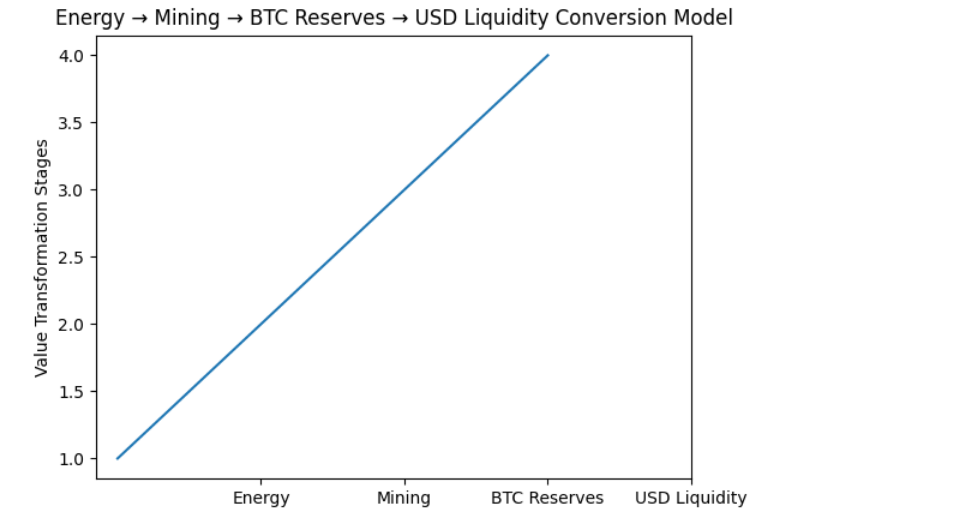
This diagram illustrates the capital transformation chain:
Energy is converted into Bitcoin through mining → Bitcoin becomes sovereign reserve collateral → Bitcoin reserves unlock USD liquidity through collateralized borrowing.
This model is increasingly adopted by energy-producing regions seeking monetary leverage without sovereign currency dilution.
3. The Absence of Despair: The Signature of a True Bull Market
One of the defining characteristics of previous Bitcoin winters was despair. Media narratives declared the asset dead. Social platforms were saturated with pessimism.
In 2026, despair is notably absent.
Corrections are met with accumulation. Bearish narratives fail to gain traction. Market participants no longer perceive dips as existential threats but as structural opportunities.
This emotional shift signals a mature bull phase.
For retail investors, the strategy must evolve. The 2026 market is not dominated by informational asymmetry but by capital asymmetry. Competing against algorithmic institutional systems on short timeframes is structurally unfavorable.
Survival strategy becomes alignment strategy.
Rather than attempting to time shallow pullbacks engineered by liquidity desks, retail participants benefit from:
- Systematic accumulation.
- Long-term holding discipline.
- Avoidance of leverage-driven liquidation risk.
The opportunity cost of hesitation grows larger than volatility risk.
We are witnessing what may be the largest capital reallocation in modern financial history. If Bitcoin approaches $150,000, it will not represent euphoria—it will represent repricing under new structural demand conditions.
The path toward $150,000 has been paved by institutions. The signal is green.
The question is not whether volatility exists. The question is whether one participates in structural capital migration or remains positioned in depreciating monetary systems.
History rarely announces itself clearly in real time. But structural shifts leave measurable footprints: ETF inflows, declining exchange reserves, sovereign mining participation, and expanding collateral use cases.
The gravity of capital is intensifying.
Final Conclusion
The scenario toward $150,000 is not driven by hype—it is driven by structural capital physics.
Institutional inflows have compressed volatility.
Scarcity mathematics creates supply shock.
Fiat erosion accelerates migration.
Despair has disappeared from corrections.
Bitcoin is transitioning from speculative frontier to strategic reserve asset.
For investors seeking new crypto opportunities, the lesson extends beyond price. The emerging opportunity lies in infrastructure, energy-backed mining, collateralized lending models, custody technologies, and sovereign-aligned digital asset strategies.
The era of chaotic volatility is being replaced by capital gravity.
The ascent may not be explosive in appearance—but its structural inevitability may prove even more powerful.
