
Main Points :
- The U.S. government has formally reaffirmed that all seized Bitcoin will be added to a Strategic Bitcoin Reserve, not sold.
- This policy originates from a presidential executive order signed in March 2025, redefining Bitcoin as a long-term strategic asset.
- Seized BTC from criminal and civil forfeitures forms the initial core of the reserve, under a budget-neutral framework.
- The move positions Bitcoin alongside gold and foreign currency reserves in U.S. strategic thinking.
- Regulatory clarity is advancing, although legislative hurdles remain, especially around stablecoins and market structure.
- For investors and builders, this signals structural, long-term demand and legitimacy for Bitcoin and digital assets.
1. A Clear Message from Davos: Bitcoin Is Not for Sale
On January 20, 2026, at the World Economic Forum in Davos, Switzerland, U.S. Treasury Secretary Scott Bessent delivered a statement that removed lingering uncertainty around the U.S. government’s Bitcoin policy.
Responding to press questions, Bessent emphasized that all Bitcoin seized by the U.S. government will be retained and added to a strategic digital asset reserve, not liquidated on the open market.
“It is the policy of this administration not to sell seized Bitcoin, but to add it to our digital asset reserves,” he stated.
This declaration was more than a clarification—it was a confirmation of a structural shift in how the United States views Bitcoin: not merely as confiscated property or speculative asset, but as strategic national capital.
2. The Executive Order That Changed Everything
The foundation for this policy was laid in March 2025, when President Donald Trump signed an executive order establishing a Strategic Bitcoin Reserve.
The order mandates that:
- Bitcoin already owned by the U.S. government is to be classified as a strategic asset.
- The reserve must be expanded using budget-neutral strategies, avoiding taxpayer burden.
- Bitcoin obtained through criminal or civil asset forfeiture is the initial source.
- Assets allocated to the reserve cannot be sold.
This mirrors historical approaches to gold accumulation, where seized or surplus assets quietly became part of sovereign reserves.
3. From Seizure to Strategy: How Confiscated BTC Is Treated
Bessent further explained the operational logic:
Once legal processes conclude and damages are finalized, seized Bitcoin is transferred directly into the digital asset reserve. The first and most critical step—halting sales—has already been implemented.
This marks a sharp departure from previous practices, where seized BTC was often auctioned via intermediaries, sometimes exerting downward pressure on the market.
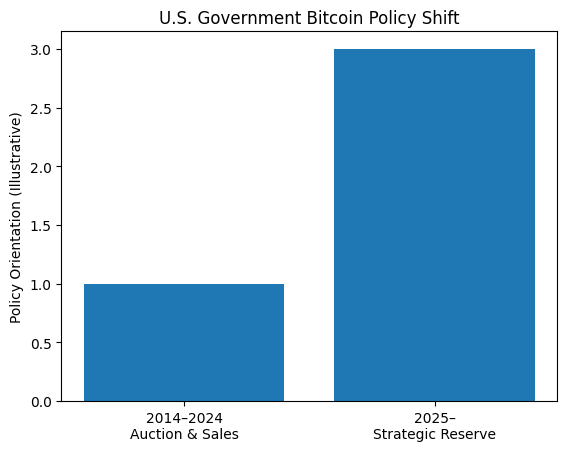
【“U.S. Government Bitcoin Policy: Before vs After 2025”】
Timeline comparing BTC auction sales (2014–2024) vs reserve accumulation (2025–).
4. The Samurai Wallet Case and Market Speculation
One sensitive topic Bessent declined to address directly involved Bitcoin seized from developers of Samurai Wallet, valued at approximately $5.3 million (about 57.55 BTC at ~$92,000/BTC).
Earlier reports suggested the U.S. Marshals Service may have transferred the BTC to Coinbase Prime, triggering speculation that the assets had been sold—potentially violating the executive order.
However, clarification soon followed.
White House senior crypto advisor Patrick Witt confirmed:
- The BTC has not been liquidated
- The BTC will not be liquidated
- The U.S. Department of Justice has verified this status
This incident underscores how sensitive market perception has become regarding sovereign Bitcoin movements.
5. Why This Matters: Bitcoin as a Strategic Reserve Asset
By institutionalizing Bitcoin holdings, the U.S. effectively acknowledges BTC as:
- A store of value
- A non-sovereign hedge asset
- A digital analogue to gold
This has far-reaching implications.
Unlike fiat reserves, Bitcoin is:
- Supply-capped (21 million BTC)
- Politically neutral
- Globally liquid
- Resistant to debasement
For the first time, a major sovereign power is explicitly integrating these properties into national strategy.
6. Regulatory Ambitions: Making the U.S. the Best Place for Digital Assets
Beyond Bitcoin reserves, Bessent also emphasized a broader goal: making the United States “the best regulatory environment for digital assets.”
This includes:
- Attracting blockchain innovation back onshore
- Preventing regulatory arbitrage
- Offering clarity without stifling innovation
However, challenges remain.
7. Legislative Headwinds: Market Structure and Stablecoins
Progress on a comprehensive crypto market structure bill has slowed. The U.S. Senate Banking Committee recently postponed hearings due to disagreements over:
- How to treat stablecoin yield or rewards
- Jurisdictional boundaries between regulators
- Industry pushback, including a withdrawal of support by Coinbase
Despite this, Bessent confirmed that active efforts continue in Washington, D.C. to advance legislation governing the broader digital asset ecosystem.
8. Implications for Investors and Builders
For readers seeking new crypto assets, revenue opportunities, and practical blockchain use, this shift is profound.
For Investors
- Structural reduction in BTC sell pressure
- Implicit sovereign validation
- Long-term demand signal
For Builders
- Increased regulatory certainty
- Stronger institutional participation
- Higher likelihood of compliant on-chain finance adoption
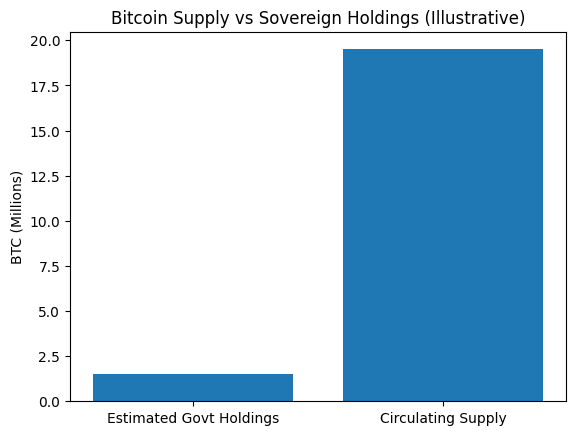
【“Potential Bitcoin Supply Removed from Circulation by Sovereign Reserves”】
Estimated BTC held by governments vs circulating supply
9. A Global Signal Beyond the United States
The U.S. decision will not occur in isolation.
Other nations—particularly those with large seized crypto holdings—may follow suit. This could accelerate:
- Bitcoin’s transition from speculative asset to monetary infrastructure
- The emergence of digital asset-backed sovereign strategies
- Competition over regulatory clarity and custody standards
10. Conclusion: A Quiet but Historic Turning Point
The reaffirmation by the U.S. Treasury that seized Bitcoin will be strategically held, not sold, marks a historic inflection point.
Bitcoin is no longer merely tolerated—it is strategically embraced.
For markets, this reduces uncertainty.
For governments, it sets a precedent.
For builders and investors, it opens a new era where digital scarcity meets sovereign strategy.
The implications will unfold over years—but the direction is now unmistakably clear.
