
Main Points :
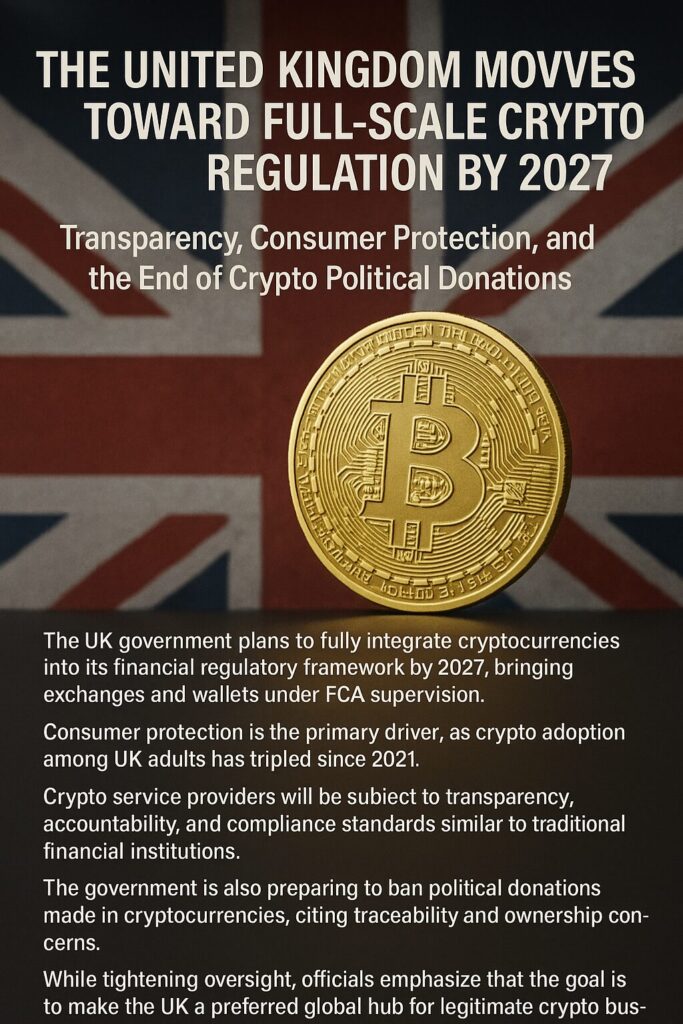
- The UK government plans to fully integrate cryptocurrencies into its financial regulatory framework by 2027, bringing exchanges and wallets under FCA supervision.
- Consumer protection is the primary driver, as crypto adoption among UK adults has tripled since 2021.
- Crypto service providers will be subject to transparency, accountability, and compliance standards similar to traditional financial institutions.
- The government is also preparing to ban political donations made in cryptocurrencies, citing traceability and ownership concerns.
- While tightening oversight, officials emphasize that the goal is to make the UK a preferred global hub for legitimate crypto businesses.
- The regulatory clarity could reshape investment strategies, DeFi structures, custody models, and compliance-driven blockchain use cases.
Introduction: Why the UK Is Acting Now
In December 2025, major UK media outlets reported that Chancellor of the Exchequer Rachel Reeves confirmed the government’s intention to bring cryptocurrencies and digital assets firmly “within the regulatory perimeter” by 2027. This announcement marks one of the clearest commitments yet by a major global financial center to treat crypto-assets not as a fringe innovation, but as a core component of the modern financial system.
Until now, cryptocurrencies in the UK have existed in a regulatory gray zone. While anti-money laundering (AML) registration exists, crypto-assets have not been regulated to the same extent as stocks, bonds, or traditional payment instruments. As a result, consumers have often lacked equivalent protections.
The new policy direction reflects a sharp rise in adoption, growing fraud risks, and political concerns about transparency—especially following the emergence of crypto-based political donations.
Title: Growth of Crypto Ownership Among UK Adults (2021–2025)
Description: Line graph showing increase from ~4% (2021) to ~12% (2025)

Crypto Adoption in the UK: Rapid Growth, Rising Risks
According to data from the UK Financial Conduct Authority (FCA), approximately 12% of UK adults now either hold or have previously held cryptocurrencies. This represents a threefold increase from 4% in 2021.
This surge has been driven by:
- Increased retail access through global exchanges
- Stablecoins used for payments and remittances
- Institutional narratives around Bitcoin and tokenized assets
- Social-media-driven investment trends
However, growth has come with significant downsides. The FCA and consumer advocacy groups have repeatedly warned that many users are exposed to:
- Fraudulent investment schemes
- High-risk, under-capitalized crypto firms
- Misleading yield and DeFi products
The absence of full regulatory oversight has made it difficult to enforce accountability when platforms fail or act dishonestly.
What the 2027 UK Crypto Regulations Will Cover
Under the Treasury’s current proposals, crypto-related businesses—including exchanges, brokers, custodians, and wallet providers—will be required to operate under the FCA’s supervisory framework.
This implies several major changes:
1. Licensing and Ongoing Supervision
Crypto service providers will need to:
- Obtain FCA authorization
- Meet governance and risk-management standards
- Demonstrate operational resilience and internal controls
2. Transparency and Disclosure
Firms will be required to:
- Clearly disclose risks to consumers
- Provide accurate information on custody, liquidity, and counterparty exposure
- Maintain audit-ready records
3. Enforcement and Sanctions
With crypto inside the regulatory perimeter, authorities will gain:
- Enhanced ability to detect suspicious activity
- Clear legal grounds to impose fines or revoke licenses
- Stronger tools for consumer redress
Government officials argue that these measures will increase trust, rather than stifle innovation.
“Regulate to Grow”: The UK’s Strategic Positioning
City Minister Lucy Rigby emphasized that the UK’s goal is not to suppress crypto activity, but to attract high-quality, compliant businesses.
Her message is clear:
“We want the UK to be the first choice for crypto firms looking to grow. Regulation provides the clarity and consistency businesses need for long-term planning.”
This reflects a broader global trend. Jurisdictions such as the EU (MiCA), Singapore, and Hong Kong are all racing to define rules that balance innovation with risk control. The UK does not want to be left behind.
For legitimate firms, especially those serving institutional clients, regulatory clarity can:
- Reduce legal uncertainty
- Enable partnerships with banks
- Support tokenization and regulated DeFi models
The Ban on Crypto Political Donations: A Separate but Related Issue
Alongside financial regulation, the UK government is drafting plans to prohibit political donations made in cryptocurrencies.
The rationale is straightforward:
- Crypto donations can obscure the true source of funds
- Ownership and control are harder to verify
- Foreign influence risks are more difficult to detect
The issue gained prominence after the Reform Party, led by Nigel Farage, became the first UK political party to accept crypto donations. The party established a dedicated crypto donation portal and claimed to apply enhanced checks.
Most notably, the party reportedly received a £9 million donation, equivalent to approximately $11.4 million, from crypto investor Christopher Harborne, making it the largest individual political donation in UK history.
Title: Largest UK Political Donations (USD Comparison)
Description: Bar chart comparing traditional vs crypto-linked donations

Why This Matters for Crypto Investors and Builders
For readers seeking new crypto assets, revenue streams, or practical blockchain applications, the UK’s move has several important implications:
1. Compliance-Driven Projects Gain Value
Projects designed with:
- Strong governance
- Transparent token economics
- Regulated custody and reporting
are likely to benefit as non-compliant competitors exit the market.
2. Shift Toward Infrastructure and B2B Use Cases
Speculative retail tokens may face headwinds, while:
- Tokenization platforms
- Regulated stablecoins
- Compliance tooling (KYC, Travel Rule, on-chain analytics)
could see increased demand.
3. DeFi Will Need Structural Innovation
Purely permissionless DeFi may struggle under stricter regimes, but hybrid models—combining smart contracts with regulated entities—could thrive.
Comparison with Global Trends
The UK’s approach aligns with broader international developments:
- EU (MiCA): Comprehensive licensing and consumer protection
- US: Fragmented but increasingly enforcement-heavy
- Asia: Regulatory sandboxes paired with strict licensing
In this context, the UK’s 2027 timeline provides businesses with a clear runway to adapt.
Conclusion: Regulation as a Catalyst, Not an Obstacle
The UK’s decision to fully regulate cryptocurrencies by 2027 represents a pivotal moment. While increased oversight will undoubtedly raise compliance costs, it also promises to eliminate bad actors, strengthen consumer trust, and unlock institutional participation.
For serious builders and investors, regulation should not be seen as the end of opportunity—but as the foundation for the next phase of sustainable growth in the crypto economy.
