
Main Points :
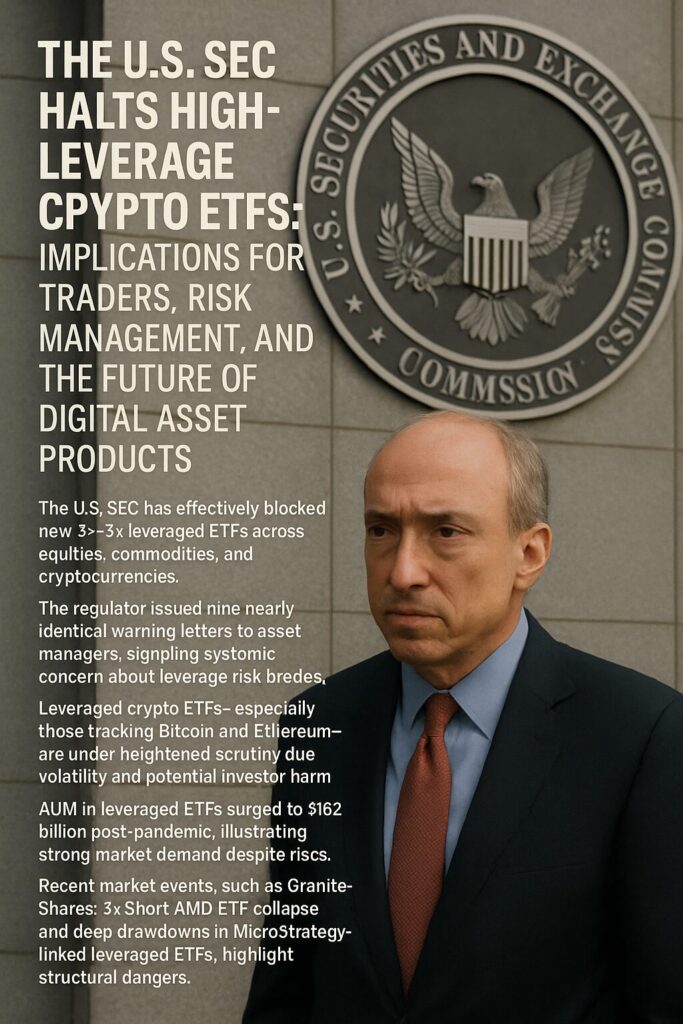
- The U.S. SEC has effectively blocked new 3×–5× leveraged ETFs across equities, commodities, and cryptocurrencies.
- The regulator issued nine nearly identical warning letters to asset managers, signaling systemic concern about leverage risk breaches.
- Leveraged crypto ETFs—especially those tracking Bitcoin and Ethereum—are under heightened scrutiny due to volatility and potential investor harm.
- AUM in leveraged ETFs surged to $162 billion post-pandemic, illustrating strong market demand despite risks.
- Recent market events, such as GraniteShares’ 3× Short AMD ETF collapse and deep drawdowns in MicroStrategy-linked leveraged ETFs, highlight structural dangers.
- The SEC’s move may accelerate a shift toward risk-controlled, collateralized, or on-chain structured products, opening new opportunities for crypto innovation.
Introduction
The U.S. Securities and Exchange Commission (SEC) has taken decisive action against one of the fastest-growing sectors of the exchange-traded product market: high-leverage ETFs. According to Bloomberg and Reuters, the SEC has effectively frozen the approval pipeline for all ETFs designed to deliver 3× or 5× the daily returns of equities, commodities, or cryptocurrencies.
This development represents one of the strongest regulatory interventions into leveraged products in years—and it has far-reaching implications for crypto markets, risk-tolerant traders, and the future landscape of digital asset investment products.
To help crypto-focused readers—especially those seeking new assets, yield opportunities, or practical blockchain applications—this article provides a structured analysis of the SEC’s actions, the market’s reactions, and what emerging trends suggest for 2025 and beyond.
Section 1 — What the SEC Has Blocked: Understanding the Halt on 3× and 5× ETFs
Bloomberg reported on December 3 that the SEC issued nine warning letters to major ETF issuers including Direxion, ProShares, and Tidal. These letters informed issuers that their applications for new high-leverage ETFs could no longer proceed unless they revised their strategies or voluntarily withdrew.
The core issue, according to the SEC, is that leveraged ETFs providing more than 200% exposure to an underlying index breach the risk tolerance implied by existing securities regulations. While the SEC does not explicitly ban leveraged ETFs, it is clear that the regulator believes 3× and 5× exposure poses unacceptable risk—especially when tied to single stocks or volatile digital assets like Bitcoin and Ethereum.
Under current rules:
- 2× leverage is the practical upper limit for single-stock ETFs.
- The U.S. currently does not allow 3× or 5× single-stock ETFs, unlike some international markets.
- Some of the applications under review included 5× leveraged BTC and ETH daily-return ETFs, which represented the first attempts to bring ultra-high-leverage crypto ETFs to the U.S. market.
This policy shift places the SEC firmly in opposition to the rapid expansion of complex exchange-traded derivatives for retail traders.
Section 2 — Why Leveraged Crypto ETFs Triggered Heightened Scrutiny
Leveraged ETFs amplify gains—but more importantly, they amplify volatility drag, daily compounding effects, and tail-risk exposure. Cryptocurrency markets, already known for double-digit monthly swings, magnify those dangers.
Examples of the types of products affected include:
- 3× long or short Bitcoin ETFs
- 3× or 5× Ethereum daily-performance ETFs
- Leveraged single-stock ETFs tied to companies closely correlated with crypto, such as Nvidia, Tesla, and especially MicroStrategy (MSTR), whose Bitcoin exposure has made it a proxy for BTC performance.
The SEC is particularly concerned about:
- Rapid portfolio decay in volatile conditions
- Retail investors misunderstanding compounding effects
- Risk models failing to anticipate extreme outcomes
- Opaque derivatives structures used to replicate leverage
The regulator’s unusually fast action—publishing the letters publicly within days—signals that it wished to halt the proliferation of such products before they reached mass distribution.
Section 3 — Market Growth and Investor Appetite: Why Demand Surged Post-Pandemic
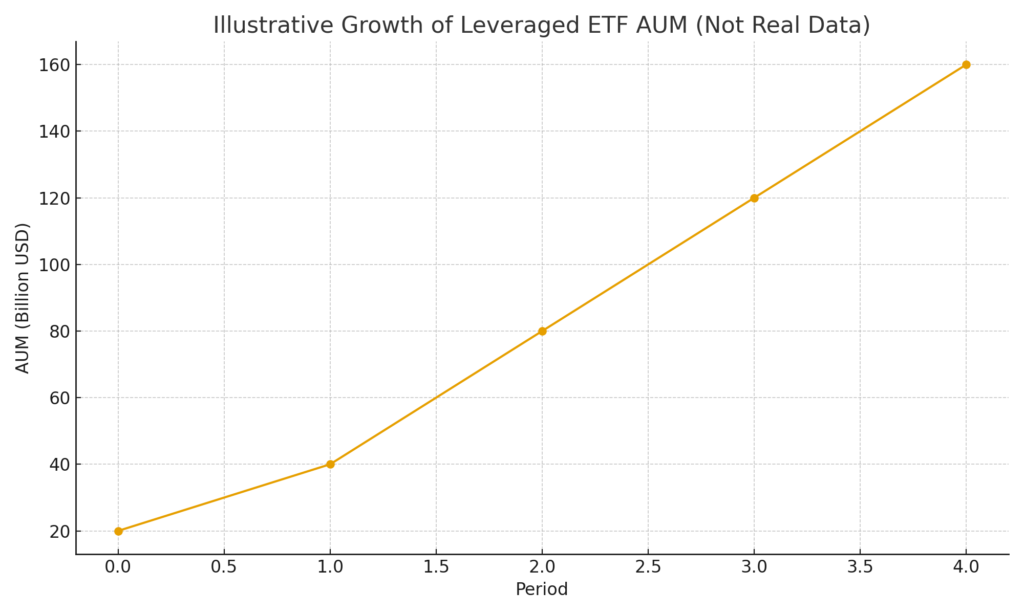
Despite risks, demand for leveraged ETFs has skyrocketed. Bloomberg Intelligence estimates that assets under management (AUM) in leveraged ETFs reached $162 billion, boosted by:
- Zero-commission trading
- Retail investor participation during the pandemic
- Social-media-driven momentum trading
- Increased familiarity with ETFs as an alternative to direct derivatives trading
Crypto-leveraged ETFs, in particular, were viewed as:
- Easier to trade than futures
- More accessible than options
- More capital-efficient for directional bets
- Fully compliant with brokerage and tax reporting frameworks
Yet, this very accessibility is what regulators fear makes these products dangerous.
Section 4 — Recent Failures Highlight Structural Risks
The SEC’s caution is not theoretical. Several high-profile leveraged products have collapsed in 2024–2025, reinforcing public concerns.
Case Study 1 — GraniteShares 3× Short AMD ETF
In Europe, the fund was forced to shut down after AMD stock surged unexpectedly, wiping out the ETF’s value.
This demonstrated how single-stock leveraged ETFs can reach zero—even when the underlying stock performs well.
Case Study 2 — MicroStrategy-Linked Leveraged ETFs Collapse
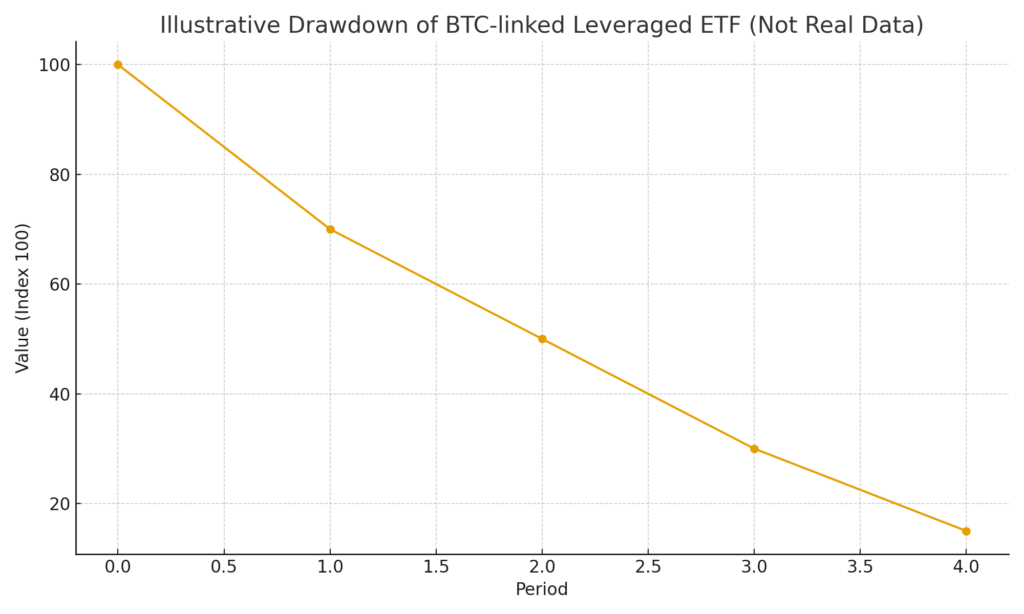
Reuters notes that two leveraged ETFs offering 2× daily exposure to MicroStrategy (MSTR) have lost approximately 85% of their value in 2025 alone.
Meanwhile, MSTR stock itself fell only 35%, revealing how daily compounding and high volatility dramatically accelerate losses.
These examples help explain why the SEC is unwilling to permit 3× or 5× products—especially those tied to crypto or crypto-correlated equities.
Section 5 — Impact on the Crypto Market and Traders
The SEC’s move affects multiple groups:
1. Retail Traders
High-leverage crypto ETFs provided an easy gateway to amplified returns. Their removal may:
- Reduce speculative manic cycles
- Push traders toward offshore platforms
- Increase usage of futures on CME or crypto exchanges
- Increase demand for options as an alternative leverage tool
2. ETF Issuers
Firms such as ProShares and Direxion must now:
- Redesign strategies
- Cap leverage at 2×
- Shift toward volatility-controlled or hedged products
- Explore multi-asset or basket-based structures to disperse risk
3. Crypto-Focused Investors
A broad trend is emerging:
- Regulators prefer spot ETFs as safer long-term instruments
- Derivative-based leveraged crypto ETFs face more constraints
- Hybrid or structured-yield products may fill the vacuum
4. Global Market Competitors
Europe, Canada, and Singapore may now become:
- Preferred jurisdictions for high-leverage crypto ETFs
- Testing grounds for new structured crypto notes
- Centers of innovation for regulated digital-asset leverage
Section 6 — Broader Regulatory Trends: Why the SEC Acted Now
Three major regulatory narratives intersect here:
- Investor protection post-meme-stock era
The SEC is still responding to the volatile period defined by GameStop, AMC, and social-media-driven leverage addiction. - Crypto regulatory tightening
As the crypto ETF landscape matures, regulators want institutional-grade products—not high-risk retail leverage. - Systemic risk control
Leveraged ETFs rely on derivatives such as swaps and options. During market stress, their liquidity needs can destabilize underlying markets.
The SEC likely sees preventing 5× Bitcoin ETFs as a way to avoid an LTCM-style systemic event tied to digital assets.
Section 7 — Opportunities Emerging from the Regulatory Shift
While some view the SEC’s halt as restrictive, it actually opens several new opportunities:
Opportunity 1 — On-Chain Structured Products
DeFi protocols can offer controlled leverage with:
- Real-time transparency
- On-chain collateralization
- Automatic liquidation mechanisms
Opportunity 2 — Risk-Adjusted Crypto ETFs
Traditional issuers could develop:
- Volatility-targeted BTC or ETH funds
- Buffered or defined-outcome crypto ETFs
- Options-based income products
Opportunity 3 — Institutional Bitcoin Exposure Growth
If leverage products are capped, institutions may shift capital toward:
- Spot Bitcoin ETFs
- Covered-call Bitcoin ETFs
- Bitcoin-backed lending markets
Opportunity 4 — Blockchain-based ETF Architecture
Some innovators are exploring:
- Tokenized ETF shares
- Real-time NAV oracles
- Smart-contract-regulated risk caps
This regulatory moment may accelerate the convergence of traditional ETFs and blockchain infrastructure.
Conclusion
The SEC’s decision to halt approvals for 3× and 5× leveraged ETFs marks a turning point in both traditional and crypto-related financial markets. While it restricts some high-risk products, it also creates a new landscape in which safer, more transparent, and potentially blockchain-enhanced investment vehicles may flourish.
For crypto investors seeking new assets or revenue opportunities, understanding the regulatory environment is not just important—it is essential. Whether through DeFi structured products, volatility-managed ETFs, or tokenized financial instruments, the next phase of innovation will occur at the intersection of risk management and blockchain technology.
