
Main Points :
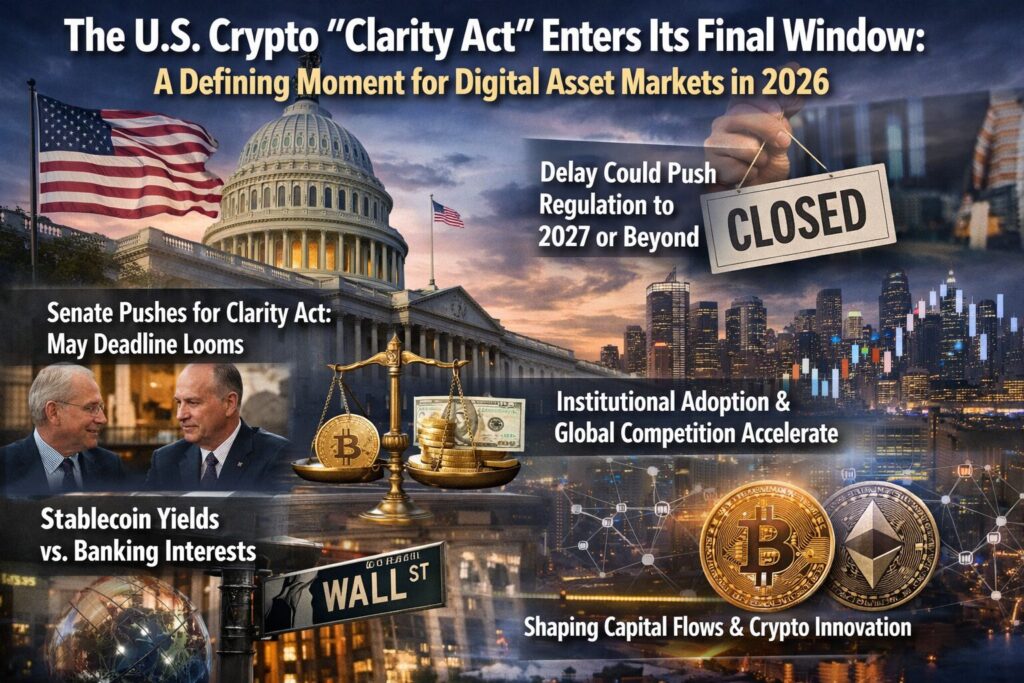
- The U.S. Senate is preparing to advance the Clarity Act in April, with May as a critical deadline
- Failure to pass by May could delay comprehensive crypto regulation until 2027 or beyond
- The biggest conflict remains stablecoin yield mechanisms vs. traditional banking interests
- Institutional adoption and global regulatory competition are accelerating
- The outcome will shape capital flows, innovation hubs, and new crypto revenue models
1. April to May: The Narrow Legislative Window That Could Define Crypto Regulation
The United States is approaching a pivotal moment in cryptocurrency regulation. The so-called Clarity Act, a comprehensive digital asset market structure bill, is now scheduled for markup discussions in the Senate Banking Committee in late April 2026. This development signals that, after years of fragmented regulatory debates, the U.S. may finally establish a unified legal framework for crypto markets.
However, the timeline is extremely tight. The Senate is only expected to convene for two working weeks in late April—specifically the weeks of April 13 and April 20. If the bill successfully clears the Banking Committee, it must then be reconciled with the version already passed by the Senate Agriculture Committee earlier this year. Only after this reconciliation can it proceed to a full Senate vote.
The real constraint lies in the legislative calendar. Lawmakers are targeting a vote before the Memorial Day recess on May 21. This effectively gives Congress just three weeks in May to finalize and pass the bill. Senator Bernie Moreno has warned that failure to meet this timeline would likely stall crypto legislation indefinitely.
This compressed schedule is not merely procedural—it reflects broader political realities. Competing legislative priorities, including election-related bills and budget negotiations, are expected to dominate Congress after May. As a result, the Clarity Act’s progress in the next 6–8 weeks may determine whether the U.S. finally establishes regulatory certainty or continues operating in ambiguity.
2. The Core Conflict: Stablecoin Yield vs. Banking Stability
At the heart of the legislative deadlock is a fundamental economic conflict: whether stablecoins should be allowed to offer yield.
Traditional banks argue that yield-bearing stablecoins could trigger deposit outflows. If users can earn competitive returns simply by holding digital dollars, banks fear a migration of liquidity away from traditional savings accounts. This could weaken the banking system’s ability to lend and manage liquidity.
On the other hand, the crypto industry sees yield as essential for innovation. Many decentralized finance (DeFi) models rely on incentives to drive participation, liquidity provision, and network growth. Without yield mechanisms, stablecoins risk becoming passive instruments rather than active components of a programmable financial system.
A compromise is now emerging. Instead of allowing interest on balances, policymakers are considering permitting transaction-based rewards. This approach would align incentives with usage rather than passive holding, potentially reducing systemic risk while preserving innovation.
Recent statements from industry leaders suggest negotiations are nearing completion. If a compromise is finalized before the April markup, it could unlock bipartisan support and accelerate passage.
3. Political Friction and Structural Barriers
Despite progress, several political obstacles remain.
Democratic lawmakers have raised concerns about ethics, market oversight, and conflicts of interest. One particularly sensitive issue involves potential connections between political figures and private stablecoin issuers. Critics argue that any regulatory framework must include strict safeguards to prevent abuse of power.
Additionally, there is disagreement over the structure of oversight between agencies such as the SEC and CFTC. The Clarity Act aims to define jurisdiction more clearly, but institutional turf battles continue to complicate negotiations.
Another factor is timing. With the 2026 midterm elections approaching, legislative priorities are increasingly influenced by political strategy. If the bill is not passed this year, a shift in congressional power could delay progress until 2027 or later.
4. Global Context: The U.S. Is Falling Behind
While the U.S. debates, other regions are moving ahead aggressively.
The European Union has already implemented the Markets in Crypto-Assets (MiCA) framework, providing regulatory clarity for exchanges, issuers, and service providers. Similarly, jurisdictions such as Singapore, Hong Kong, and the UAE are positioning themselves as crypto-friendly hubs.
This global competition has real consequences. Capital, talent, and innovation tend to flow toward regulatory certainty. Without a clear framework, U.S.-based companies face disadvantages in scaling operations and attracting institutional investment.
Global Crypto Regulatory Readiness Index (2026)
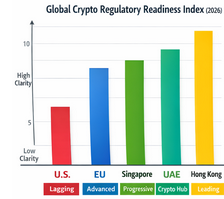
Description: Bar chart comparing U.S., EU, Singapore, UAE, Hong Kong
Purpose: Show how delayed regulation impacts competitiveness
5. Institutional Capital Is Waiting for Clarity
Institutional adoption of crypto continues to grow, but regulatory uncertainty remains a major barrier.
Major financial institutions—including asset managers, payment networks, and banks—are increasingly exploring blockchain-based products. However, without clear rules, many remain cautious about large-scale deployment.
The Clarity Act could unlock significant capital inflows by:
- Defining asset classifications
- Establishing custody and compliance standards
- Providing legal certainty for token issuance
This is particularly important for stablecoins, which are becoming a critical layer of global payments infrastructure. In emerging markets, stablecoins are already being used for remittances, treasury management, and cross-border settlements.
Institutional Crypto Allocation Growth (2023–2026)
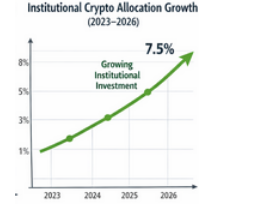
Description: Line chart showing increasing allocation percentages
Purpose: Highlight demand waiting for regulation
6. Implications for New Revenue Models and Crypto Assets
For investors and builders, the Clarity Act represents more than regulatory clarity—it could reshape the entire crypto economy.
If passed, we can expect several emerging trends:
6.1 Yield Redesign
Projects will shift from passive yield to activity-based incentives, creating new tokenomics models.
6.2 Compliance-Native Protocols
Protocols designed with regulatory compliance from inception will gain a competitive advantage.
6.3 Institutional DeFi
Hybrid models combining decentralized infrastructure with regulated access points will expand.
6.4 Tokenized Real-World Assets (RWA)
Clear rules will accelerate tokenization of assets such as bonds, real estate, and commodities.
Future Crypto Market Structure Under Clarity Act
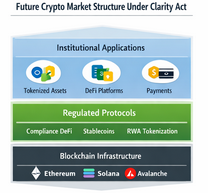
Description: Layered diagram showing:
- Base Layer: Blockchain infrastructure
- Middle Layer: Regulated protocols
- Top Layer: Institutional applications
7. Strategic Outlook: What Happens If It Fails?
If the Clarity Act fails to pass by May, the consequences could be significant:
- Regulatory uncertainty persists
- U.S. loses further ground to global competitors
- Institutional adoption slows
- Innovation shifts offshore
Some analysts suggest that August 2026 may represent the absolute deadline before legislative attention shifts entirely to budget and defense bills. Beyond that, the next realistic opportunity may not come until 2027.
Conclusion: A Defining Crossroads for Crypto
The coming months represent a decisive moment for the cryptocurrency industry. The Clarity Act is not just another piece of legislation—it is a foundational framework that could determine how digital assets integrate into the global financial system.
For investors, the outcome will influence where capital flows and which assets gain legitimacy. For builders, it will define the rules of innovation. And for governments, it will signal whether they intend to lead or follow in the next phase of financial evolution.
The window is narrow, the stakes are high, and the implications are global. Whether the U.S. seizes this opportunity or misses it may shape the trajectory of crypto for the next decade.
