
Main Points :
- The U.S. Senate Banking Committee has made progress on the “Clarity Act,” a bill defining digital asset market structure, after high-level talks with major bank CEOs.
- The bill aims to formally divide jurisdiction between the SEC and CFTC, clarifying which crypto assets are securities vs. commodities.
- Key tensions remain: stablecoin yield, DeFi accountability, AML/CTF monitoring, and classification of developers/validators as intermediaries.
- Banks strongly oppose indirect yield on stablecoins offered by exchanges, while Democrats push for DeFi oversight frameworks.
- The U.S. is positioning itself as the global center of crypto activity—but regulatory clarity will determine whether capital flows into new digital assets or exits to friendlier jurisdictions.
- Market implications: greater institutional adoption, new compliant DeFi models, investor protection, and new revenue opportunities for compliant exchanges.
Introduction
The United States—long criticized for regulatory uncertainty around digital assets—is finally moving toward a structured legal framework that could redefine the crypto ecosystem. On December 11, U.S. Senate Banking Committee Chairman Tim Scott met with leaders from Bank of America, Citigroup, and Wells Fargo to discuss the progress of the Clarity Act, formally known as the Digital Asset Market Structure Act. According to Scott, the legislation is “steadily moving forward” in its mission to secure America’s leading role in global cryptocurrency markets.
This development comes during a period when institutional interest in crypto continues to grow, stablecoins have become essential liquidity rails in decentralized markets, and DeFi protocols have expanded beyond trading into lending, staking, insurance, and token issuance. Because the U.S. has lacked a consistent regulatory framework, companies have often chosen to operate from Europe, Singapore, the UAE, or other jurisdictions offering clearer licensing regimes.
If successfully passed, the Clarity Act may become the most influential U.S. crypto legislation in history—defining not only which assets qualify as securities or commodities, but also establishing how exchanges, wallet providers, DeFi developers, and stablecoin issuers must operate.
For readers seeking new crypto assets, next-generation revenue opportunities, and practical blockchain applications, understanding the Clarity Act is essential.
Section 1 — Background: Why the Clarity Act Matters Now
For more than a decade, the U.S. has been divided between two regulatory bodies:
| Regulator | Domain | Crypto Interpretation |
|---|---|---|
| SEC (Securities and Exchange Commission) | Securities | Many tokens are “unregistered securities.” |
| CFTC (Commodity Futures Trading Commission) | Commodities & derivatives | Bitcoin, ETH (by some interpretations), and other tokens may be commodities. |
This overlapping jurisdiction has resulted in:
- unpredictable enforcement actions
- lawsuits determining market classification
- institutional hesitation
- lack of compliance standards for DeFi
- uneven treatment of exchanges
By contrast, the EU’s MiCA framework provides clearer paths for token issuance, custody, and stablecoin operations—and has begun attracting global fintech companies seeking predictable rules.
The Clarity Act attempts to establish a unified system that ends years of uncertainty.
Section 2 — What the Senate Banking Committee Discussed with Bank CEOs
Chairman Tim Scott met with:
- Brian Moynihan (Bank of America)
- Jane Fraser (Citigroup)
- Charlie Scharf (Wells Fargo)
Two separate meetings were held:
- one with Democrats
- one with Republicans
Both meetings were described as “friendly,” but the content revealed deep concerns across several sectors:
Key Topics Discussed
- Stablecoin Yield
- DeFi Regulation
- Anti-Money Laundering (AML) and Compliance
- Developer and Validator Accountability
- Jurisdiction Allocation (SEC vs. CFTC)
Traditional banks object strongly to crypto exchanges offering indirect yields on stablecoins—meaning platforms that use customer deposits to generate returns through lending, staking, or liquidity pools, then passing a portion to users.
Banks argue:
“This resembles deposit-taking without banking licenses.”
Twelve Democratic senators support restricting or eliminating such yield models.
For investors, this debate is crucial. Yield-bearing stablecoins have been central to the growth of DeFi ecosystems, providing predictable returns without volatility exposure. If the U.S. restricts stablecoin yield, capital may shift to offshore platforms—or innovation may move toward regulated, on-chain money-market funds backed by U.S. Treasury bills.
Section 3 — DeFi Under Scrutiny: The Biggest Obstacle
DeFi has become the most politically complex area of the bill.
Traditional finance and Democratic senators argue that:
- DeFi enables anonymous fundraising, including illicit flows
- Developers and validators should be treated as intermediaries
- DeFi must have mandatory monitoring, similar to traditional finance
Crypto legal expert Jake Chervinsky emphasizes that DeFi is the number-one point of contention. The problem is structural:
- DeFi protocols do not store user data
- smart contracts operate autonomously
- validators do not control individual transactions
- front-end providers may be the only identifiable party
Regulators are now asking:
“If no one controls the system, who is responsible?”
The answer will shape the next generation of DeFi:
- Model A: permissionless DeFi with risk disclosures
- Model B: compliance gates, KYC wallets, and regulated validators
- Model C: hybrid regulatory models with on-chain compliance modules
For investors, this will determine whether the U.S. becomes:
- a hub for compliant institutional DeFi, or
- a jurisdiction where innovation moves offshore
Section 4 — SEC vs. CFTC: Dividing Power Over Crypto
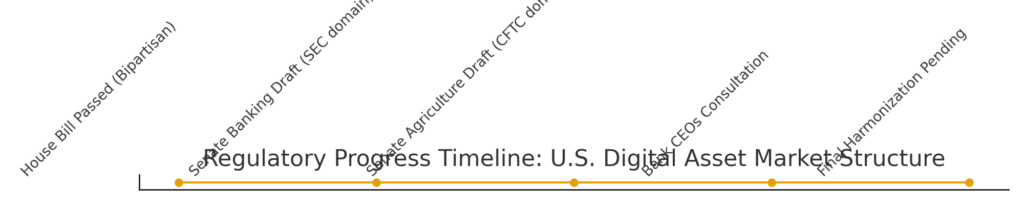
The House of Representatives already passed the Digital Asset Market Transparency Act with bipartisan support. Now the Senate must integrate:
- the Banking Committee’s SEC-focused sections, and
- the Agriculture Committee’s CFTC-focused sections.
What each committee wants:
Banking Committee (SEC Domain)
- Define when a token is a security
- Exclude certain crypto assets from securities classification
- Establish “sufficient decentralization” criteria
Agriculture Committee (CFTC Domain)
- Give CFTC expanded authority over spot markets
- Regulate commodity digital assets
- Provide clear rules for centralized and decentralized exchanges
This dual-committee structure is slowing progress because:
- SEC chair Gary Gensler has historically insisted most tokens are securities
- CFTC argues futures markets only function with commodity status
- Congress must reconcile both frameworks
Section 5 — How the Clarity Act Could Change Market Opportunities
1. New Tokens and Startups
A clear definition of “non-security tokens” will allow:
- compliant token launches
- public offerings without SEC lawsuits
- exchange listings without risk of retroactive enforcement
Startups will finally be able to design tokenomics knowing the legal boundaries.
2. Institutional DeFi
Banks, investment funds, and fintech companies could adopt:
- regulated liquidity pools
- permissioned lending markets
- KYC-gated staking platforms
- on-chain Treasury-backed instruments
This is likely to generate new revenue streams, especially for U.S.-regulated exchanges.
3. Stablecoin Innovation
If yield models are restricted, innovation will shift toward:
- tokenized T-bill products
- on-chain repurchase agreements (repo markets)
- regulated money-market stablecoins
These models could produce transparent, predictable returns, appealing to both retail and institutional investors.
4. DeFi Accountability
If developers or validators are classified as intermediaries:
- DeFi may adopt “compliance modules”
- smart contracts may integrate real-time monitoring
- protocols may require KYC’ed wallets for certain functions
This could create a new generation of compliant DeFi products.
Section 6 — Global Market Implications
The U.S. has the world’s largest capital markets. If it introduces a comprehensive crypto framework:
- institutional inflows will increase
- U.S. banks may enter stablecoin issuance
- crypto funds may operate with regulatory certainty
- exchanges could expand services like derivatives, margin trading, and yield products in compliance with law
However, if the framework becomes overly restrictive:
- capital will move offshore
- developers may relocate to Europe or Asia
- DeFi innovation may shift to permissionless jurisdictions
For investors seeking new crypto assets
Tokens aligned with:
- institutional DeFi
- regulated stablecoin infrastructure
- compliance-oriented chain architectures
may experience significant long-term growth.
Section 7 — Market Trends from Other Sources
Recent global developments reinforce the Clarity Act’s importance:
- UAE continues rapid licensing of crypto exchanges
- MiCA in Europe attracts token issuers
- Hong Kong pushes for institutional tokenized asset markets
- Singapore strengthens stablecoin regulatory regime
- Japan accelerates listing frameworks for venture tokens
International competition means the U.S. risks losing leadership unless it finalizes the Clarity Act.
Conclusion
The Clarity Act is more than a regulatory document—it is a strategic decision about the future of U.S. leadership in global finance. After consultations with the largest U.S. banks, the Senate Banking Committee signaled real progress. However, major challenges remain: DeFi accountability, stablecoin yield restrictions, and SEC-CFTC jurisdictional boundaries.
For investors:
- A clear framework will enable safer, more predictable market participation.
- New token offerings will become less risky.
- DeFi will evolve into a compliance-compatible ecosystem.
- Institutional liquidity will deepen, improving market stability.
The coming months will determine whether the U.S. becomes the hub of global crypto innovation—or whether the next generation of digital asset opportunities emerges elsewhere.
