

Key Points :
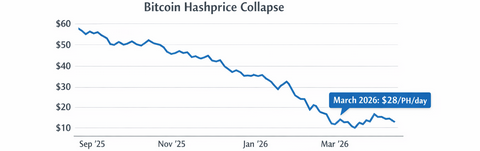
- Hash price plunges to historic lows, reaching $28–30 per PH/sec/day in March 2026
- Bitcoin’s price drop and record-high hash rates lead to severe profitability issues for miners
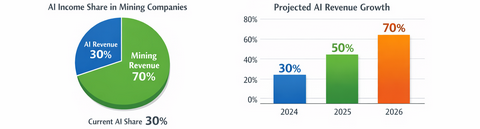
- AI and high-performance computing (HPC) adoption is accelerating, with up to 70% of mining revenue potentially coming from AI by the end of 2026
- Miners are increasingly shifting to AI, due to the stark contrast in profitability between Bitcoin mining and AI/HPC
- A transition toward hybrid infrastructure models, with mining companies embracing AI alongside traditional mining, is underway.
A Tense Quarter for Bitcoin Miners
Bitcoin mining, once a lucrative venture, has been facing mounting challenges. According to CoinShares’ Bitcoin Mining Report Q1 2026, the period following Bitcoin’s April 2025 halving event was the most difficult for miners in recent history. The price of Bitcoin plummeted 31% from its all-time high of around $126,000 in early October 2025 to about $86,000 by the end of December 2025. Simultaneously, the hash rate, the measure of computational power used to mine Bitcoin, hit an all-time high.
This combination of a steep drop in Bitcoin prices and soaring hash rates has led to a drastic fall in hash price, the key profitability metric for miners. Hash price dropped to its lowest level in five years, falling to $36–38 per PH/sec/day. This sharp decline in hash price severely impacted miners’ bottom lines, with many companies finding themselves at a loss or barely breaking even.
March 2026: A Historic Low in Hash Price
By early March 2026, hash price had plummeted further to $28–30 per PH/sec/day, marking the lowest levels seen since the 2025 halving event. CoinShares’ report highlighted that this has forced many miners into a perilous position. The weighted average cash cost for publicly traded miners rose to nearly $79,995 per BTC, while the hash price was hovering around $36–38 per PH/sec/day.
While hash prices slightly recovered to the $30–35 range after March, it wasn’t enough to offset the losses many miners faced. CoinShares notes that at current hash prices, many mining rigs, especially those with performance below the S19XP model, are no longer profitable to operate. For miners facing electricity costs above $0.06 per kWh, many machines are likely operating at a loss.
A Changing Landscape: Miners Shift Toward AI
The severe decline in Bitcoin mining profitability has led to a growing trend of mining companies transitioning to artificial intelligence (AI) and high-performance computing (HPC). AI infrastructure, offering more stable and higher profits from long-term contracts with tech giants, has become a more attractive alternative for many miners.
The shift from Bitcoin mining to AI/HPC is happening quickly. As of early 2026, AI-related revenue for publicly traded mining companies already accounts for approximately 30% of their overall income, and it could reach up to 70% by the end of the year. This shift is particularly evident in large-scale GPU colocation and cloud services, where contracts totaling over $70 billion have been signed for 2025–2026. Many existing mining operations are repurposing some of their infrastructure for AI purposes, and some are even halting mining operations entirely.
This move to AI is not just about diversification; it’s a matter of survival. As profitability in Bitcoin mining continues to face pressure, miners are increasingly opting to direct their power and resources toward AI, which has proven to be a more economically viable option.
A Hybrid Future: Mining and AI Under One Roof
CoinShares predicts that the future of the mining industry will see fewer companies focusing exclusively on mining. Instead, the dominant players will likely be “hybrid” infrastructure firms that handle both Bitcoin mining and AI/HPC services. The hybrid model allows companies to capitalize on the higher profits generated by AI, while still maintaining a foothold in Bitcoin mining.
However, this transition is not uniform across all mining companies. Some, like IREN and Bitfarms, are shifting toward AI and HPC as a primary business strategy, while others, like CleanSpark, are maintaining a more gradual approach, focusing on maximizing mining profits before diving deeper into AI.
The Market’s Future: Will Bitcoin Mining Recover?
Looking ahead, CoinShares remains optimistic that hash prices will eventually stabilize in the $30–40 range. The report suggests that if Bitcoin prices recover to the $100,000 level, hash prices could rise to around $37 per PH/sec/day. However, if Bitcoin stays below $80,000, hash prices may continue to face downward pressure due to rising network difficulty and the exit of unprofitable miners.
In a more bullish scenario where Bitcoin approaches its all-time high of $126,000, CoinShares forecasts hash prices could reach as high as $59 per PH/sec/day. Such a recovery would significantly benefit miners, but for now, many are betting on diversification into AI as a hedge against ongoing profitability issues.
Conclusion: Mining’s Transition to AI and Hybrid Infrastructure
The Bitcoin mining industry is currently grappling with severe profitability pressures, driven by the dual factors of low hash prices and high network difficulty. In response, miners are increasingly turning to AI and high-performance computing to diversify their revenue streams and secure more stable profits. As this shift accelerates, the future of Bitcoin mining may look drastically different, with hybrid infrastructure companies emerging as the dominant players. The path forward for many miners will likely involve a careful balance between mining and AI, as they adapt to an ever-changing economic landscape.
