
Main Points :
- The U.S. SEC, under Chairman Paul Atkins, is preparing an “Innovation Exemption” aimed at reducing regulatory friction for crypto and emerging financial technologies.
- The exemption would allow the SEC to support innovation without waiting for new legislation—an unprecedented shift in U.S. regulatory posture.
- Reform focuses on capital formation for SMEs, modernization of disclosure rules, and reducing burdens that disproportionately affect smaller firms.
- A token classification system defining which crypto assets qualify as securities will be announced within months.
- Recent market trends show renewed crypto institutional adoption, rising tokenization activity, and improved IPO environments—indicating strong synergy with the proposed exemption.
Introduction
For more than a decade, the United States has faced criticism for its fragmented approach toward cryptocurrency regulation. Despite leading the world in financial innovation, regulatory uncertainty pushed many promising blockchain teams offshore, making global hubs like Singapore, Dubai, and Hong Kong more attractive.
However, that era may be turning.
In a December 2 CNBC interview, SEC Chairman Paul Atkins unveiled a bold initiative: the creation of an “Innovation Exemption” designed to allow crypto and emerging fintech sectors to operate in a more flexible, growth-oriented environment. Unlike previous attempts requiring congressional action, this exemption would be created directly under existing SEC authority.
This represents a major shift, not only for crypto entrepreneurs but for the broader capital markets ecosystem, where IPOs, compliance costs, and corporate disclosures have long been burdened by legacy frameworks.
The following article summarizes the announcement, analyzes sector implications, cites additional market developments from external sources, and evaluates how this exemption could shape the global competitive landscape for blockchain adoption.
Section 1: What the Innovation Exemption Means
Atkins explained that the SEC already holds the authority to create exemptions that support innovation:
“The United States can finally embrace sectors of innovation it has rejected for years.”
The exemption is expected to do the following:
1. Allow controlled experimentation for crypto startups
Startups may conduct limited fundraising, token issuance, or pilot operations without immediately triggering full securities registration.
2. Reduce regulatory uncertainty
Many companies have delayed U.S. launches due to unclear enforcement. A formal exemption sets predictable boundaries.
3. Improve capital formation for SMEs
Atkins emphasized that excessive disclosure burdens have crushed small companies:
Companies with $250 million market cap were forced to comply with the same disclosures as companies 100× their size.
4. Support IPO reform and encourage more U.S. listings
The number of U.S.-listed companies has fallen to half of what it was 30 years ago.
Atkins explicitly blamed regulatory burden for this trend.
Section 2: Revising Corporate Disclosure Rules
A centerpiece of the new policy is the overhaul of corporate disclosures.
Atkins criticized the current system for requiring information that is no longer aligned with investor priorities:
“If the disclosure regime is hijacked to demand information irrelevant to materiality, investors do not benefit.”
Planned reforms include:
- focusing disclosures on material, investor-relevant data
- reducing compliance costs to free capital for innovation
- eliminating redundant reporting requirements
This reform aligns with the White House’s push to eliminate mandatory quarterly reporting and modernize shareholder dispute procedures.
Section 3: A Token Classification System Coming Within Months
One of the most impactful developments for the crypto sector is the upcoming token classification framework.
Announced at the Philadelphia Federal Reserve Fintech Conference on November 13, the framework aims to:
- specify which tokens qualify as securities
- define categories for utility tokens, payment tokens, governance tokens, and hybrids
- give developers a clear compliance roadmap
This is critical because, under the current regime, developers often do not know until after enforcement whether their token is considered a security.
The lack of clarity has frozen innovation—particularly in the U.S. venture and token-launch ecosystem.
Section 4: Broader Market Context — Crypto Adoption Trends
To evaluate the significance of the Innovation Exemption, it is essential to examine market trends from 2023–2025, which provide context for policy timing.
Trend 1: Institutional crypto adoption accelerating
Major banking and asset-management firms—including BlackRock, Fidelity, and JPMorgan—have moved heavily into blockchain, stablecoin settlement, tokenized treasuries, and digital custody.
Trend 2: Tokenization is becoming a multi-trillion-dollar narrative
Analysts from Citi, BCG, and Franklin Templeton project tokenized real-world assets (RWA) to exceed $4–$5 trillion by 2030.
The SEC sees this as a national competitiveness issue.
Trend 3: Improved macro environment for risk assets
As inflation cooled and the Fed reduced rates, risk capital returned to crypto and tech.
Trend 4: Retail trading platforms rising again
U.S. retail interest in BTC and ETH increased following ETF approvals and improved regulatory clarity.
Trend 5: SME demand for alternative fundraising channels
Regulatory sandboxes in UK, Singapore, Japan, and UAE have shown positive results with controlled exemptions—something the U.S. now seeks to replicate.
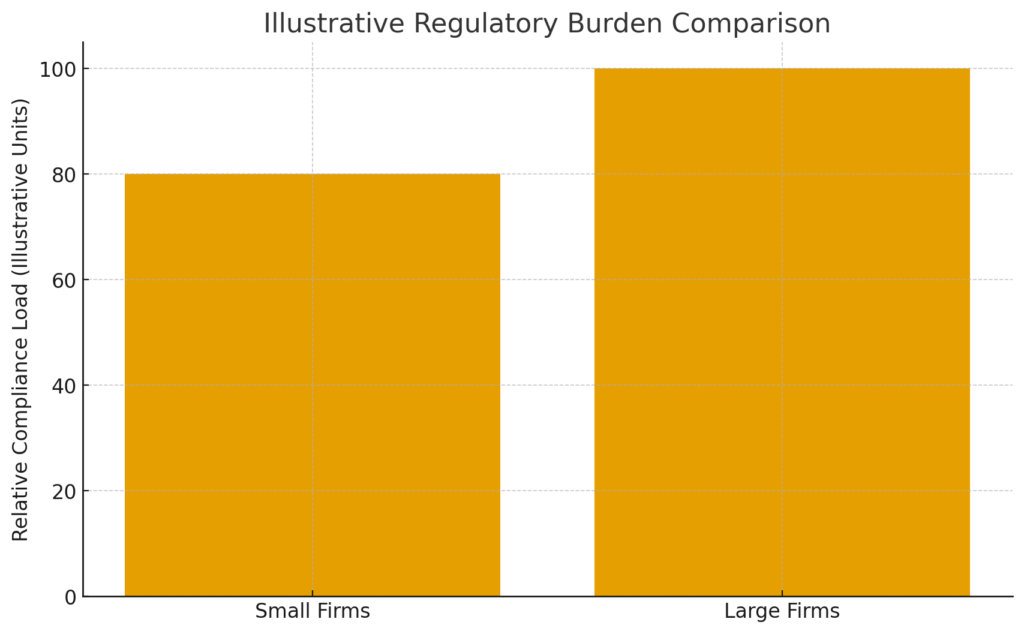
This diagram helps visualize how equal reporting requirements create disproportionate burdens on smaller firms.
Section 5: Impact on Crypto Entrepreneurs and Investors
1. Easier fundraising
Tokens for utility or network access could qualify under the exemption, enabling:
- pilot launches
- early-stage token sales
- U.S.-based token distribution without offshore arbitrage
2. Greater clarity for exchanges and custodians
Classification rules will determine:
- which assets require broker-dealer licensing
- which assets can be traded freely
- how stablecoins and payment tokens are supervised
This clarity directly reduces legal risk for VASPs and exchanges.
3. More competitive U.S. capital markets
By expanding pathways to raise capital domestically, the U.S. can retain talent and companies that previously relocated.
4. Increased appetite for innovative assets
Retail and institutional investors can evaluate assets with clearer disclosures and regulatory certainty.
Section 6: Impact on Global Crypto Competition
Countries such as UAE, Singapore, Hong Kong, and EU (MiCA) have aggressively positioned themselves as crypto hubs.
For the United States to remain competitive:
- clearer digital asset rules
- reduced regulatory friction
- modernized capital formation tools
are considered essential.
Atkins’ initiative is strategically aligned with these global developments.

This chart contextualizes the regulatory environment’s effect on public listings.
Section 7: Recent Developments From Other Sources
U.S. Treasury and banking regulators exploring stablecoin oversight reforms
Recent reports confirm that the Treasury aims to classify payment stablecoins as a regulated financial instrument, but with support for private-sector innovation.
Major exchanges pursuing U.S. compliance pathways
Coinbase, Kraken, and other major exchanges have expanded institutional products anticipating a more supportive regulatory stance.
Corporate America exploring blockchain internalization
Large enterprises—FedEx, Starbucks, Walmart—continue to use blockchain for logistics and settlement, creating new opportunities for tokenized ecosystems.
Conclusion
The proposed Innovation Exemption signals a transformative shift in the SEC’s approach to emerging financial technologies. By acknowledging that the old disclosure and securities framework cannot fully accommodate modern digital assets, the SEC is preparing the U.S. capital market for a new era—one where crypto, SMEs, tokenization, and global competition intersect.
If successfully implemented, the exemption may:
- accelerate blockchain adoption
- stimulate U.S.-based token launches
- reduce operational and compliance burdens
- revive IPO activity
- position the U.S. to lead the next wave of financial innovation
For entrepreneurs, investors, exchanges, and global market participants, this may represent the most meaningful shift in U.S. crypto regulation in more than a decade.
