
Main Points :
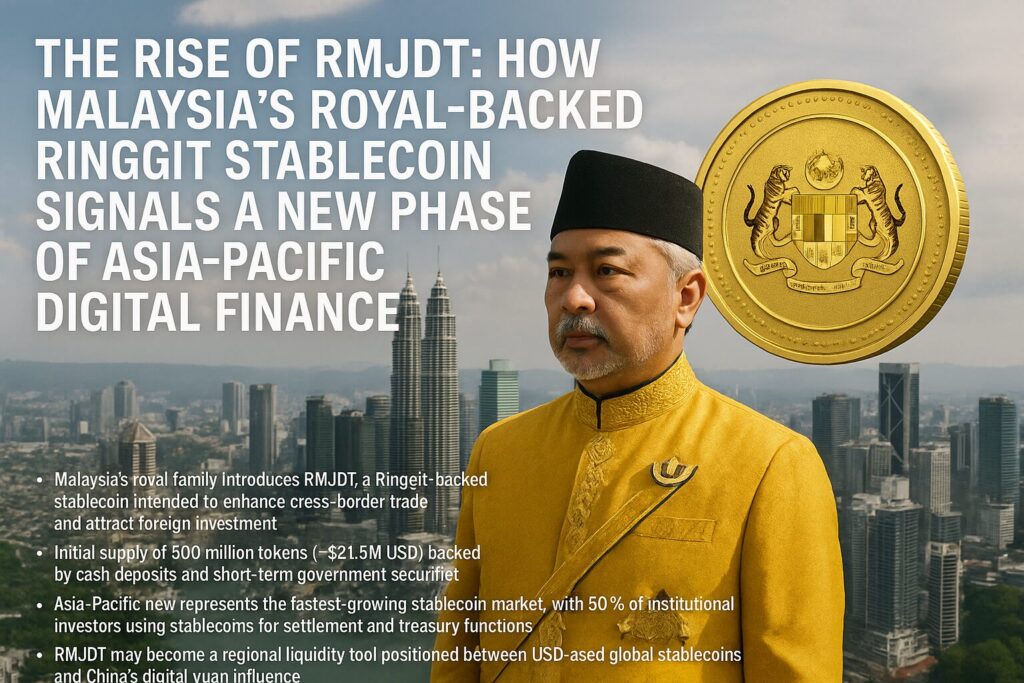
- Malaysia’s royal family introduces RMJDT, a Ringgit-backed stablecoin intended to enhance cross-border trade and attract foreign investment.
- Initial supply of 500 million tokens (~$121.5M USD) backed by cash deposits and short-term government securities.
- Asia-Pacific now represents the fastest-growing stablecoin market, with 56% of institutional investors using stablecoins for settlement and treasury functions.
- Regional regulatory trends—Hong Kong, Singapore, Australia, Japan—are forming a competitive environment for sovereign or sovereign-aligned stablecoins.
- RMJDT may become a regional liquidity tool positioned between USD-based global stablecoins and China’s digital yuan influence.
Introduction: A Royal Signal for a New Financial Architecture
The announcement of the RMJDT stablecoin by Ismail Ibrahim, the eldest son of Malaysia’s king, marks a notable moment in the evolution of sovereign-aligned digital currencies. While many nations have explored central bank digital currencies (CBDCs), far fewer have endorsed or allowed quasi-sovereign actors to initiate fiat-backed stablecoins intended for cross-border commerce. The RMJDT appears designed not merely as a digital payment instrument but as a geopolitical financial tool positioning Malaysia within a rapidly transforming Asia-Pacific digital economy.
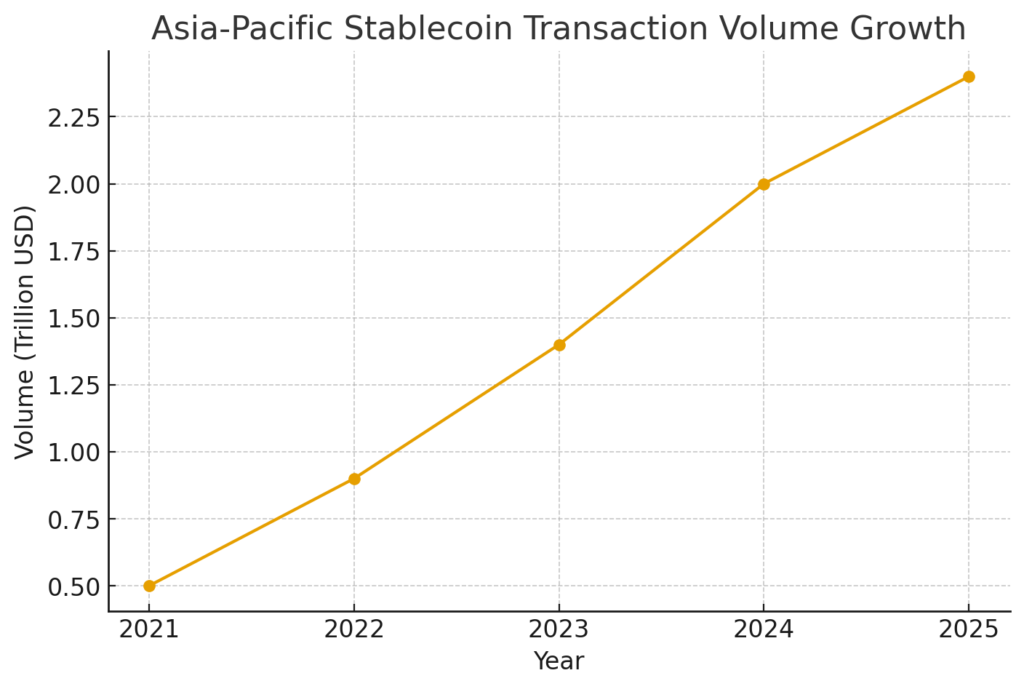
The Asia-Pacific region already commands the fastest growth in global stablecoin adoption—both in usage volume and institutional penetration. According to Circle, stablecoin transactions in the region exceeded $2.4 trillion between June 2024 and June 2025, driven by trade settlement, corporate treasury optimization, and the expansion of blockchain-powered supply chain systems.
Against this backdrop, RMJDT represents more than another fiat-pegged token. It symbolizes a hybrid strategy: strengthening Malaysia’s monetary presence, drawing investment, and leveraging blockchain infrastructure such as Zetrix to interlink national systems with global digital markets.
1. RMJDT Overview: Structure, Backing, and Strategic Purpose
The RMJDT stablecoin launches with an initial supply of 500 million tokens, equivalent to approximately $121.5 million USD at current FX assumptions. Its fully collateralized model relies on:
- Ringgit cash deposits
- Malaysian short-term government securities
These reserves indicate a conservative, risk-averse approach similar to major global stablecoin issuers such as Circle (USDC) and Paxos (USDP).
Ismail Ibrahim emphasized in the press release that establishing reserve structures connected to Zetrix—a blockchain platform aligned with Malaysia’s national digital strategy—is essential for operational stability. The issuer’s intention is to embed RMJDT into cross-border trade infrastructure, particularly across ASEAN and broader Asia-Pacific corridors.
RMJDT’s design echoes a global trend: nations seeking to develop digital liquidity tools without committing to full-scale CBDC deployments. By allowing private or semi-governmental issuers to operate under reserve requirements, Malaysia may accelerate digital adoption while reducing regulatory friction.
2. The Competitive Landscape: Asia-Pacific’s Stablecoin Acceleration
The region’s stablecoin growth has outpaced the rest of the world for several key reasons:
A. Dominance in Cross-Border Trade
Asia-Pacific accounts for a substantial portion of global trade flows. Stablecoins provide:
- faster settlement
- reduced FX slippage
- lower remittance and transaction fees
- instant treasury reconciliation
Corporations—especially those operating in Malaysia, Singapore, Thailand, Japan, Australia, and South Korea—have shown increasing preference for blockchain-based trade settlement.
B. Institutional Adoption Reaches New Highs
Circle reported that 56% of institutional investors in Asia actively use stablecoins for settlement or treasury-related purposes, marking the highest adoption rate globally.
The rationale includes liquidity management, real-time settlement, and the ability to maintain working capital across multiple time zones without relying on traditional correspondent banking networks.
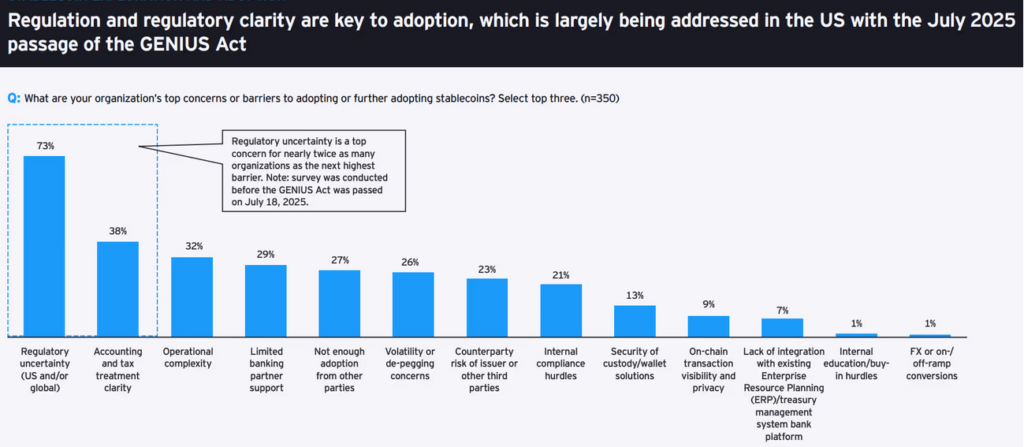
C. Regulatory Momentum
Countries have begun formalizing digital asset frameworks:
- Hong Kong: Introduced comprehensive stablecoin regulations in July 2025.
- Japan: Already permits yen-backed stablecoins under trust arrangements.
- Singapore: Provides a predictable licensing route for stablecoin issuers.
- Australia: Is executing full digital asset licensing legislation.
Malaysia’s RMJDT aligns with this emerging regulatory cohesion, positioning the country as a stablecoin innovator rather than a late adopter.
3. RMJDT’s Potential Use Cases in Regional Digital Finance
A. Trade Settlement Between ASEAN and China, the Middle East, and Africa
Malaysia serves as a strategic logistics and trade hub. RMJDT may become a preferred settlement asset for:
- palm oil exports
- electronics manufacturing supply chains
- energy and commodities trade
- Islamic finance cross-border flows
If supported by major Malaysian banks and trade networks, RMJDT could function similarly to USDC or USDT, but with regional FX benefits.
B. Treasury and Cash Management for SMEs and Multinationals
Stablecoins offer instant settlement and programmable treasury operations. RMJDT may attract:
- exporters managing multi-currency working capital
- logistics and supply chain firms
- fintech platforms needing liquidity tools
- crypto exchanges seeking non-USD settlement pairs
C. Potential Integration with Zetrix and Government Systems
The involvement of Zetrix hints at broader possibilities:
- digital identity integration
- on-chain regulatory reporting
- automated tax or compliance workflows
- trade documents (e.g., e-C/O, certificates of origin) settled with embedded payment tokens
This merges blockchain utility with public-sector infrastructure—an approach similar to China’s use of blockchain networks for trade documentation.
4. Comparison with Other Government-Linked Stablecoin Initiatives
| Region | Stablecoin Model | Sovereign Backing | Purpose |
|---|---|---|---|
| Japan | Trust-based Yen stablecoins | Indirect via trust banks | Domestic digitization & Web3 expansion |
| Singapore | Licensed fiat stablecoins (e.g., XSGD) | Regulatory backing | Regional remittances & fintech |
| Hong Kong | Regulated issuance from 2025 | Direct oversight | Trade & financial center competitiveness |
| Middle East (e.g., UAE) | Bank-issued stablecoins | Central bank regulated | Global trade & digital asset corridors |
Malaysia’s RMJDT stands out because it is initiated by a royal family member, not solely the central bank. This gives it semi-sovereign legitimacy—more authority than a private issuer but more flexibility than a full CBDC.
5. Economic Implications: From Ringgit Strengthening to Foreign Investment Magnet
A. Potential Ringgit Stabilization
Increased usage of RMJDT in cross-border flows may:
- raise demand for ringgit-backed reserves
- reduce volatility in FX markets
- establish new liquidity pools outside the USD-dominated systems
B. Attraction of Foreign Direct Investment (FDI)
With transparent backing and a blockchain settlement layer, RMJDT can:
- ease settlement for foreign investors
- provide a predictable digital asset for corporate treasury
- position Malaysia as a fintech-friendly jurisdiction
C. Competitive Advantage for Malaysia’s Digital Economy
RMJDT can integrate into:
- digital banking operations
- fintech startup ecosystems
- remittance networks
- institutional digital asset platforms
This reinforces Malaysia as a major player in ASEAN’s digital asset transformation.
6. Risks and Challenges Ahead
A. Regulatory Coordination with Bank Negara Malaysia
Although the issuance is semi-sovereign, stablecoin oversight requires:
- guidelines on reserve audits
- redemption rights
- stress-scenario liquidity management
- capital adequacy for issuers
B. Competition with USD Stablecoins
USDT and USDC dominate global liquidity. RMJDT must find niche adoption, not compete head-on.
C. Regional Interoperability
Success hinges on integration with:
- Singapore’s MAS
- Hong Kong’s SFC
- Chinese trade networks
- ASEAN fintech ecosystems
Conclusion: RMJDT as a New Catalyst in Asia-Pacific Digital Trade
RMJDT is more than Malaysia’s entry into the stablecoin space—it is a strategic financial instrument aligned with regional digitalization trends and geopolitical trade interests. Its potential lies in creating new liquidity corridors, improving FX efficiency, and enabling programmable financial interactions across borders. As Asia-Pacific continues to dominate global stablecoin usage and innovation, RMJDT may serve as a catalyst for a multi-currency, blockchain-powered trade ecosystem that expands beyond USD dominance.
If regulatory clarity remains strong and integration with trade networks progresses, RMJDT could evolve into one of the most influential localized stablecoins in the region, benefiting investors, fintech innovators, and corporations seeking efficient cross-border value transfer mechanisms.
