
Main Points :
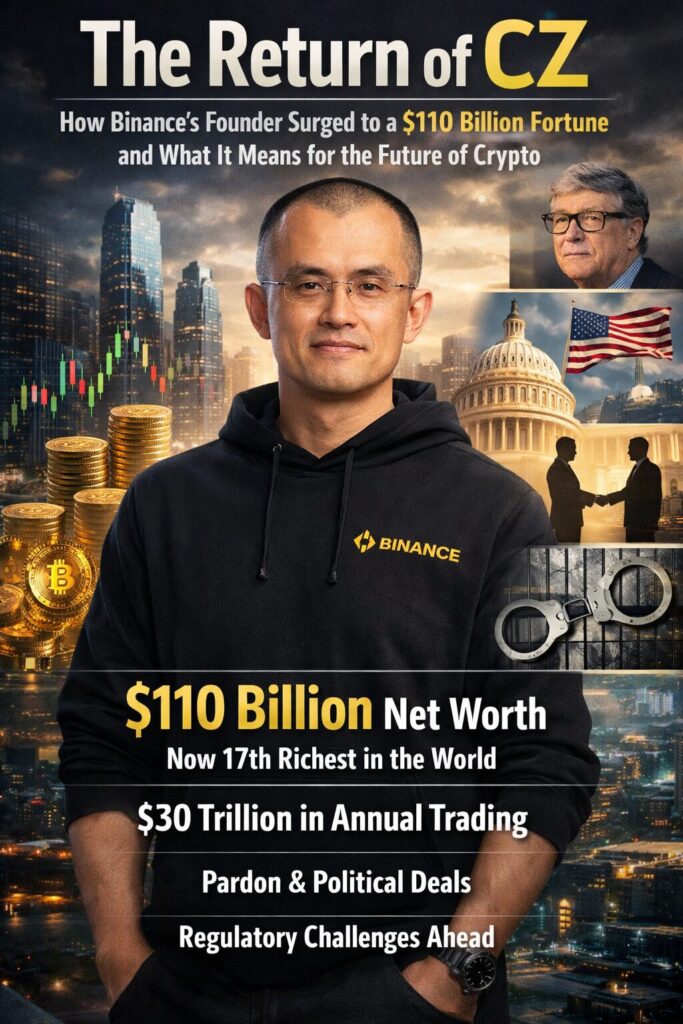
- Binance founder Changpeng Zhao (CZ) has reached an estimated $110 billion net worth, ranking 17th on the global rich list, surpassing Bill Gates.
- The surge is driven largely by Binance’s dominance in global crypto trading, with more than $30 trillion in annual trading volume.
- CZ’s comeback follows legal challenges and a prison sentence, highlighting the resilience of crypto entrepreneurship.
- Political developments, including a 2025 presidential pardon, and strategic partnerships have contributed to Binance’s resurgence.
- Despite its growth, regulatory scrutiny and compliance concerns remain significant challenges for the company and the broader crypto industry.
Section 1 — CZ’s Extraordinary Comeback After Legal Turmoil
In one of the most remarkable financial rebounds in recent history, Changpeng Zhao (CZ), the founder of the world’s largest cryptocurrency exchange Binance, has seen his estimated net worth soar to $110 billion, according to the latest global billionaire rankings published by Forbes.
This valuation places CZ at 17th among the world’s richest individuals, surpassing technology titan Bill Gates, whose net worth is estimated at approximately $108 billion.
What makes this milestone particularly striking is the timing. Only 17 months earlier, Zhao had pleaded guilty to violations of anti-money-laundering compliance requirements in the United States. The case resulted in a $4.3 billion settlement by Binance, Zhao’s resignation as CEO, and a four-month prison sentence served in California.
Historically, such regulatory actions might have permanently damaged the reputation and business prospects of a financial entrepreneur. However, the cryptocurrency industry operates under a unique set of dynamics. Innovation cycles move rapidly, and market leadership can rebound quickly when infrastructure, liquidity, and user trust remain intact.
For CZ, the rebound demonstrates a key reality of the digital asset economy: ownership of critical infrastructure platforms can create immense and resilient value, even amid regulatory turbulence.
Section 2 — Binance’s Dominance in Global Crypto Trading
The primary driver behind Zhao’s rising fortune is the continued dominance of Binance within the global cryptocurrency ecosystem.
Binance maintains roughly 38% of the total global cryptocurrency trading market, according to industry estimates. Its platform handles both spot trading and derivatives trading, and combined volumes are estimated to exceed $30 trillion annually.
This scale places Binance far ahead of competitors such as Coinbase, Kraken, and OKX.
Industry analytics firm Artemis estimates that Binance generated approximately $16–17 billion in revenue between 2024 and 2025, roughly 2.5 times the revenue of Coinbase, the largest publicly traded cryptocurrency exchange in the United States.
Because Binance remains privately held, estimating Zhao’s wealth requires assessing the company’s valuation. Analysts estimate Binance’s enterprise value at approximately $100 billion, with Zhao believed to own around 90% of the company’s shares.
This ownership structure is a crucial factor. Unlike many Silicon Valley founders who hold diluted equity after multiple funding rounds, Zhao maintained significant control over Binance’s equity. As a result, any appreciation in the company’s value has a dramatic impact on his personal net worth.
Global Crypto Exchange Market Share (Estimated)
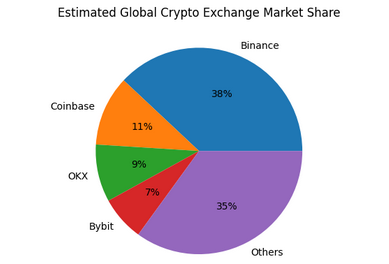
The chart should illustrate approximate market share distribution:
- Binance — 38%
- Coinbase — 11%
- OKX — 9%
- Bybit — 7%
- Others — 35%
This visual highlights Binance’s continuing dominance within the global trading ecosystem.
Section 3 — Political Winds and Strategic Partnerships
Another factor influencing Binance’s recovery has been changing political dynamics in the United States and globally.
In October 2025, former U.S. President Donald Trump issued a presidential pardon to Zhao. While the legal implications of the pardon primarily affected Zhao personally, the symbolic value was significant.
The move was interpreted by some observers as part of a broader shift toward a more crypto-friendly regulatory environment in parts of the United States.
Additionally, Binance has strengthened its global partnerships.
One notable example involves World Liberty Financial, a cryptocurrency venture associated with the Trump family. Binance integrated USD1, a stablecoin issued by the project, into a $2 billion investment transaction involving Abu Dhabi-based investment firm MGX.
Such partnerships demonstrate how cryptocurrency exchanges increasingly operate not only as trading platforms but also as financial infrastructure providers, facilitating stablecoins, institutional capital flows, and digital asset custody.
Zhao himself has also reappeared in high-profile industry events. In February 2026, he attended the Mar-a-Lago Crypto Forum, organized by World Liberty Financial, signaling a symbolic return to the U.S. business scene.
Section 4 — The Ongoing Compliance Debate
Despite Binance’s resurgence, compliance concerns continue to shadow the exchange.
Recent reports by major media outlets—including Fortune, The Wall Street Journal, and The New York Times—suggested that Binance may have dismissed an internal investigator who raised concerns about $1 billion in transactions linked to sanctioned Iranian entities.
Binance has strongly denied the allegations, stating that its compliance program meets international regulatory standards and that it continues to strengthen anti-money-laundering safeguards.
The controversy reflects a broader issue facing the cryptocurrency sector.
Unlike traditional banks, crypto exchanges operate globally across multiple jurisdictions. This structure can create challenges in enforcing sanctions, monitoring transactions, and ensuring regulatory compliance.
As governments increasingly introduce Travel Rule requirements, enhanced KYC regulations, and stricter anti-money-laundering frameworks, exchanges like Binance must continually upgrade their compliance systems.
Binance Estimated Revenue Growth

Suggested data points:
- 2020 — $3B
- 2021 — $8B
- 2022 — $12B
- 2023 — $14B
- 2024–2025 — $16–17B
The graph should show the exponential growth trajectory of the exchange’s revenue.
Section 5 — CZ’s Skepticism Toward Billionaire Rankings
Interestingly, Zhao himself has historically questioned the accuracy of billionaire wealth estimates.
When Forbes previously estimated his net worth at $87.3 billion in October 2025, ranking him 21st globally, Zhao responded on social media platform X that the figure was “not accurate and significantly overstated.”
He added that the real measure of success was how many people one could help, rather than the numerical estimate of wealth.
In the same month, China’s Hurun Research Institute estimated Zhao’s wealth at $26.7 billion, ranking him 13th among Chinese billionaires.
Zhao dismissed that estimate as well, humorously claiming that the real figure might be closer to one-hundredth of that amount.
Whether these statements reflect modesty, strategic ambiguity, or a genuine challenge in valuing private crypto assets remains an open question.
Unlike publicly traded companies, the value of privately held crypto firms fluctuates with market conditions, liquidity cycles, and investor sentiment.
Section 6 — What CZ’s Wealth Means for the Crypto Economy
For readers interested in discovering new crypto assets, identifying future revenue streams, and exploring practical blockchain applications, Zhao’s story offers several important lessons.
1. Infrastructure Is More Valuable Than Individual Tokens
While the market often focuses on speculative token prices, the real long-term value in the crypto industry frequently lies in infrastructure platforms—exchanges, custody solutions, payment rails, and blockchain networks.
Binance’s dominance illustrates how controlling trading infrastructure can generate massive economic power.
2. Crypto Markets Are Cyclical but Resilient
Despite regulatory setbacks, Binance has continued to grow. This suggests that crypto markets may experience volatility but retain strong structural demand for digital asset services.
3. Stablecoins and Institutional Capital Are Key Drivers
Partnerships involving stablecoins and institutional investors are increasingly central to the ecosystem.
The integration of stablecoins like USD1 into billion-dollar investment flows shows how blockchain finance is gradually merging with traditional capital markets.
The Emerging Crypto Financial Stack
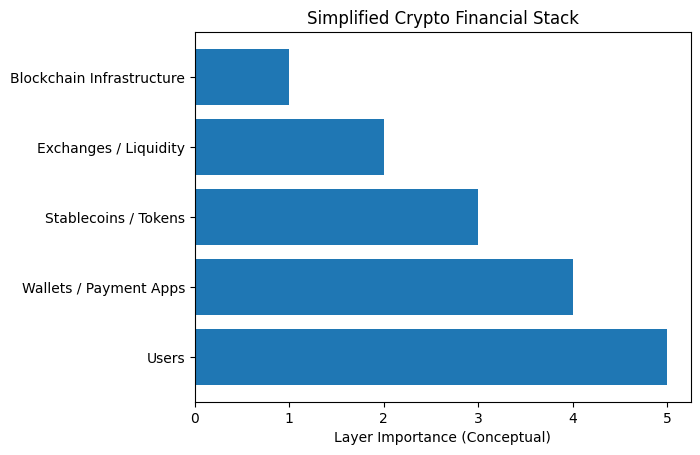
Suggested diagram layers:
Users
↓
Wallets and Payment Apps
↓
Stablecoins and Tokens
↓
Exchanges and Liquidity Providers
↓
Blockchain Infrastructure
This diagram helps readers understand where exchanges like Binance sit within the broader digital asset ecosystem.
Conclusion — The Future of Crypto Power
Changpeng Zhao’s return to the top ranks of global wealth is more than just a personal financial milestone. It reflects the growing structural importance of cryptocurrency infrastructure in the global financial system.
Even after regulatory setbacks, the crypto economy continues to expand, driven by institutional capital, stablecoin adoption, and technological innovation.
For investors and entrepreneurs seeking the next wave of blockchain opportunities, the lesson is clear:
The greatest value in the digital asset economy may not come from the next speculative token, but from the platforms, protocols, and financial infrastructure that power the entire ecosystem.
As the industry matures, figures like CZ illustrate both the extraordinary opportunities—and the complex regulatory challenges—that accompany the rise of decentralized finance.
