

Main Takeaways :
- The FOMC functions less as a trend-setting catalyst for Bitcoin and more as a clearing mechanism for accumulated leverage and expectations.
- In easing or rate-cut cycles, market expectations tend to be heavily priced in ahead of the decision, making post-announcement drawdowns structurally likely.
- The critical focus for the next 30 days is not Federal Reserve rhetoric, but whether post-event supply–demand normalization and liquidity recovery actually occur.
1. Why the FOMC Matters to Crypto — But Not in the Way Most Traders Think
The Federal Open Market Committee (FOMC) meeting held on January 28, 2026 (U.S. time) resulted in a decision to keep the federal funds rate unchanged at 3.75%. The Federal Reserve emphasized a data-dependent approach, signaling neither urgency toward rate cuts nor a renewed tightening bias. Economic activity remains resilient, labor markets show stability, and inflation—while easing from prior peaks—continues to run slightly above target.
From a macroeconomic standpoint, this policy stance can be characterized as “near-neutral with a wait-and-see bias.” Yet for Bitcoin and the broader crypto market, the significance of the FOMC lies less in the policy outcome itself and more in how markets behave around the event.
Historically, the FOMC has attracted outsized attention from crypto traders because it represents one of the few globally synchronized macro events that directly affect liquidity expectations. However, a closer examination of price action reveals a counterintuitive reality: the FOMC rarely defines the medium- or long-term direction of Bitcoin. Instead, it serves as a structural reset point where imbalances created by speculative positioning are resolved.
This distinction is crucial for investors searching for new crypto assets, yield opportunities, or practical blockchain use cases. Misinterpreting the FOMC as a directional signal often leads to poor timing decisions, unnecessary leverage, and missed opportunities that arise after volatility subsides.
2. Post-FOMC Bitcoin Performance: What the Data from 2025 Tells Us
An analysis of Bitcoin’s performance following FOMC meetings in 2025 reveals a striking pattern. In meetings where rates were left unchanged, Bitcoin’s price movements over the subsequent seven days were generally muted, showing only minor gains or losses. These reactions lacked consistency and did not establish lasting trends.
In contrast, the meetings in September, October, and December 2025—when rate cuts were implemented—were followed by declines of approximately 6% to 8% in Bitcoin’s price within a week. At first glance, this seems paradoxical. Rate cuts are traditionally viewed as bullish for risk assets, including cryptocurrencies.
The explanation lies in market structure rather than macro policy. By the time rate cuts were officially announced, expectations for monetary easing had already been extensively priced in. Futures open interest had risen, leverage had accumulated, and spot liquidity had thinned. When the announcement arrived without delivering a new bullish surprise, the market’s dominant response was position unwinding rather than fresh buying.
In other words, the outcome was dictated not by the decision itself, but by the market’s positioning going into the event.
3. The Pre-FOMC Market Environment: Calm on the Surface, Fragile Beneath
Leading up to FOMC meetings, the crypto market often enters a deceptively tranquil state. Several recurring characteristics can be observed:
- Futures open interest and leverage ratios rise steadily.
- Price action stabilizes within narrow ranges.
- Spot market liquidity declines as participants wait for confirmation.
- Implied volatility compresses, reinforcing the illusion of stability.
This environment is driven by a shared assumption: “The outcome is already known.” Traders become increasingly confident in their expectations, and risk-taking migrates into derivatives markets rather than spot accumulation.
Yet this calm is structurally fragile. With limited incremental buyers on the sidelines and excessive leverage already deployed, the market becomes highly sensitive to any catalyst that forces reassessment—even if that catalyst confirms expectations rather than contradicting them.
4. What Happens After the Event: Adjustment, Not Direction
Once the FOMC announcement passes, the market faces a fundamental problem: there is no longer a reason to hold speculative positions that were built purely for the event. If no new bullish narrative emerges, marginal demand disappears.
This is particularly pronounced during easing cycles. When rate cuts are delivered as expected, they often serve as a trigger for profit-taking rather than a green light for further risk exposure. Short-term traders close positions, stop-losses are triggered, and volatility expands.
At this stage, the market is not “choosing a direction.” It is being cleared.
On-chain and market microstructure indicators often move in tandem during this phase: trading volume increases, bid–ask spreads widen, and intraday price swings intensify. These signals collectively indicate a transition into what can best be described as a post-event normalization phase.
5. Interpreting SOPR and Other On-Chain Signals in Context
The Short-Term Holder Spent Output Profit Ratio (SOPR) is frequently cited as evidence of market sentiment following macro events. SOPR measures whether recently acquired Bitcoin is being sold at a profit (above 1.0) or at a loss (below 1.0).
While a declining SOPR after the FOMC can indicate that short-term participants are capitulating, it should not be interpreted in isolation. What matters more is whether SOPR normalization is accompanied by improving spot liquidity and declining forced selling pressure.
A falling SOPR combined with rising volumes and stabilizing spreads suggests that the market is successfully digesting excess positions. In contrast, persistently weak SOPR alongside thin liquidity may signal that adjustment is incomplete.
6. Visualizing the Adjustment Process
Illustrative BTC Price Behavior Around FOMC
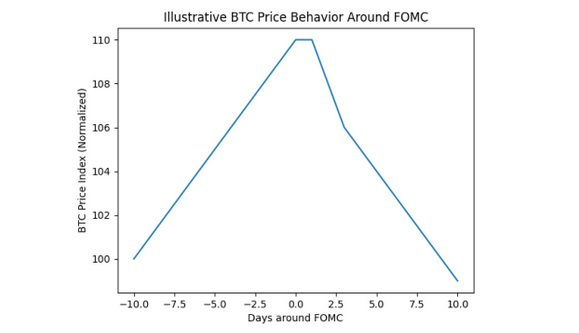
This conceptual chart shows how Bitcoin prices often stabilize before the FOMC, followed by increased volatility and adjustment after the event. The chart is normalized for structural illustration and does not represent exact historical prices.
Illustrative Open Interest and Volatility Around FOMC
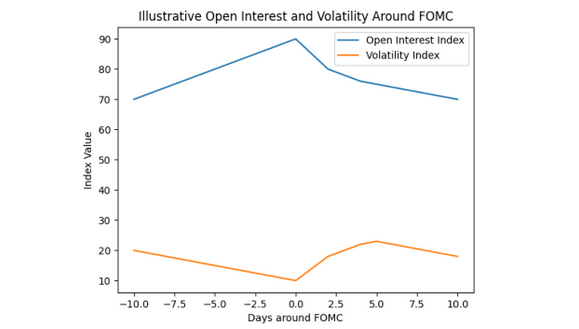
This figure highlights the typical pre-event buildup in futures open interest and suppressed volatility, followed by post-event deleveraging and volatility expansion.
7. Why This Adjustment Does Not Invalidate the Long-Term Thesis
It is critical to emphasize that post-FOMC corrections do not inherently negate Bitcoin’s medium- or long-term trajectory. Instead, they often strengthen it by removing excess leverage and resetting risk conditions.
For investors and operators focused on practical blockchain applications—such as payments, settlement infrastructure, tokenized assets, or yield-generating protocols—these adjustment phases can create healthier entry points. Lower leverage, clearer price discovery, and restored liquidity form a more stable foundation for sustainable growth.
From this perspective, the FOMC acts as a maintenance mechanism rather than a directional switch.
8. What to Watch Over the Next 30 Days
In evaluating the aftermath of the January 2026 FOMC, the most important variables are not policy statements or forward guidance. Instead, attention should be directed toward:
- The pace at which futures open interest declines.
- Whether spot market depth and liquidity recover.
- Signs that selling pressure from short-term holders is diminishing.
- Stabilization of volatility without renewed leverage buildup.
Only once these conditions are met can the market meaningfully transition into its next phase—whether that phase involves renewed accumulation, sector rotation into altcoins, or increased adoption of blockchain-based financial services.
Conclusion
The FOMC does not decide Bitcoin’s direction. It temporarily disrupts equilibrium, exposing and resolving imbalances created by speculative positioning. While this process often introduces short-term instability, it also prepares the market for its next structural move.
Thirty days after an FOMC meeting, the most relevant question is not whether rates were held or cut, but how thoroughly the market has been cleared. For those seeking new crypto assets, sustainable yield opportunities, and real-world blockchain use cases, understanding this adjustment structure is not optional—it is essential.
