
Main Points :
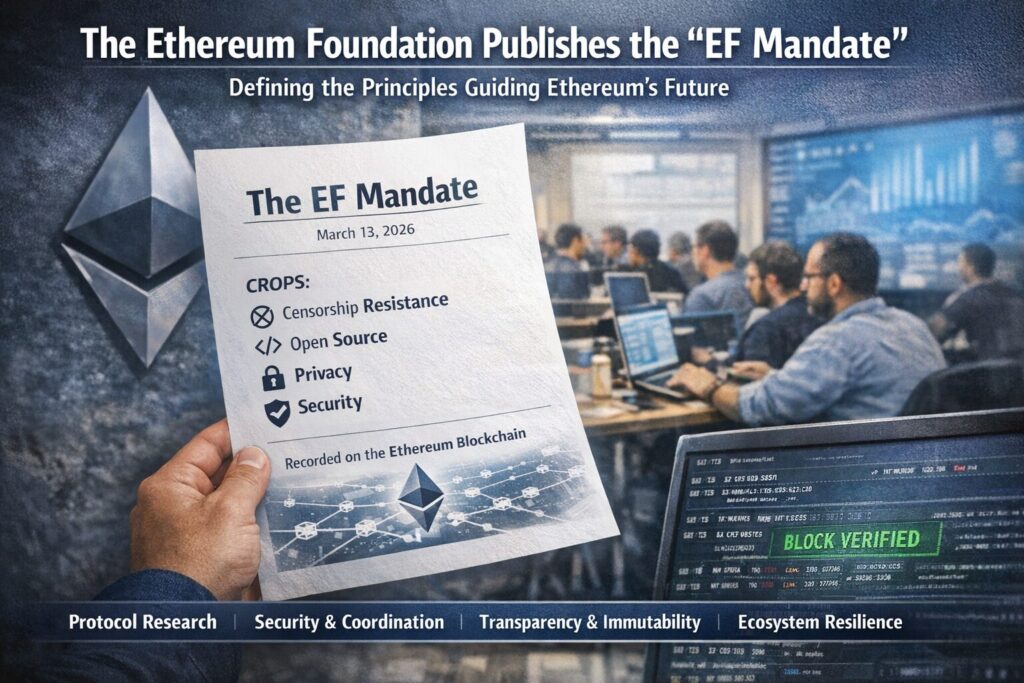
- The Ethereum Foundation (EF) released a formal governance document called the EF Mandate on March 13, 2026.
- The document defines four core principles summarized as CROPS: Censorship Resistance, Open Source, Privacy, and Security.
- The EF clarified that its primary role is supporting protocol-level research, security, and coordination, not controlling application development.
- The Mandate formalizes long-standing cultural norms that previously guided Ethereum informally.
- The document has been permanently recorded on the Ethereum blockchain, reinforcing transparency and immutability.
- The move is expected to strengthen developer confidence, governance transparency, and long-term ecosystem resilience.
Introduction
On March 13, 2026, the Ethereum Foundation published a new governance document called the “EF Mandate.”
This document functions as a hybrid charter, manifesto, and internal policy guide outlining the principles guiding Ethereum’s development and clarifying the Foundation’s role within the broader ecosystem.
For years, Ethereum operated largely through informal norms and shared culture among developers, researchers, and community participants. However, as the ecosystem has expanded into a multi-trillion-dollar global infrastructure supporting decentralized finance, NFTs, tokenized assets, and enterprise blockchain solutions, the need for clearer institutional guidance has become more pressing.
The EF Mandate therefore represents an important milestone: the formal articulation of the values and responsibilities that have long underpinned Ethereum’s development philosophy.
According to statements accompanying the publication, the goal is not to increase the Foundation’s authority but rather to clarify its limited and supportive role, ensuring that Ethereum continues to function as a decentralized, community-driven network.
The CROPS Framework: Four Pillars of Ethereum
At the heart of the EF Mandate lies a conceptual framework known as CROPS, representing the four essential qualities Ethereum aims to preserve.
C – Censorship Resistance
The first pillar of CROPS is censorship resistance, a core concept inherited from early blockchain philosophy.
Censorship resistance means that no central authority can arbitrarily block or reverse transactions, ensuring that individuals maintain sovereignty over their digital assets and interactions. This principle is particularly significant in regions where financial infrastructure may be subject to political or institutional control.
Ethereum’s decentralized node architecture and distributed validator network ensure that transaction validation remains independent of centralized gatekeepers.
For developers and investors, censorship resistance represents a powerful guarantee: applications built on Ethereum can operate globally without reliance on a single controlling entity.
This attribute is increasingly important as decentralized finance (DeFi), digital identity systems, and borderless payment networks continue to grow.
R – Open Source
The second pillar is open source development, which ensures that Ethereum remains a transparent and collaborative platform.
Ethereum’s codebase is publicly available, allowing developers worldwide to review, audit, and contribute to its improvement. This open innovation model has been instrumental in Ethereum’s rapid evolution since its launch in 2015.
Thousands of independent teams now contribute to the ecosystem, building infrastructure such as:
- Layer-2 scaling solutions
- decentralized exchanges
- smart-contract frameworks
- developer tools
The EF Mandate emphasizes that innovation should occur at the ecosystem level rather than being centrally directed by the Foundation itself.
By preserving open source principles, Ethereum maintains an environment where new protocols, applications, and financial models can emerge organically.
P – Privacy
Privacy forms the third pillar of the CROPS framework.
Although blockchains are transparent by design, Ethereum researchers have increasingly focused on technologies that allow privacy-preserving transactions while maintaining network security.
Emerging privacy technologies include:
- zero-knowledge proofs (ZK-SNARKs and ZK-STARKs)
- privacy-focused Layer-2 networks
- decentralized identity systems
These tools enable users to prove information without revealing sensitive data.
As digital surveillance expands globally, privacy-preserving infrastructure is becoming essential not only for individuals but also for businesses seeking to protect proprietary information.
The EF Mandate positions privacy as a prerequisite for meaningful user sovereignty in decentralized systems.
S – Security
The fourth pillar is security, which ensures that Ethereum remains a reliable platform for storing value and executing smart contracts.
Security within the Ethereum ecosystem involves multiple layers:
- cryptographic integrity
- consensus reliability
- smart-contract auditing
- infrastructure resilience
Following Ethereum’s transition to Proof-of-Stake in 2022, the network’s security now depends on a large validator set staking ETH to secure consensus.
The Foundation emphasizes that protocol-level research and security improvements are among the areas where it intends to focus most strongly, as these are responsibilities that cannot easily be decentralized to independent teams.
Clarifying the Role of the Ethereum Foundation
A major objective of the EF Mandate is to clarify the Foundation’s limited but critical role within the ecosystem.
The document states that the Ethereum Foundation should primarily focus on areas where there is no natural alternative steward, including:
- core protocol research
- long-term security initiatives
- ecosystem coordination
- public goods funding
Conversely, application-layer innovation — including DeFi protocols, NFT platforms, and blockchain gaming — is expected to remain the responsibility of independent teams and startups.
This division of responsibilities reinforces Ethereum’s decentralized governance structure and avoids excessive centralization of influence.
Why the Mandate Was Necessary
For much of Ethereum’s history, the ecosystem relied heavily on shared culture and implicit norms.
According to Aya Miyaguchi, these principles had always existed but were rarely written down formally.
As the ecosystem expanded dramatically — with thousands of developers and billions of dollars in on-chain assets — the need for explicit documentation became increasingly clear.
Formalizing these values helps ensure that new participants entering the ecosystem understand the philosophical foundations guiding Ethereum’s development.
Recording the Mandate on the Blockchain
One particularly symbolic element of the EF Mandate is that the document itself has been recorded on the Ethereum blockchain.
By storing the mandate on-chain, the Foundation ensured that the document becomes permanent, transparent, and verifiable.
Anyone can verify the record using the blockchain explorer Etherscan.
This approach reflects Ethereum’s broader philosophy: governance statements should be public, immutable, and independently verifiable rather than dependent on centralized archives.
Vitalik Buterin on Decentralized Coordination
Ethereum co-founder Vitalik Buterin commented on the Mandate by emphasizing the unique capability of blockchain networks to coordinate human activity without centralized leadership.
According to Buterin, Ethereum represents a new type of infrastructure capable of enabling large-scale collaboration among individuals who may never meet or trust each other directly.
This concept has profound implications beyond finance, including:
- decentralized governance systems
- open digital infrastructure
- global cooperative networks
Ethereum therefore serves not just as a blockchain platform but as a new model for coordinating digital societies.
Recent Trends in the Ethereum Ecosystem
The publication of the EF Mandate arrives during a period of significant evolution for Ethereum.
Several major trends are shaping the ecosystem:
1. The Rise of Layer-2 Networks
Layer-2 solutions such as rollups have dramatically increased Ethereum’s scalability, enabling faster transactions and lower fees.
These networks now process a growing share of Ethereum’s total activity, reducing congestion on the base layer.
2. Institutional Adoption
Institutional investors and financial firms are increasingly exploring Ethereum for:
- tokenized assets
- stablecoin infrastructure
- decentralized finance applications
Major asset managers have also launched Ethereum-based investment products, reflecting growing institutional confidence.
3. Real-World Asset Tokenization
Another rapidly expanding sector is real-world asset (RWA) tokenization, where physical or financial assets are represented on blockchain networks.
These include:
- government bonds
- real estate
- private credit markets
Ethereum currently hosts the largest share of this emerging market.
4. Privacy-Focused Technologies
The development of zero-knowledge proof systems is enabling a new generation of privacy-preserving applications.
These technologies are expected to play a crucial role in the next phase of blockchain adoption.
Chart Insert Location
Suggested visualization:
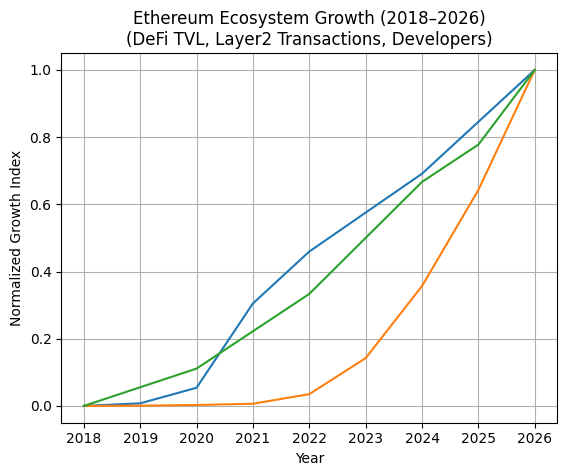
Title: Ethereum Ecosystem Growth (2018-2026)
Graph elements:
- Total Value Locked in DeFi
- Layer-2 transaction volume
- number of developers building on Ethereum
This chart helps illustrate how Ethereum has evolved from a developer platform into a global decentralized infrastructure layer.
Diagram Insert Location
Suggested diagram:
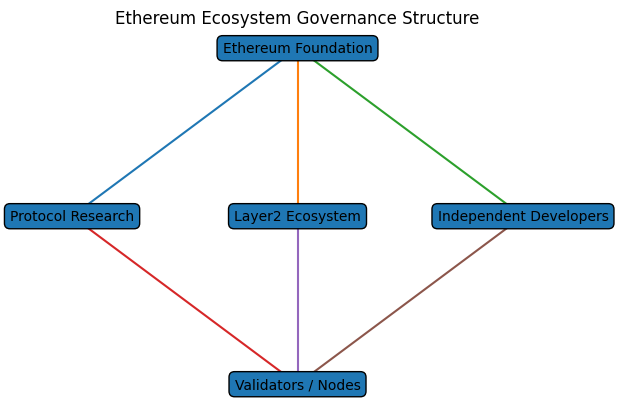
Title: Ethereum Ecosystem Governance Structure
Diagram components:
- Ethereum Foundation
- Core protocol research
- Layer-2 ecosystems
- Independent application developers
- Validators and node operators
This diagram visually demonstrates the decentralized governance model emphasized by the EF Mandate.
Implications for Investors and Builders
For investors and builders seeking the next wave of blockchain opportunities, the EF Mandate carries several implications.
First, it reinforces Ethereum’s commitment to decentralization and open innovation, suggesting that the ecosystem will continue to encourage independent experimentation.
Second, by clarifying the Foundation’s role, the Mandate reduces concerns about centralized governance risks.
Third, the CROPS framework highlights areas likely to receive continued development focus:
- privacy technologies
- security research
- open infrastructure
These sectors may represent promising areas for new startups, investment opportunities, and technical innovation.
Conclusion
The publication of the EF Mandate marks an important moment in Ethereum’s evolution.
By formally defining its guiding principles and institutional role, the Ethereum Foundation has taken a step toward greater transparency and long-term governance stability.
The CROPS framework — censorship resistance, open source development, privacy, and security — provides a concise articulation of the values that have shaped Ethereum since its inception.
At the same time, the Mandate emphasizes that the Foundation is only one steward among many within the ecosystem.
As Ethereum continues to expand into decentralized finance, digital identity, tokenized assets, and global payment infrastructure, these principles will likely serve as the foundation guiding its future development.
For developers, investors, and entrepreneurs searching for the next wave of blockchain innovation, Ethereum remains one of the most dynamic and influential ecosystems in the digital asset economy.
