
Main Points :
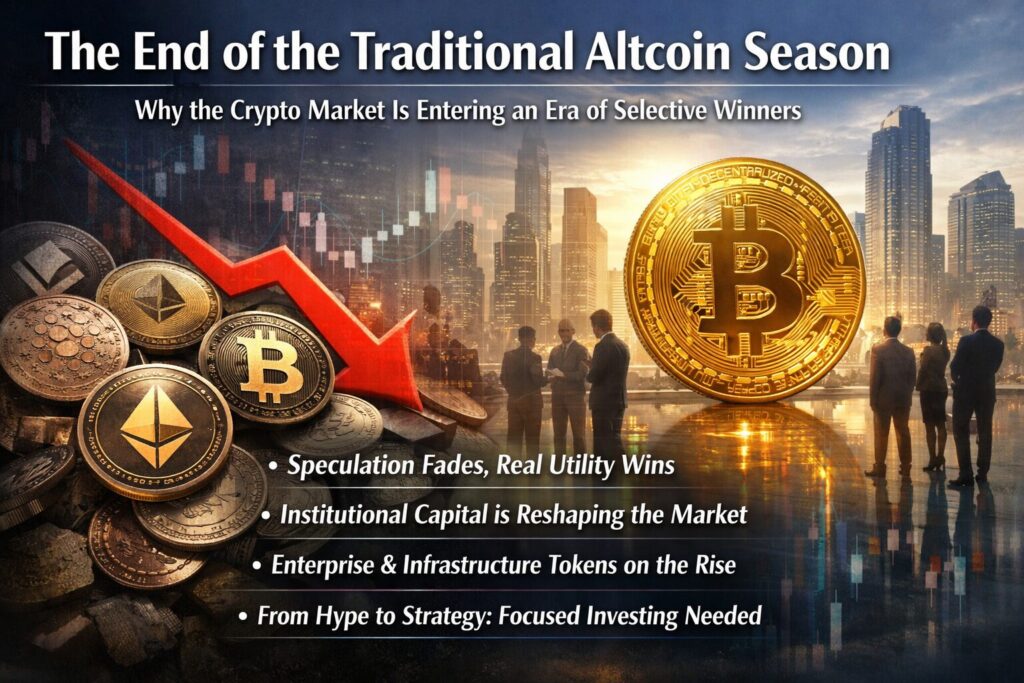
- The traditional “altcoin season” where almost all tokens rise together may be ending.
- Future crypto cycles may reward projects with real business models and adoption rather than speculative tokens.
- Institutional capital is increasingly shaping market behavior.
- Bitcoin dominance and capital rotation patterns are evolving as the market matures.
- Enterprise-linked tokens, infrastructure networks, and real-world blockchain applications may outperform speculative assets.
- Investors may need to shift from broad speculation to selective analysis.
1. The End of the Traditional Altcoin Season
For much of cryptocurrency’s history, investors have relied on a familiar market cycle known as the altcoin season. In previous cycles, once Bitcoin reached a new all-time high, capital would gradually flow into Ethereum and eventually into hundreds of alternative cryptocurrencies. This phenomenon often created a “rising tide lifts all boats” effect where even relatively weak projects experienced massive price appreciation.
However, according to Bitwise Chief Investment Officer Matt Hougan, this traditional pattern may be coming to an end.
Hougan recently suggested that the era in which nearly every token rises together may no longer exist in future cycles. Instead, the market is entering a phase where projects will be evaluated individually, and only those with strong technological foundations, real-world applications, or meaningful adoption may experience sustained growth.
In earlier bull markets—particularly during the 2017 ICO boom and the 2021 DeFi and NFT surge—many tokens appreciated largely because of speculation. Investors poured capital into newly launched projects without carefully evaluating their long-term sustainability. In many cases, tokens with minimal development activity achieved valuations in the billions of dollars.
Today’s crypto market looks very different.
The ecosystem has matured significantly, and the influx of institutional investors is forcing the market to become more disciplined. This shift suggests that the next altcoin cycle will look less like a speculative frenzy and more like a technology investment market.
2. The Evolution of Capital Rotation in Crypto Markets
One of the most recognizable patterns in cryptocurrency markets has been the capital rotation cycle.
Historically, the process has followed a predictable sequence:
- Bitcoin rallies and attracts institutional attention.
- Ethereum follows as investors search for higher returns.
- Capital spreads into smaller altcoins.
- Eventually, speculative tokens and meme coins surge.
This process can be visualized as a capital rotation cycle across the crypto ecosystem.
[Crypto Capital Rotation Model]
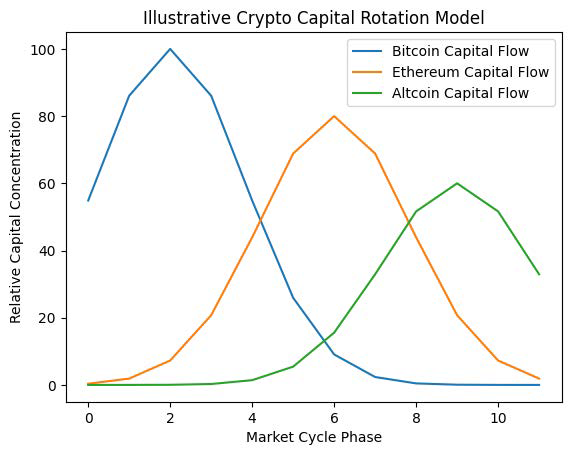
The chart illustrates how capital historically flows from Bitcoin into Ethereum and then into smaller altcoins as market confidence increases.
However, this model may be changing.
Bitcoin remains the primary gateway asset for new capital entering the market. Institutional investors, ETFs, and corporate treasuries overwhelmingly favor Bitcoin because of its liquidity, regulatory clarity, and perceived role as digital gold.
This growing institutional presence means that a larger share of capital may remain concentrated in Bitcoin, rather than flowing evenly across the entire crypto market.
Ethereum still benefits from strong network effects due to decentralized finance, stablecoins, and smart contract applications. But the vast universe of altcoins may no longer receive the same broad speculative inflows.
Instead, capital may move selectively toward projects with real economic activity.
3. Bitcoin’s Role in the New Market Structure
Bitcoin continues to dominate the cryptocurrency ecosystem.
Even after periods of volatility, Bitcoin has maintained its position as the most trusted digital asset among institutions and large investors. According to market data, Bitcoin has recently traded around $70,000, recovering from a temporary drop to approximately $60,000 earlier in the year.
This recovery reinforces Bitcoin’s role as the foundation of the crypto market cycle.
Several factors explain Bitcoin’s continued dominance:
- Spot Bitcoin ETFs in major markets
- Increasing adoption by institutional investors
- Growing perception of Bitcoin as digital gold
- Macroeconomic uncertainty driving demand for alternative assets
Because of these factors, Bitcoin may absorb a larger share of new capital entering the crypto ecosystem.
In previous cycles, speculative enthusiasm quickly spread beyond Bitcoin. Today, however, investors appear more cautious. Capital allocation decisions increasingly resemble those in traditional venture capital or technology investing.
This means altcoins must compete for attention rather than benefiting automatically from Bitcoin rallies.
4. The Rise of Selective Altcoin Investing
If the traditional altcoin season disappears, what replaces it?
According to Hougan and several industry analysts, the future may involve selective altcoin seasons, where only specific categories of tokens outperform.
Projects likely to attract attention include:
- Blockchain infrastructure networks
- Real-world asset tokenization platforms
- Enterprise blockchain integrations
- AI-blockchain hybrid technologies
- Financial protocols with real revenue
In contrast, purely speculative tokens without clear utility may struggle to attract long-term investment.
This shift is already visible in recent market performance.
[Selective Altcoin Performance]
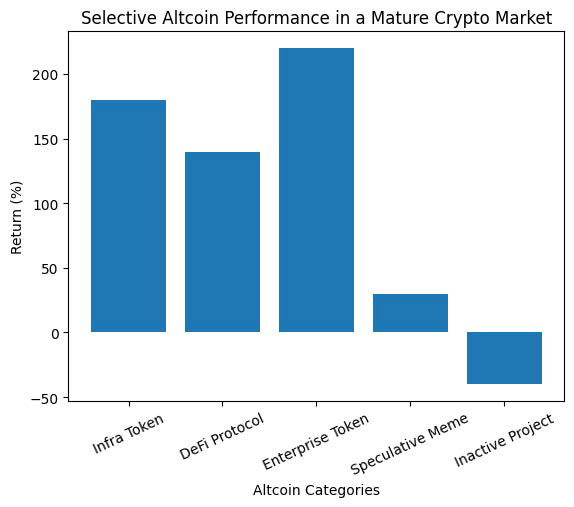
The chart illustrates how different categories of tokens may experience dramatically different returns in a more mature crypto market.
Infrastructure tokens or enterprise-linked networks may significantly outperform speculative meme assets. Meanwhile, inactive or poorly developed projects may decline.
This growing divergence marks a major structural change in how crypto markets behave.
5. Debate Within the Crypto Community
Not everyone agrees that the traditional altcoin season is disappearing.
Some analysts argue that altcoin cycles are simply becoming more difficult to identify, rather than disappearing entirely.
Crypto analyst Matthew Hyland has pointed to signals in Bitcoin dominance charts, suggesting that weakening dominance could indicate an upcoming altcoin rally.
Meanwhile, BitMEX co-founder Arthur Hayes has taken a different perspective.
Hayes argues that altcoin seasons are always happening somewhere in the market. According to him, investors who believe altcoin season has not arrived may simply be holding the wrong assets.
In his view, the crypto market is already fragmented into multiple micro-cycles. Some sectors—such as gaming tokens, AI tokens, or Layer-2 infrastructure—may experience strong rallies even when the broader altcoin market remains stagnant.
This perspective suggests that the concept of a single unified altcoin season may be outdated.
Instead, crypto markets may consist of many overlapping sector cycles.
6. Social Sentiment and Investor Behavior
Recent data from sentiment analysis platform Santiment provides further evidence that investor behavior is changing.
According to the firm, social media mentions of altcoins have recently fallen to their lowest levels in two years. At the same time, investor discussions have become heavily concentrated on Bitcoin.
This shift in sentiment suggests that the market may currently be in a Bitcoin-focused phase of the cycle.
Historically, these periods often occur early in bull markets when institutional capital drives Bitcoin higher before retail investors begin exploring alternative tokens.
However, the difference today is that retail investors may now be more cautious.
Many participants in the crypto market experienced severe losses during previous cycles, particularly following the collapse of speculative projects, algorithmic stablecoins, and poorly designed token economies.
As a result, investors may increasingly prioritize quality over hype.
7. Real-World Adoption as the Key Driver
One of the most important changes in the crypto ecosystem is the growing focus on real-world utility.
Over the past few years, blockchain technology has moved beyond purely speculative trading and into practical applications such as:
- International payments
- Tokenized securities
- Supply chain tracking
- Decentralized finance
- Digital identity systems
Large technology companies and financial institutions are increasingly experimenting with blockchain infrastructure.
If this trend continues, the next generation of successful altcoins may look very different from the speculative tokens that dominated earlier cycles.
Instead of hype-driven projects, the market may favor networks that support real economic activity.
Examples include:
- Layer-2 scaling solutions
- Tokenized asset platforms
- decentralized data networks
- infrastructure supporting AI computation
These types of projects may benefit from sustained demand regardless of speculative market cycles.
8. What This Means for Crypto Investors
For investors searching for new opportunities in digital assets, the shift toward selective markets carries important implications.
First, broad speculation across hundreds of tokens may become less effective as an investment strategy.
Instead, investors may need to evaluate projects based on:
- technological innovation
- developer activity
- user adoption
- revenue models
- tokenomics sustainability
This approach resembles traditional venture capital investing more than the speculative trading that characterized early crypto markets.
Second, diversification strategies may need to evolve.
Instead of holding large numbers of small tokens, investors may focus on key sectors of the blockchain economy, such as infrastructure, financial protocols, and enterprise adoption.
Finally, long-term investors may increasingly view cryptocurrencies not just as speculative assets but as foundations of future digital economies.
Conclusion
The cryptocurrency market may be entering a new phase of maturity.
The traditional altcoin season—where nearly every token rises together—may be fading as institutional capital, technological development, and real-world adoption reshape the industry.
Instead of broad speculative rallies, future market cycles may reward projects with genuine utility, strong ecosystems, and sustainable economic models.
For investors and builders alike, this shift represents both a challenge and an opportunity.
The era of indiscriminate speculation may be ending, but a more sophisticated and resilient crypto ecosystem may be emerging in its place.
Those who adapt to this new environment—by focusing on real technology, real adoption, and real value creation—may find themselves positioned at the forefront of the next generation of digital finance.
