
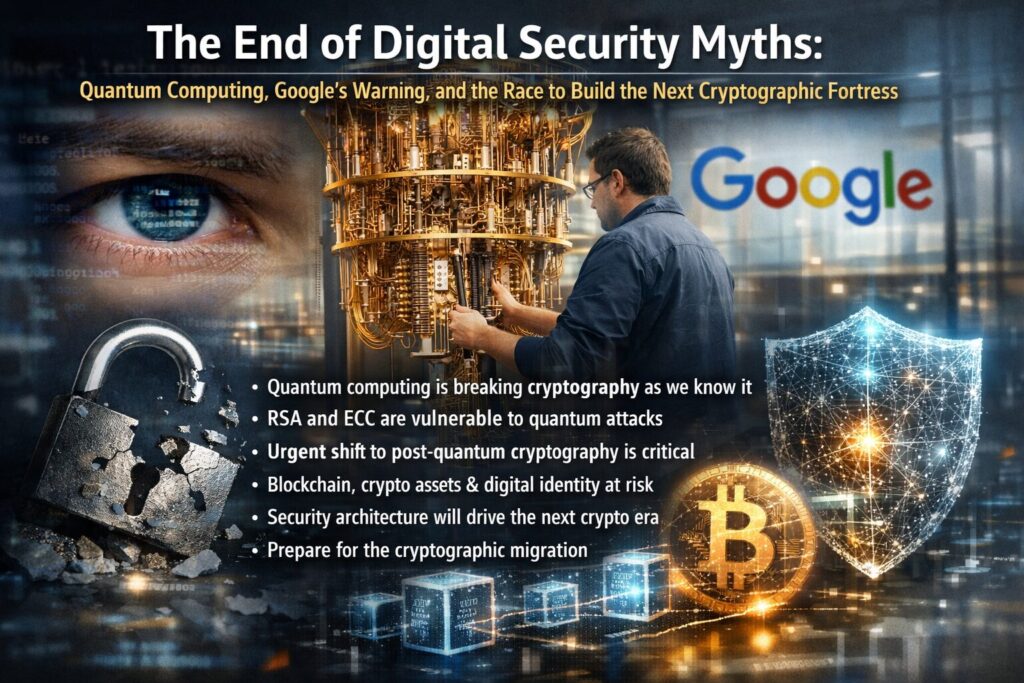
Key Points :
- Quantum computing is no longer theoretical—it is approaching practical disruption of cryptography
- Traditional public-key systems (RSA, ECC) are fundamentally vulnerable to quantum algorithms
- Google’s latest research signals an urgent transition phase—not a distant concern
- Post-quantum cryptography (lattice-based, multivariate systems) is becoming a survival requirement
- Blockchain, crypto assets, and digital identity systems face structural risk
- The next wave of crypto innovation will be driven by security architecture, not speculation
- Developers, institutions, and investors must prepare for a cryptographic migration cycle
1. The Quiet Collapse of Digital Trust
The digital world has long rested on an invisible foundation: trust in mathematics. Every secure transaction, every encrypted message, and every blockchain signature relies on the assumption that certain mathematical problems are practically impossible to solve.
For decades, systems like RSA and elliptic curve cryptography (ECC) have been considered unbreakable—not in theory, but in practice. The computational cost required to break them using classical computers would exceed the age of the universe.
However, this assumption is now under direct threat.
Recent research, including a major white paper from Google, has made it clear that quantum computing is progressing faster than many expected. Once sufficiently powerful quantum machines become available, these “impossible” problems—like factoring large numbers or solving discrete logarithms—become trivial.
In other words, the lock is still there, but the key has already been invented.
This is not a distant, abstract risk. It is a structural vulnerability that affects:
- Banking systems
- Blockchain networks
- Digital identity frameworks
- Government communications
The implications are profound: the entire architecture of digital trust could collapse if not rebuilt in time.
2. Why Quantum Computing Breaks Everything
At the core of the issue lies a fundamental shift in computation.
Classical computers process information sequentially or in parallel using bits (0 or 1). Quantum computers, however, operate using qubits, which can exist in multiple states simultaneously due to superposition.
This allows them to execute certain algorithms exponentially faster.
One such algorithm—Shor’s Algorithm—can efficiently break RSA and ECC, the very systems securing most of today’s internet.
The result is stark:
- Private keys can be derived from public keys
- Digital signatures can be forged
- Blockchain wallets can be drained
What was once computationally infeasible becomes trivial.
This creates a “harvest now, decrypt later” scenario, where attackers can store encrypted data today and decrypt it once quantum capabilities mature.
3. The Blockchain Paradox: Transparency vs Vulnerability
Blockchain technology, often praised for its transparency and immutability, becomes paradoxically vulnerable in the quantum era.
Public blockchains expose:
- Public keys
- Transaction histories
- Address structures
While this transparency is essential for decentralization, it also creates a future attack surface.
For example:
- If a wallet address has revealed its public key (e.g., through a transaction), it becomes vulnerable to quantum attacks
- Smart contracts relying on current cryptographic primitives may become insecure
This means that even assets that appear secure today could be silently compromised in the future.
For crypto investors and builders, this introduces a new dimension of risk:
Security is no longer static—it is time-dependent.
4. The Rise of Post-Quantum Cryptography
The solution is not incremental—it is foundational.
Post-quantum cryptography (PQC) represents a complete redesign of cryptographic systems to resist quantum attacks.
Key approaches include:
- Lattice-based cryptography
- Multivariate polynomial cryptography
- Hash-based signatures
These systems rely on mathematical problems that remain hard even for quantum computers.
However, transitioning to PQC is not simple.
It requires:
- Rewriting protocols
- Updating infrastructure
- Coordinating global standards
This is not a patch—it is a migration.
5. Insert Figure 1 Here
Quantum Threat vs Post-Quantum Defense
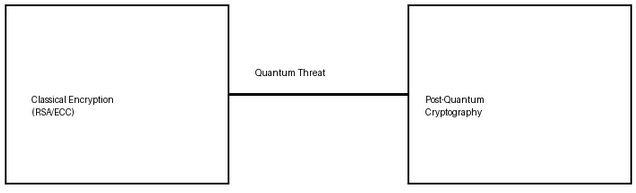
This diagram illustrates the transition from vulnerable classical encryption to quantum-resistant systems, highlighting the urgency of migration.
6. Market Implications: Where the Opportunity Lies
For readers seeking new crypto assets and revenue opportunities, this shift is not just a risk—it is an opportunity.
Emerging Investment Themes
- Quantum-Resistant Blockchains
Projects integrating PQC into their protocol layer - Hybrid Cryptography Systems
Combining classical and quantum-resistant methods - Secure Identity Infrastructure
Post-quantum DID (Decentralized Identity) systems - Crypto Migration Services
Tools for upgrading wallets and contracts - Hardware Security Modules (HSMs)
Quantum-safe key storage solutions
Strategic Insight
The next bull cycle may not be driven purely by speculation—but by infrastructure resilience.
Investors should begin evaluating:
- Cryptographic design choices
- Upgrade pathways
- Governance flexibility
Because in the quantum era, security becomes the new alpha.
7. The Governance Challenge in Decentralized Systems
Unlike centralized systems, blockchains cannot be easily updated.
Upgrading cryptography requires:
- Community consensus
- Hard forks
- Protocol redesign
This introduces a governance challenge:
- How do you coordinate a global upgrade?
- What happens if users do not migrate?
- Can legacy systems coexist safely?
This is where true decentralization is tested—not in ideology, but in execution.
8. A New Definition of Digital Sovereignty
At its core, this transition is not just technical—it is philosophical.
Cryptography underpins:
- Financial sovereignty
- Privacy
- Ownership
If these systems fail, the consequences extend beyond economics into civil liberties.
The move to post-quantum systems represents a redefinition of digital sovereignty:
- From computational assumptions
- To mathematically resilient guarantees
This is the next stage of the internet.
9. The Responsibility of Builders and Investors
We are entering a historical inflection point.
Just as the internet required new protocols (TCP/IP), the quantum era demands new cryptographic foundations.
Builders must:
- Design with quantum resistance in mind
- Avoid short-term convenience
- Prioritize long-term security
Investors must:
- Look beyond hype cycles
- Evaluate technical resilience
- Support projects preparing for this transition
Because the cost of inaction is not just financial—it is existential.
10. Conclusion: The War Between Intelligence and Computation
The emergence of quantum computing marks a new phase in human history.
It is not merely a technological advancement—it is a confrontation between:
- Human-designed mathematical systems
- The raw power of physical computation
The outcome will define the future of digital civilization.
If we succeed:
- Security becomes stronger
- Systems become more resilient
- Trust is redefined
If we fail:
- Digital assets become vulnerable
- Privacy collapses
- Decentralization weakens
The choice is not whether to act—but how quickly we can adapt.
The “mathematical fortress” of the future will not be built on past assumptions, but on new principles forged under pressure.
And those who understand this shift early will not only survive—they will lead.
