
Key Takeaways :
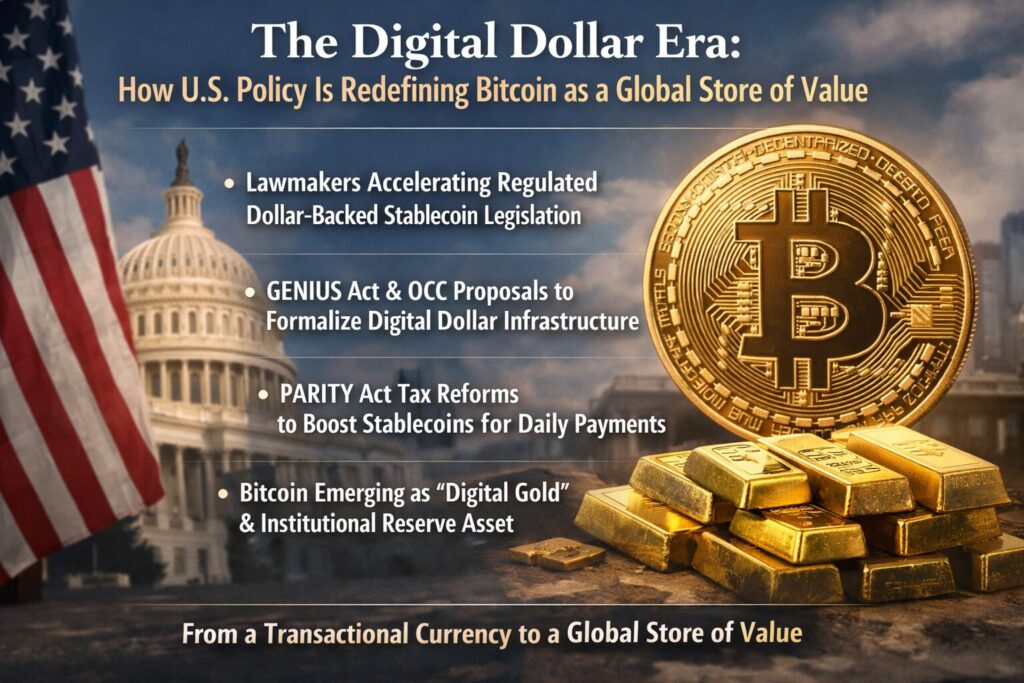
- U.S. lawmakers are accelerating legislation to integrate regulated dollar-backed stablecoins into the financial system
- The GENIUS Act and Office of the Comptroller of the Currency proposals aim to formalize digital dollar infrastructure
- Tax reforms under the proposed PARITY Act could make stablecoins dominant for daily payments
- Bitcoin is increasingly positioned as a “digital gold” rather than a transactional currency
- Institutional adoption is reinforcing Bitcoin’s role as a treasury and reserve asset
Introduction: A Structural Shift in Digital Finance
The global cryptocurrency landscape is entering a new phase—one defined not by ideological debates over decentralization, but by pragmatic regulatory frameworks that divide digital assets into functional categories. Recent developments in the United States suggest a decisive move toward institutionalizing dollar-backed stablecoins as the backbone of digital payments, while simultaneously redefining Bitcoin’s role as a store of value rather than a medium of exchange.
This transition is not merely technical. It represents a structural reconfiguration of the digital economy, where governments, regulators, and financial institutions are actively shaping how different crypto assets are used. The implications extend far beyond the U.S., influencing global liquidity flows, institutional investment strategies, and the future architecture of financial systems.
1. The Rise of the Digital Dollar Infrastructure
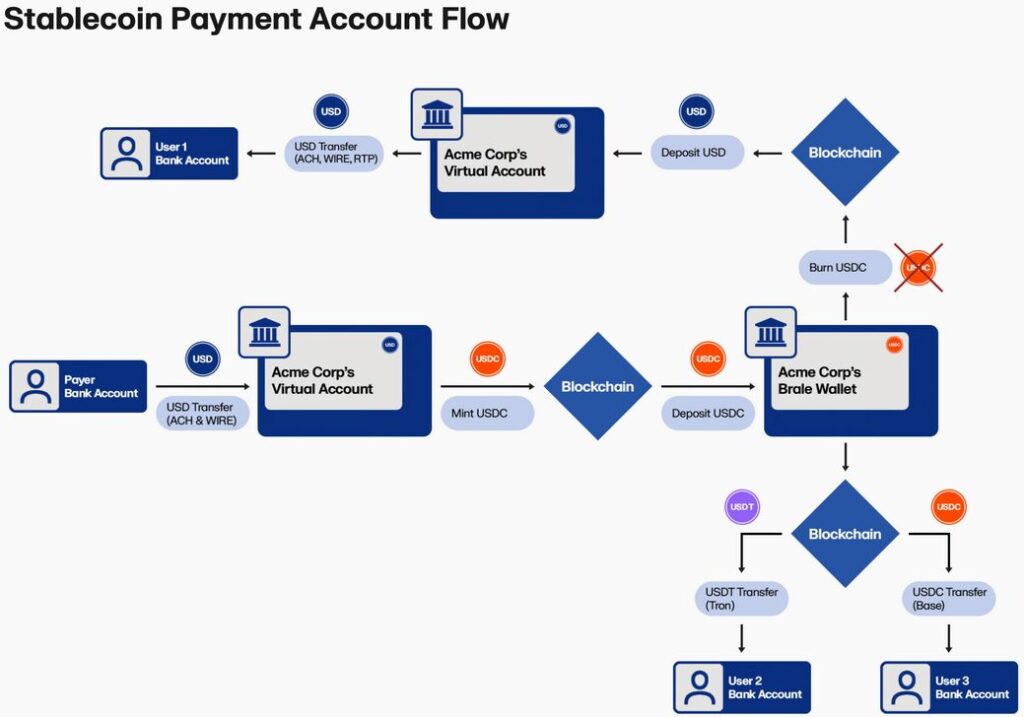
The U.S. government is moving aggressively to ensure that the dollar remains dominant in the digital age. Central to this effort is the integration of regulated stablecoins into the financial system.
The GENIUS Act, currently under Senate review, proposes a comprehensive regulatory framework for stablecoins backed by U.S. dollars. Unlike earlier fragmented approaches, this bill aims to create a unified standard for issuance, reserve management, and compliance. The goal is clear: to make stablecoins not just permissible, but foundational to the next generation of payments.
At the same time, the Office of the Comptroller of the Currency (OCC) has introduced regulatory guidance that would allow banks to directly engage with stablecoin infrastructure. This includes custody, issuance, and transaction validation. By bringing stablecoins under the umbrella of traditional banking supervision, regulators are effectively legitimizing them as a core financial instrument.
The White House has reinforced this direction through policy reports framing stablecoins as a critical tool for maintaining U.S. dollar hegemony in a digital world. In essence, stablecoins are being positioned as the digital extension of fiat currency—programmable, borderless, and scalable.
2. Tax Policy as a Catalyst for Adoption
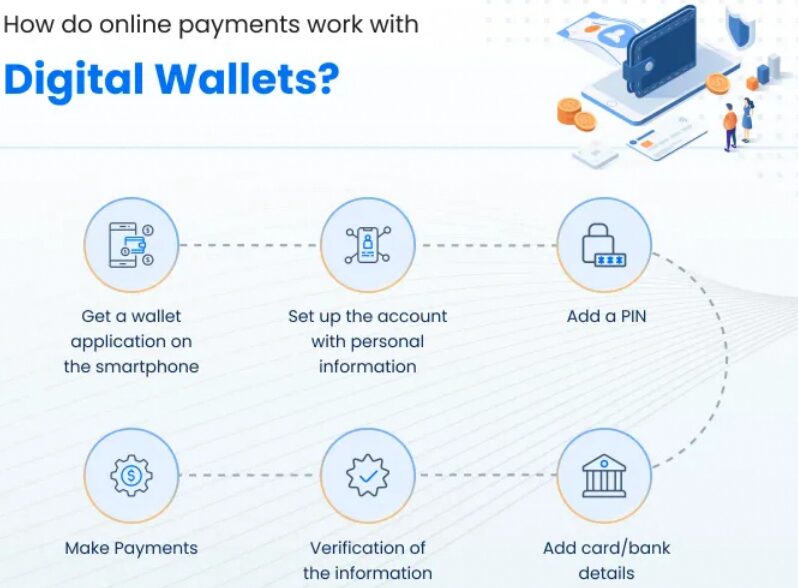
One of the most powerful drivers of adoption is not technology, but taxation. The proposed PARITY Act introduces a significant shift by reducing or eliminating tax burdens on small, everyday transactions conducted using dollar-pegged stablecoins.
This is a critical development. Under current tax regimes, using cryptocurrencies for payments often triggers capital gains events, creating friction for users. By contrast, the PARITY Act would treat stablecoin transactions more like fiat payments, removing a major barrier to everyday usage.
In parallel, stricter rules are being considered for non-stablecoin cryptocurrencies. The potential application of wash sale rules to Bitcoin and other assets would limit tax-loss harvesting strategies, aligning crypto more closely with traditional securities regulation.
The result is a clear incentive structure: use stablecoins for transactions, and hold Bitcoin for long-term investment.
3. Bitcoin’s Evolution into Digital Gold
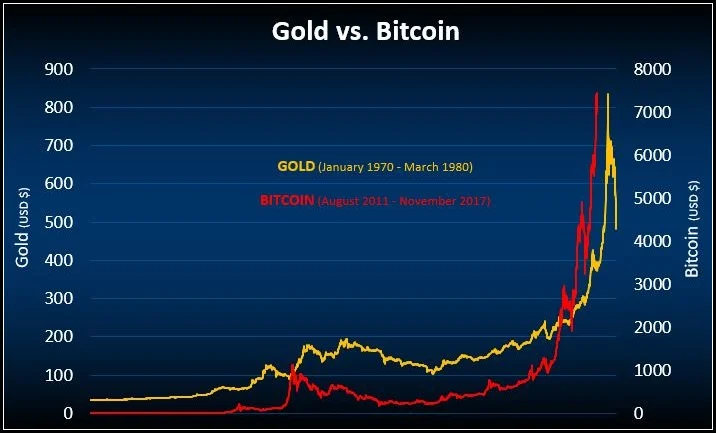
As stablecoins take over the transactional layer, Bitcoin is undergoing a parallel transformation. No longer positioned primarily as a peer-to-peer payment system, Bitcoin is increasingly viewed as a store of value—a form of “digital gold.”
This shift is driven by several factors:
First, regulatory positioning. By excluding Bitcoin from the government-managed digital dollar ecosystem, policymakers are implicitly defining it as an external asset. This reinforces its narrative as independent, scarce, and resistant to control.
Second, institutional adoption. Corporations and asset managers are increasingly allocating Bitcoin as part of their treasury strategies. This mirrors historical patterns where gold served as a hedge against inflation and currency debasement.
Third, macroeconomic conditions. In an environment of persistent inflation, geopolitical uncertainty, and monetary expansion, Bitcoin’s fixed supply becomes a compelling feature. It offers a hedge not just against inflation, but against systemic risk.
The combination of these factors is solidifying Bitcoin’s identity—not as a currency for daily use, but as a foundational asset in the global financial system.
4. The Emergence of a Two-Layer Crypto Economy
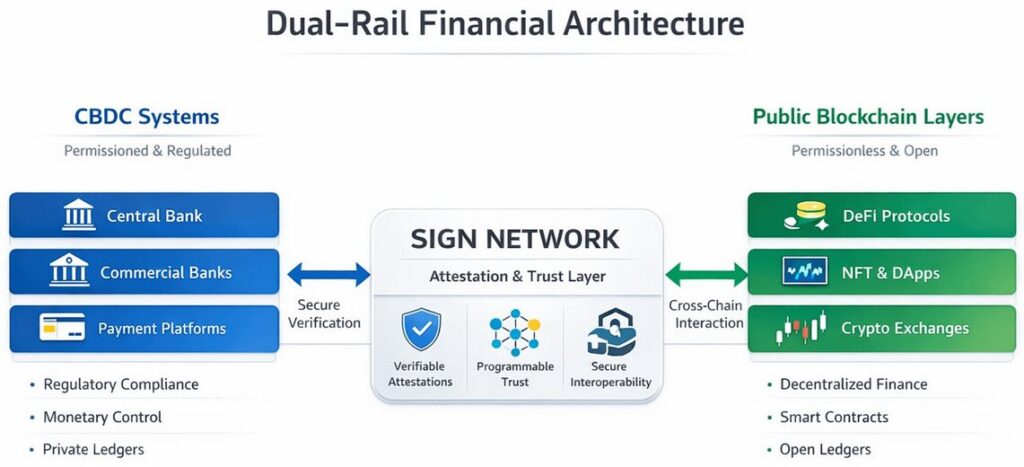
The evolving regulatory landscape is giving rise to a two-layer crypto economy:
Transaction Layer (Stablecoins):
Stablecoins dominate payments, remittances, and financial operations. Their stability, regulatory clarity, and integration with banking systems make them ideal for everyday use.
Savings Layer (Bitcoin):
Bitcoin serves as a reserve asset, a hedge, and a long-term store of value. Its role is analogous to gold in the traditional financial system.
This division is not accidental. It reflects a broader trend toward specialization within the crypto ecosystem. Just as traditional finance separates checking accounts from investment portfolios, digital finance is beginning to distinguish between transactional and savings assets.
For institutional investors, this clarity is invaluable. It reduces uncertainty, simplifies asset allocation, and enhances the overall credibility of the crypto market.
5. Implications for Investors and Builders
For readers seeking new crypto assets, revenue opportunities, and practical blockchain applications, this shift presents several key insights.
Investment Strategy:
Bitcoin’s evolving role suggests a focus on long-term accumulation rather than short-term trading. As institutional demand grows, price dynamics may increasingly reflect macroeconomic factors rather than retail sentiment.
Business Opportunities:
Stablecoin infrastructure is emerging as a high-growth sector. Opportunities exist in payment processing, compliance solutions, cross-border remittances, and financial integrations.
Product Design:
Applications that seamlessly integrate stablecoin payments while offering Bitcoin-based savings features could capture significant market share. This aligns with real-world user needs: spending in stable currency while preserving wealth in a scarce asset.
Regulatory Alignment:
Projects that align with regulatory frameworks are more likely to succeed. The era of regulatory arbitrage is giving way to one of compliance-driven innovation.
6. Global Context and Future Outlook
The U.S. is not operating in isolation. Similar trends are emerging globally, with regions such as Europe and Asia exploring their own digital currency frameworks.
However, the U.S. approach—leveraging private-sector stablecoins rather than central bank digital currencies (CBDCs)—offers a unique model. It combines innovation with regulatory oversight, potentially accelerating adoption while maintaining financial stability.
Looking ahead, several scenarios are likely:
- Stablecoins become the default medium for digital payments worldwide
- Bitcoin solidifies its position as a global reserve asset
- Institutional participation continues to expand, driving market maturity
- Regulatory frameworks converge internationally, creating a more unified digital economy
Conclusion: A New Financial Paradigm
The accelerating push toward a digital dollar ecosystem marks a turning point in the evolution of cryptocurrency. Rather than competing directly, stablecoins and Bitcoin are being assigned complementary roles within a structured financial system.
Stablecoins are becoming the rails of digital commerce—efficient, compliant, and scalable. Bitcoin, meanwhile, is emerging as the anchor of digital wealth—scarce, secure, and independent.
For investors, builders, and policymakers, understanding this division is critical. It is not merely a trend, but the foundation of a new financial paradigm—one where the future of money is layered, specialized, and deeply integrated into the global economy.
