
Main Points :
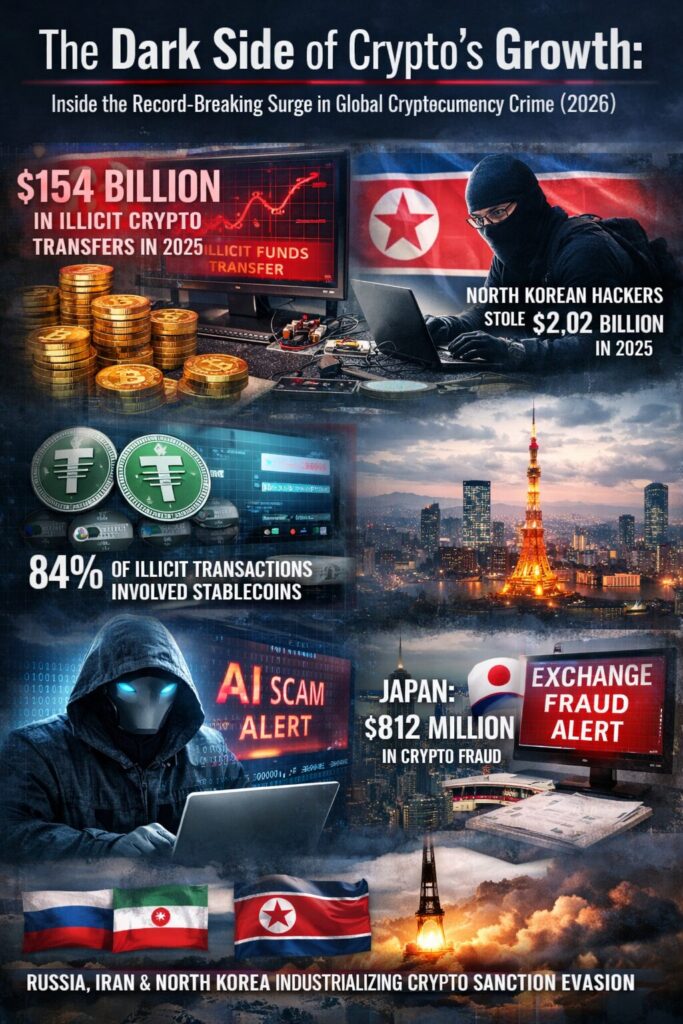
- Global cryptocurrency crime reached $154 billion in illicit transfers in 2025, the highest ever recorded.
- Stablecoins accounted for 84% of illicit transaction volume, highlighting their increasing role in crypto ecosystems.
- North Korean hacking groups stole over $2.02 billion in cryptocurrency in 2025 alone.
- AI-driven scams surged more than 1,400%, dramatically increasing fraud efficiency.
- In Japan, $812 million worth of crypto fraud-related transfers were detected from domestic exchanges.
- Sanctioned states including Russia, Iran, and North Korea are industrializing crypto-based sanction evasion.
Introduction: Crypto’s Expansion Brings a Parallel Rise in Crime
The global cryptocurrency ecosystem has experienced explosive growth over the past decade. What began as an experimental financial technology built around Bitcoin has now expanded into a multi-trillion-dollar financial infrastructure that includes decentralized finance (DeFi), stablecoins, tokenized assets, and blockchain-based payment networks.
Yet as the industry matures, so too does the sophistication of those who exploit it.
According to the 2026 Cryptocurrency Crime Trends Report released by Chainalysis, illicit crypto activity reached $154 billion in 2025, representing a 162% increase year-over-year and marking the highest level ever recorded.
While cryptocurrency was once associated primarily with darknet markets and ransomware, today’s illicit ecosystem has evolved dramatically. State-sponsored hacking, AI-driven fraud, sophisticated money-laundering networks, and geopolitical sanction evasion have transformed the nature of blockchain-related crime.
At the same time, the same transparency that makes blockchain attractive for finance also provides law enforcement with unprecedented investigative capabilities.
This article analyzes the key findings from the Chainalysis report and places them within the broader context of global crypto adoption, regulation, and emerging technologies.
The $154 Billion Surge in Illicit Crypto Transfers
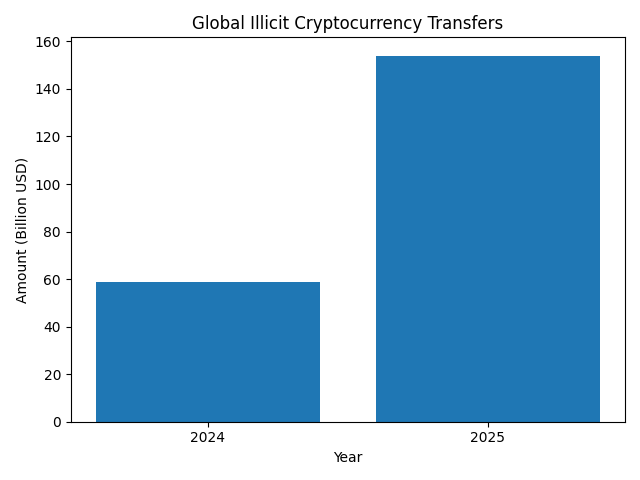
One of the most striking findings in the 2026 report is the scale of illicit crypto transfers.
In 2025, cryptocurrency addresses associated with illegal activity received approximately:
$154 billion
This represents a 162% increase compared with 2024, making it the largest volume of illicit blockchain transactions ever recorded.
Several factors contributed to this surge:
- Rapid expansion of the global crypto economy
- Increased adoption of stablecoins
- Expansion of organized cybercrime groups
- State-sponsored hacking operations
- Industrialization of sanction evasion networks
However, an important nuance is that total crypto transaction volume globally also increased significantly, meaning illicit transactions still represent a relatively small portion of the overall ecosystem.
Nevertheless, the absolute scale has become large enough to attract heightened scrutiny from regulators and financial institutions worldwide.
Stablecoins Become the Dominant Tool for Illicit Transfers
One of the most surprising developments highlighted in the report is the role of stablecoins.
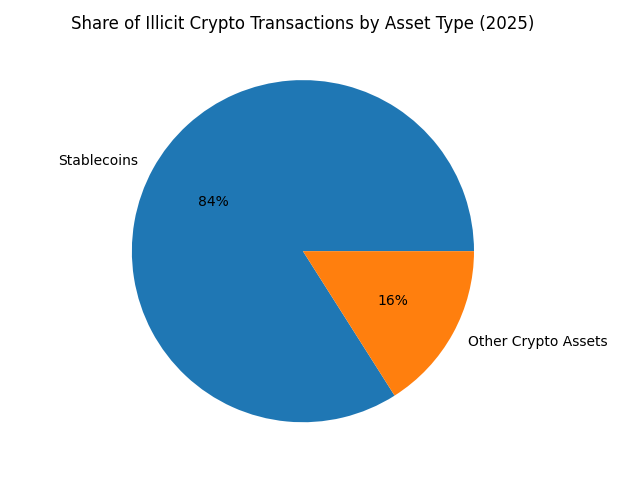
Of the $154 billion in illicit transactions:
84% were conducted using stablecoins.
Stablecoins such as USDT, USDC, and other dollar-pegged tokens have become the primary medium of exchange across many blockchain ecosystems.
Their popularity among both legitimate users and criminals stems from several advantages:
- Price stability relative to fiat currencies
- High liquidity across exchanges and DeFi platforms
- Fast settlement times
- Easy cross-border transfers
For criminal networks, these characteristics provide an efficient mechanism for moving funds internationally without relying on traditional banking systems.
At the same time, stablecoins remain traceable on public blockchains, which has enabled law enforcement agencies to recover or freeze significant amounts of illicit funds in recent years.
North Korean Hackers Continue to Dominate Crypto Theft
State-sponsored cybercrime remains one of the most serious threats facing the cryptocurrency industry.
According to the Chainalysis report:
North Korean hacking groups stole approximately $2.02 billion in cryptocurrency during 2025.
This represents a 51% increase from the previous year.
Since 2016, cumulative losses attributed to North Korean operations have reached approximately:
$6.75 billion
These attacks are typically conducted by groups associated with the Lazarus Group, which operates under the direction of the North Korean government.
Their primary targets include:
- Cryptocurrency exchanges
- DeFi protocols
- Cross-chain bridges
- Blockchain startups
Evolution of Attack Techniques
Modern attacks have become significantly more sophisticated.
Recent campaigns involve:
- Corporate infiltration, where attackers pose as developers or employees to gain internal access.
- Advanced social engineering, targeting executives and security teams.
- Supply-chain attacks against development tools and software dependencies.
- Malware embedded in developer job recruitment processes.
This evolution demonstrates that crypto cybercrime increasingly resembles advanced persistent threats (APT) seen in traditional cybersecurity warfare.
AI-Powered Crypto Fraud Explodes
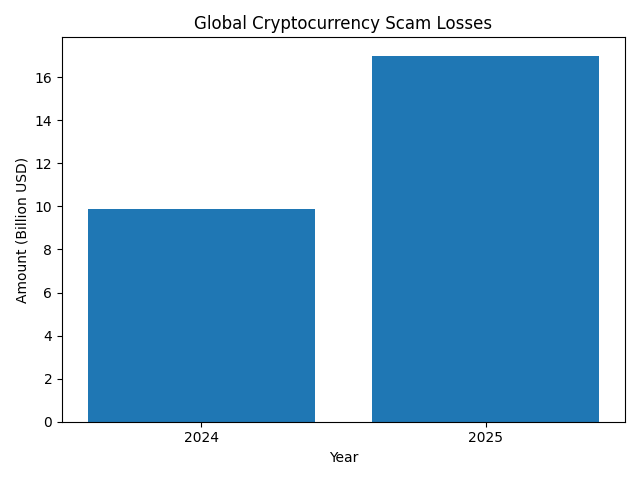
Another alarming trend identified in the report is the rapid growth of AI-driven fraud.
In 2025, global cryptocurrency fraud losses reached approximately:
$17 billion
This represents a dramatic increase from $9.9 billion in 2024.
The most significant contributor to this growth has been the emergence of AI-enabled impersonation scams, which increased by more than 1,400% year-over-year.
Why AI Scams Are So Effective
Artificial intelligence has dramatically lowered the barrier to large-scale social engineering.
Criminal groups are now using AI tools to create:
- Realistic voice clones
- Deepfake video calls
- Automated phishing bots
- Fake investment advisors
- Personalized scam scripts
These technologies allow scammers to impersonate:
- Crypto exchange employees
- Venture capital investors
- project founders
- family members of victims
As a result, the average loss per fraud case has increased 4.5× compared with traditional scams.
Japan’s Growing Exposure to Crypto Fraud
The report also highlights a concerning trend in Japan.
According to estimates by Chainalysis Japan, cryptocurrency linked to fraud totaling approximately:
$812 million
was transferred from major domestic exchanges in 2025.
This amount represents roughly 38% of the total fraud losses reported by Japan’s National Police Agency, which reached about $2.16 billion.
The data suggests that cryptocurrency is increasingly being used as a money-laundering channel for traditional fraud schemes.
Common patterns include:
- Romance scams
- Investment fraud
- Fake crypto trading platforms
- Social-media impersonation schemes
These scams often involve victims converting yen into cryptocurrency before transferring funds to overseas addresses controlled by criminal networks.
Sanctioned States Are Industrializing Crypto Finance
Perhaps the most geopolitically significant trend in the report is the use of cryptocurrency by sanctioned nations.
Countries including:
- Russia
- Iran
- North Korea
are increasingly using blockchain networks to bypass international financial restrictions.
In 2025, transfers to sanctioned entities increased by:
694%
reaching approximately:
$104 billion
Russia’s Ruble-Backed Stablecoin
One notable example is the Russian ruble-backed stablecoin A7A5, which has reportedly processed:
$93.3 billion in transactions within less than a year.
This token is believed to function as an alternative trade settlement infrastructure, allowing businesses to bypass traditional banking systems.
Such developments suggest that cryptocurrencies may increasingly play a role in geopolitical financial competition.
Blockchain Transparency: A Double-Edged Sword
Despite the scale of illicit activity, blockchain technology also offers unique advantages for law enforcement.
Unlike cash transactions, blockchain transfers are permanently recorded on public ledgers.
This transparency allows investigators to:
- Trace fund flows across wallets
- Identify criminal networks
- Freeze assets at exchanges
- Recover stolen funds
According to Chainalysis, combining blockchain analytics with AI-driven intelligence can significantly enhance the ability of regulators and law enforcement agencies to dismantle illicit networks.
Hayato Shigekawa, Principal Solution Architect at Chainalysis Japan, emphasized the importance of collaboration:
“By combining blockchain transparency with AI-powered intelligence, law enforcement agencies and compliance teams can neutralize criminal networks more effectively.”
What This Means for the Future of Crypto
The surge in cryptocurrency crime does not necessarily indicate failure of the technology itself. Rather, it reflects the rapid expansion of a new global financial infrastructure.
Historically, every major financial innovation—from online banking to credit cards—has experienced similar waves of criminal exploitation during its early growth phases.
Several trends are likely to shape the next phase of the industry:
- Stronger compliance frameworks for exchanges and custodians
- AI-based fraud detection systems
- Advanced blockchain monitoring tools
- International regulatory cooperation
- Improved cybersecurity standards across the industry
For crypto entrepreneurs, investors, and institutions, the lesson is clear:
Security and compliance must evolve as quickly as innovation.
Conclusion: The Battle Between Innovation and Exploitation
The Chainalysis 2026 report paints a complex picture of the cryptocurrency ecosystem.
On one hand, blockchain technology is enabling new financial systems, decentralized applications, and global payment networks.
On the other hand, the same technology is being exploited by cybercriminals, fraud networks, and even nation-states seeking to evade sanctions.
The coming years will likely see an intensifying battle between these two forces.
However, the transparency of blockchain, combined with advances in analytics and artificial intelligence, may ultimately tilt the balance in favor of regulators and law enforcement.
For investors and builders interested in the future of digital assets, this moment represents both a warning and an opportunity.
The next generation of blockchain innovation will not simply be about creating new tokens—it will be about building secure, compliant, and resilient financial infrastructure for a digital world.
