
Main Points :
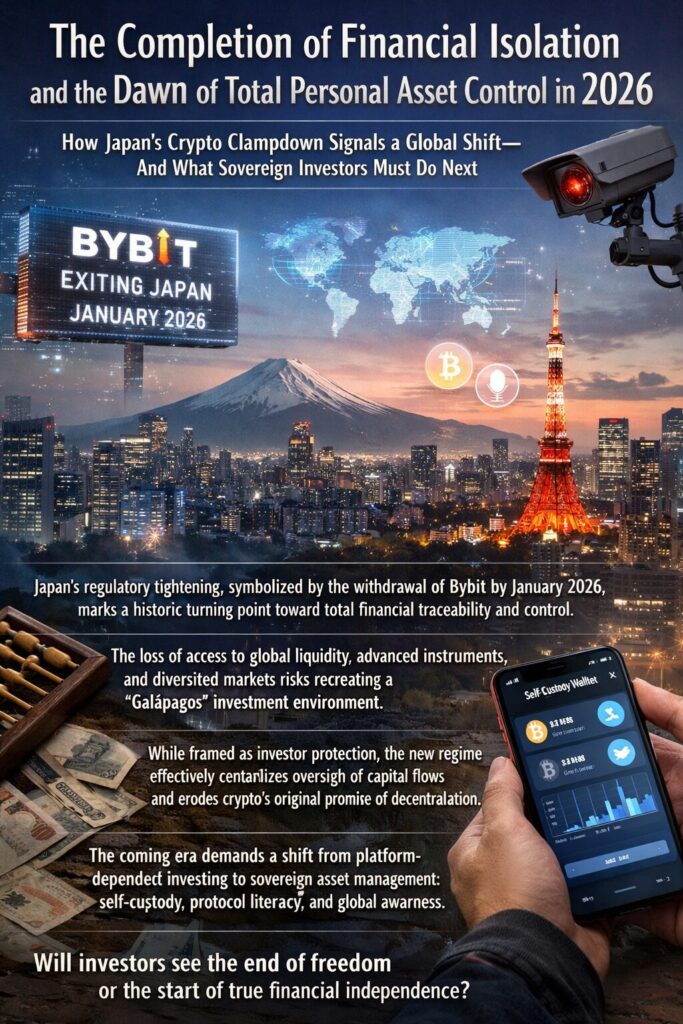
- Japan’s regulatory tightening, symbolized by the withdrawal of Bybit by January 2026, marks a historic turning point toward total financial traceability and control.
- The loss of access to global liquidity, advanced instruments, and diversified markets risks recreating a “Galápagos” investment environment, widening asset gaps between domestic and global investors.
- While framed as investor protection, the new regime effectively centralizes oversight of capital flows and erodes crypto’s original promise of decentralization.
- The coming era demands a shift from platform-dependent investing to sovereign asset management: self-custody, protocol literacy, and global awareness.
- The decisive factor for post-2026 outcomes will be whether investors treat this moment as a loss of freedom—or as a catalyst for genuine financial independence.
1. The Fall of the Last Fortress of Freedom and the Regulatory Wall Foreseen by David Sacks
For years, Japanese investors relied on overseas exchanges as their final gateway to financial freedom. That era is ending.
The decision by Bybit to fully exit the Japanese market—setting January 2026 as the final deadline for Japanese residents—is not merely the shutdown of a service. It is the collapse of the last stronghold that allowed individuals to interact with global liquidity, advanced derivatives, and innovative financial products beyond the reach of domestic constraints.
Once a date is fixed, denial is no longer an option. Investors who once accessed world-class markets through offshore platforms now face an accelerating closure of that window. The pace is not gradual; it is abrupt and decisive.
Behind the stated objective of “investor protection,” regulators have woven an increasingly sophisticated net designed to capture every movement of capital. Transactions once dispersed across borders are now being funneled into fully observable channels, rendering personal economic activity transparent—and controllable.
This is the moment that figures such as David Sacks have long warned about: regulation no longer acting as a safety rail, but as a structural barrier. The withdrawal of a major global exchange is the signal flare announcing that the system is ready—that comprehensive oversight has been achieved.
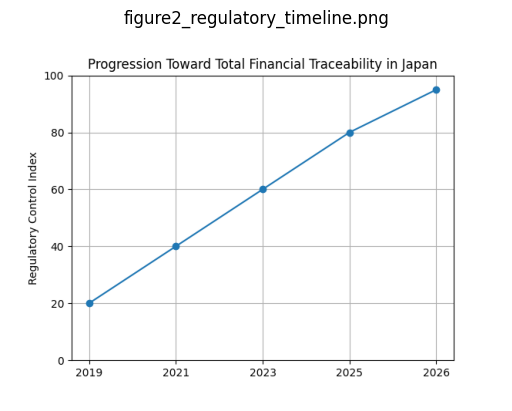
What lies ahead for Japan is not integration, but isolation: a tightly regulated aquarium cut off from the ocean of global finance.
Reverting to domestic exchanges is not a neutral platform change. It is the removal of wings. Investors accustomed to free movement are being conditioned to operate as flightless birds—safe, supervised, and grounded.
Cross-border capital mobility, once taken for granted, will give way to a regime where every transaction is logged, assessed, and potentially constrained. Crypto’s original ideal—value without permission—has been hollowed out within national borders, reduced to a compliant appendage of the existing financial system.
This did not happen overnight. But few were prepared for how quietly and efficiently it would be completed.
2. The Return of “Galápagosization”: Asset Inequality and Investor Isolation

Japan’s renewed drift toward financial “Galápagosization” threatens far more than feature limitations. It undermines long-term economic survival.
As the rest of the world accelerates toward decentralized finance, tokenized assets, and borderless value transfer, Japan is closing its gates. The cost of this divergence will be measured not only in missed opportunities, but in compounding disadvantage.
Bybit’s ecosystem once offered an overwhelming breadth of assets, leverage options, and professional-grade risk tools. Losing access to these is not an inconvenience—it is a structural handicap. Investors confined to domestic platforms will compete with global peers while operating with dulled instruments and delayed information.
History offers a cautionary parallel. Japan’s mobile phone industry once thrived under unique domestic standards, only to be left behind as global ecosystems evolved. Crypto risks following the same trajectory: protected, isolated, and ultimately obsolete.
In such an environment, information decays faster, capital efficiency declines, and innovation slows. Investors become inward-looking not by choice, but by design.
Meanwhile, the state’s determination to monitor asset movement down to the smallest detail moves directly against crypto’s founding philosophy. Decentralization promised escape from centralized control; instead, convenience was traded for oversight—and now even that convenience is being withdrawn.
This divergence becomes stark when contrasted with developments abroad. In the United States, regulatory restructuring increasingly aims to clarify rules and stimulate innovation. Japan, by contrast, prioritizes containment and supervision. The difference reflects not just policy choices, but divergent visions of economic vitality.
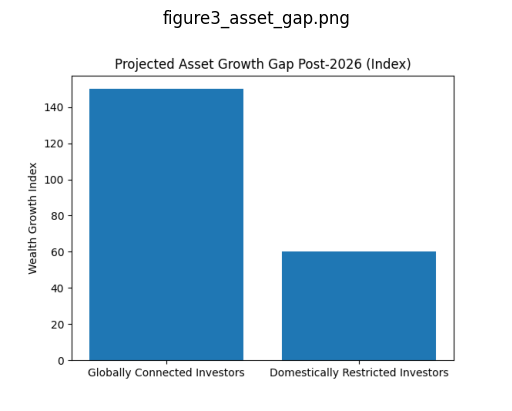
By 2026 and beyond, the gap between investors who remain domestically confined and those who maintain global connectivity will harden into irreversible asset inequality. Information barriers and restricted choices quietly siphon wealth while deepening dependence on the state.
This is not an abstract risk. It is an engineered outcome.
3. Sovereign Investing at the Closed Gate: Reclaiming Control in a Managed Society
Facing a closed future, the rational response is not despair—but reconstruction.
With little time remaining before offshore access is severed, investors must confront the risk of over-reliance on any single platform, institution, or jurisdiction. The lesson is now undeniable: access granted by others can be revoked instantly.
True asset protection begins with self-custody. Hardware wallets, non-custodial architectures, and protocol-level understanding are no longer optional skills—they are survival tools. Trusting only domestically regulated exchanges is equivalent to surrendering one’s financial fate to external authority.
The real value of digital assets lies in their neutrality: no owner, no gatekeeper, no central switch. Returning to that principle is now urgent.
The completion of a managed society may be unavoidable. But literacy in privacy preservation, custody separation, and decentralized protocols defines the next generation of investors. Sovereignty is no longer ideological; it is practical.
Rather than mourning lost access, investors must convert this rupture into capability—learning how to store, move, and manage value independently. The winter ahead will reward those who keep a global perspective, monitor shifts early, and adapt faster than regulation can ossify.
Freedom does not vanish entirely; it relocates. Those who seek it must follow.
Whether this ultimatum becomes an epitaph for lost liberty or a rite of passage toward true independence depends on choices made now. The door is closing—but alternatives still exist beyond its frame.
True victory in the coming era will belong to those who never relinquish sovereignty over their wealth, regardless of how severe the regulatory climate becomes.
Conclusion
Japan’s financial isolation is not a temporary policy phase—it is the completion of a system. Yet systems are navigable by those who understand their limits.
As 2026 approaches, the decisive divide will not be between compliant and non-compliant investors, but between dependent and sovereign ones. The former will operate within shrinking boundaries; the latter will build resilience beyond them.
Learning must not stop. Global awareness must not fade. And asset sovereignty must never be outsourced.
That is the only path through a closed gate.
