
Main Points :
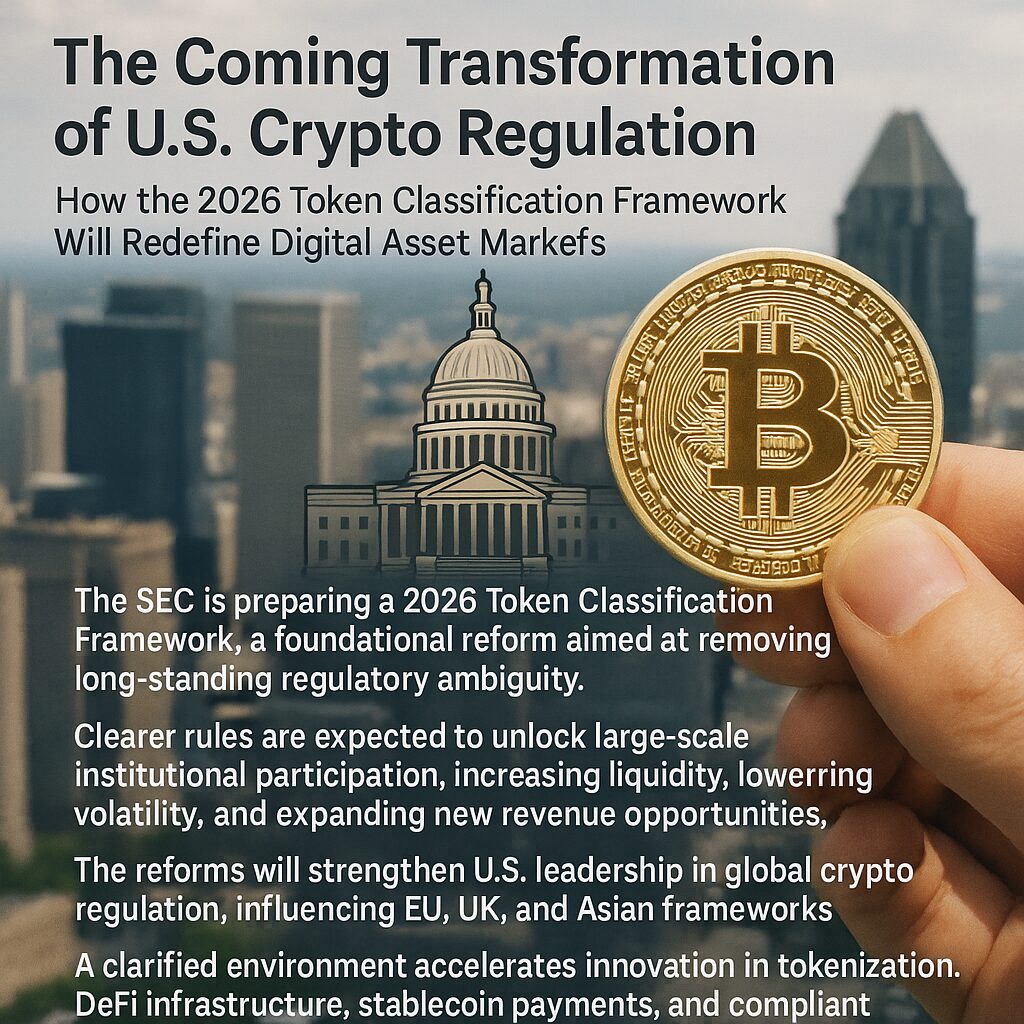
- The SEC is preparing a 2026 Token Classification Framework, a foundational reform aimed at removing long-standing regulatory ambiguity.
- Clearer rules are expected to unlock large-scale institutional participation, increasing liquidity, lowering volatility, and expanding new revenue opportunities.
- The reforms will strengthen U.S. leadership in global crypto regulation, influencing EU, UK, and Asian frameworks.
- A clarified environment accelerates innovation in tokenization, DeFi infrastructure, stablecoin payments, and compliant yield products.
- Market participants—exchanges, developers, and enterprises—must prepare strategic shifts in compliance, product design, and treasury structures.
1. Ending a Decade of Regulatory Uncertainty
For more than ten years, the United States has operated in a fragmented regulatory environment: unclear definitions of securities, conflicting statements between agencies, and litigation-driven policymaking. The SEC Chair’s announcement that 2026 will mark the introduction of a formal Token Classification Framework represents a decisive turning point.
This initiative aims to eliminate the industry’s foundational question:
Which tokens are securities, which are commodities, and which are neither?
This ambiguity historically discouraged startups from launching in the U.S., deterred venture capital from allocating large tranches, and exposed exchanges to enforcement risks. By moving toward a rule-based structure, the SEC signals an environment where:
- Companies can design token economics with predictable compliance pathways
- Exchanges can list assets without facing retroactive enforcement
- Developers can innovate without fear of classification-based shutdowns
Regulatory clarity, in this sense, becomes a catalyst for growth, not a barrier. Companies that previously invested millions in legal defense will be able to redirect capital to real innovation—scaling networks, onboarding users, and integrating compliant financial services.
2. Institutional Capital and Market Evolution
Why Clarity Unlocks Institutional Money
Institutional investors, from pension funds to sovereign wealth funds, collectively manage tens of trillions of dollars. They have watched the crypto sector for years but historically avoided direct exposure due to unclear regulation.
A formal token classification removes the largest obstacle to their participation:
legal risk.
Once institutions understand whether a digital asset is legally treated as a security, commodity, or consumer token, they can:
- Construct compliant investment mandates
- Build derivatives, ETFs, structured notes, and yield products
- Deploy large volumes of liquidity without fear of enforcement
The SEC’s direction suggests that crypto assets may be integrated into financial markets similarly to equities, commodities, structured products, or even money-market instruments depending on classification.
Market Impact: Lower Volatility, Deeper Liquidity
Institutional capital stabilizes markets. Historically, crypto’s volatility stemmed from shallow liquidity and retail-driven trading cycles. When multi-billion-dollar funds enter with long-term strategies, price movements gain:
- Depth – large buy/sell flows without major slippage
- Predictability – macro correlation increases
- Lower volatility – crypto begins behaving like established asset classes
This is why many analysts predict that Bitcoin and tokenized real-world assets (RWAs) may approach the liquidity and risk profiles of commodities like gold by the late 2020s.
[Regulatory Clarity & Institutional Adoption Trend]
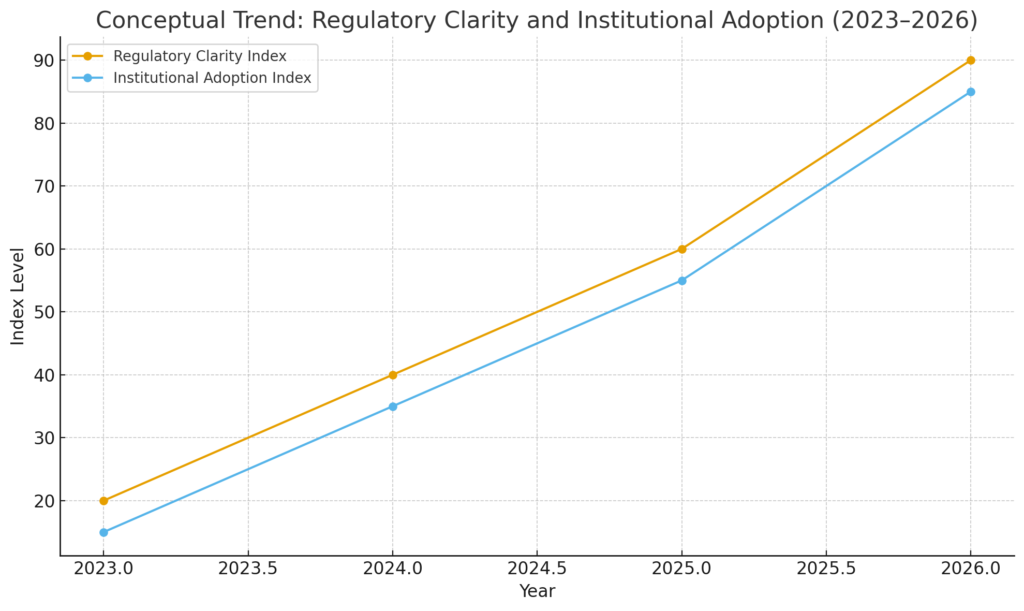
This conceptual chart illustrates the expected parallel rise in regulatory clarity and institutional adoption from 2023 to 2026.
3. Token Classification as a Catalyst for Innovation
Clear Rules Enable Better Products
Under the anticipated 2026 framework, tokens will fall under several possible categories, such as:
- Security Tokens – subject to disclosure rules, suitable for fundraising, governance, and regulated yield
- Utility Tokens – used for access, computation, payments
- Payment Tokens / Stablecoins – designed for settlement and monetary use
- Commodity Tokens – decentralized assets resembling Bitcoin or similar architectures
This classification will finally standardize token design. Startups will launch products with full understanding of:
- Required disclosures
- Anti-fraud rules
- Distribution compliance obligations
- Custody and transfer requirements
- Whether tokens may be listed on exchanges without registration
For innovators, this means faster time-to-market, lower legal uncertainty, and clearer limitations on what tokens can promise, reward, or represent.
4. The U.S. Push to Reclaim Global Leadership
Regulatory Competition Among Nations
Until recently, the U.S. lagged behind:
- EU’s MiCA regulation, with comprehensive licensing and stablecoin rules
- UK’s phased crypto asset regime
- Singapore and Hong Kong’s licensing systems
- Japan’s extremely strict but clear exchange and custody laws
The absence of clarity pushed many crypto companies offshore.
However, by signaling a complete classification system and potential legislative cooperation in 2026, the U.S. positions itself once again as a global standard-setter. Other jurisdictions will look to American frameworks for:
- Enforcement models
- Definitions of decentralization
- Token disclosure requirements
- Institutional market structure standards
The SEC’s move is not just regulatory—it is geopolitical.
Crypto-native finance is becoming the new competitive battleground of global economic influence.
5. New Opportunities for Investors, Builders, and Enterprises
The Next Wave of Growth Sectors
Once classification stabilizes markets, several sectors are expected to grow rapidly:
1. Tokenized Real-World Assets (RWAs)
Everything from U.S. Treasury bills to real estate and supply-chain receivables may be tokenized. Even today, on-chain treasuries surpass $10 billion in assets.
2. Institutional DeFi
Compliance-compatible decentralized infrastructure—permissioned liquidity pools, KYC-enabled smart contracts, on-chain credit scoring—will emerge as banks seek yield.
3. Stablecoin Payments
With predictable rules, fintechs and EMIs can adopt stablecoins for real-time settlement and global payroll.
4. Yield-Generating Digital Instruments
Fully compliant on-chain notes, ETFs, and money-market fund equivalents can attract conservative investors.
5. Consumer & Enterprise Utility Networks
Gaming, loyalty points, IP rights, and computation networks can issue tokens with clear utility definitions, enabling mass-market adoption.
6. Strategic Recommendations for Market Participants
For Exchanges and VASPs
Prepare for differentiated treatment of token classes:
- Security tokens → broker-dealer rules
- Payment tokens → money-transmission rules
- Commodity tokens → CFTC oversight
VASPs should begin restructuring inventory, custody controls, and hedging strategies to align with new categories.
For Startups and Token Issuers
Plan token economic models as if the 2026 framework were already in effect:
- Avoid “investment-like” promises unless prepared to comply with securities disclosure
- Standardize vesting, unlock schedules, and distribution methods
- Implement clear utility and governance boundaries
For Institutional Investors
Begin preparing:
- Risk models integrating classification-based liquidity tiers
- Compliance workflows for tokenized securities
- Multi-chain asset custody frameworks
- Stablecoin treasury strategies
Conclusion: The U.S. Crypto Market Enters Its Most Important Phase
The SEC’s anticipated 2026 Token Classification Framework marks the beginning of a transformative era. After more than a decade of uncertainty, the U.S. is moving toward:
- Clarity
- Institutional maturity
- Global leadership
- Accelerated innovation
For builders, investors, exchanges, and enterprises, the message is clear:
Prepare now.
The next major wave of crypto adoption will be shaped by regulation—not speculation.
