
Main Points :
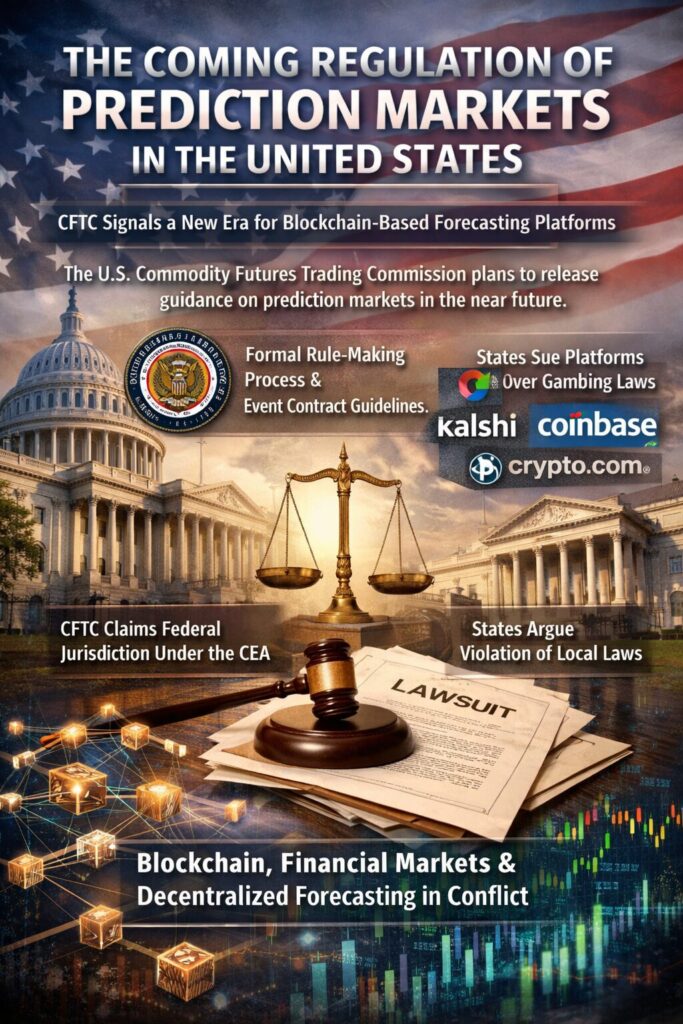
- The U.S. Commodity Futures Trading Commission (CFTC) plans to release guidance on prediction markets in the near future.
- The agency will begin a formal rule-making process to define which event contracts can self-certify and how they should be evaluated.
- Several U.S. states are simultaneously pursuing lawsuits against prediction-market platforms such as Kalshi, Coinbase, and Crypto.com.
- The CFTC claims federal jurisdiction under the Commodity Exchange Act (CEA), while states argue the platforms violate local gambling laws.
- The debate highlights the growing intersection between blockchain technology, financial markets, and decentralized forecasting platforms.
1. A Turning Point for Prediction Markets
Prediction markets—platforms where users trade contracts based on the outcome of future events—are entering a new regulatory phase in the United States. The U.S. Commodity Futures Trading Commission (CFTC) has announced that it will soon release official guidance on how such markets should operate, signaling the beginning of a broader rule-making process that could reshape the industry.
CFTC Chairman Michael Zelig made the announcement during the Milken Institute’s “Future of Finance” conference on March 3, explaining that the agency intends to clarify how event-based contracts should be evaluated under federal commodities law. The upcoming guidance will focus on two key questions: which types of contracts can be self-certified by exchanges and which require stricter review by regulators.
Prediction markets have existed for decades in academic and experimental contexts, but recent technological developments—particularly blockchain infrastructure—have turned them into an emerging financial sector. Platforms like Polymarket, Kalshi, and others allow traders to speculate on everything from elections and economic indicators to geopolitical events.
These markets have attracted both interest and controversy. Supporters argue that prediction markets aggregate collective intelligence and produce highly accurate forecasts, while critics claim they can resemble online gambling or create incentives around sensitive events such as wars or assassinations.
The CFTC’s move toward formal regulation indicates that the U.S. government now views prediction markets as a legitimate financial sector rather than merely a speculative novelty.
2. The Role of Blockchain in Prediction Markets
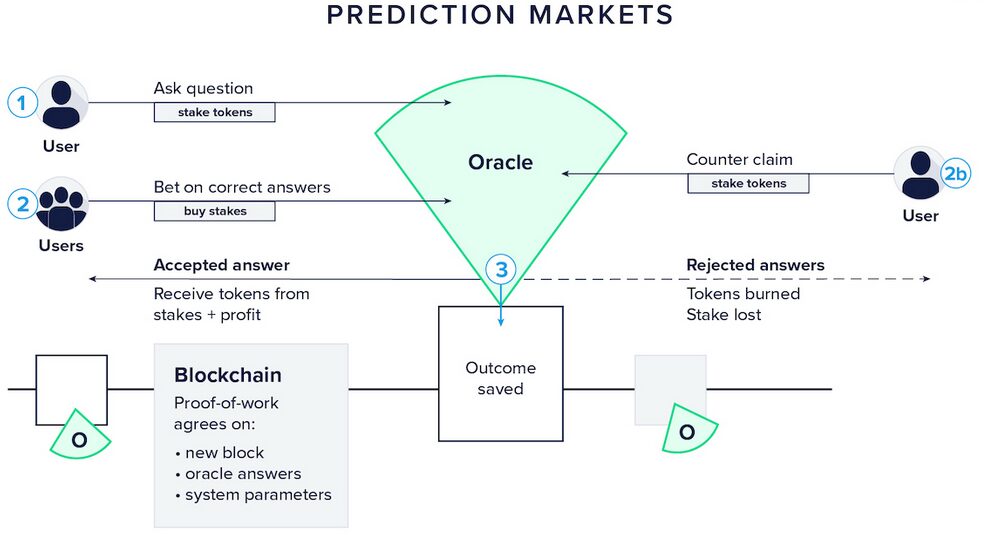
Blockchain technology has dramatically expanded the potential of prediction markets by enabling decentralized participation and transparent settlement. Smart contracts allow outcomes to be automatically executed when certain conditions are verified, reducing reliance on centralized intermediaries.
Many modern prediction platforms rely on crypto infrastructure for liquidity, tokenization, and cross-border participation. Stablecoins such as USDC and USDT are often used for settlement, while decentralized oracles verify event outcomes.
From a financial innovation perspective, prediction markets share characteristics with derivatives markets. Event contracts can function similarly to binary options, where a contract pays $1 if a specified outcome occurs and $0 if it does not.
For example:
- A contract predicting whether inflation exceeds a certain threshold.
- A contract predicting whether a specific cryptocurrency reaches a price target.
- A contract predicting the result of an election.
Because these contracts resemble derivatives products, regulators like the CFTC consider them within the scope of commodities law.
For investors seeking new revenue streams in the digital asset economy, prediction markets represent a hybrid between financial trading and information markets.
3. Regulatory Reversal After the Biden Administration
The current regulatory shift represents a significant departure from the approach taken during the previous U.S. administration.
Under former CFTC Chairman Rostin Behnam during the Biden administration, the agency proposed rules that would restrict event contracts related to war, terrorism, and assassination, arguing that such products could be “contrary to the public interest.”
However, that proposal was formally withdrawn earlier this year.
Chairman Zelig has taken a different stance, describing prediction markets as an “essential tool” for modern financial systems. Rather than restricting them outright, the CFTC now aims to create a regulatory framework that enables their development while maintaining oversight.
This shift reflects a broader global trend toward recognizing blockchain-based financial platforms as legitimate components of modern capital markets.
Countries such as the United Kingdom, Singapore, and the United Arab Emirates are also exploring regulatory frameworks that allow innovative financial products while protecting investors.
4. Legal Conflict Between Federal and State Authorities
Despite the CFTC’s intention to clarify federal regulation, the legal landscape remains complex.
Over the past month, state authorities in Nevada, Tennessee, and several other jurisdictions have filed lawsuits against prediction-market platforms including Kalshi, Coinbase, and Crypto.com.
These states argue that event-contract trading platforms violate local gambling and gaming laws.
The CFTC, however, has filed legal briefs supporting Crypto.com’s position that prediction markets fall under federal commodities regulation rather than state gambling law.
This conflict raises an important legal question: who ultimately has jurisdiction over prediction markets?
If courts determine that event contracts are commodities derivatives, federal law will likely take precedence. However, if they are classified as gambling products, state regulations may continue to apply.
The outcome of these legal disputes will significantly influence the future structure of the industry.
5. The Upcoming Rule-Making Process
The CFTC plans to issue an Advance Notice of Proposed Rulemaking (ANPR) as the first step in the regulatory process.
This document will invite public comment from industry participants, researchers, and financial institutions.
The process typically unfolds in several stages:
- Publication of the ANPR.
- Collection of public comments.
- Drafting of proposed rules.
- Further consultation and revisions.
- Final rule publication.
Historically, regulatory processes of this scale can take several years before final rules are implemented.
Another complicating factor is a recent U.S. Supreme Court decision in 2024 known as the “Loper Bright” ruling, which increased judicial scrutiny of federal regulatory agencies.
As a result, the CFTC must carefully design rules that clearly fall within the legal authority granted by the Commodity Exchange Act.
6. Market Growth and the Role of Platforms
Prediction markets have experienced rapid growth in recent years, especially during major geopolitical and economic events.
Platforms such as Polymarket have attracted millions of dollars in trading volume during election cycles, central bank decisions, and global crises.
The appeal of prediction markets lies in their ability to aggregate real-time information from participants worldwide.
For traders and investors, these markets offer unique advantages:
- Opportunities to hedge against geopolitical risk.
- A new form of data-driven speculation.
- Alternative financial instruments not available in traditional markets.
Blockchain-based prediction markets also enable global participation, allowing users from multiple jurisdictions to trade simultaneously.
However, this global accessibility is precisely what raises regulatory concerns.
7. Implications for Crypto Investors and Developers
For the crypto industry, the CFTC’s initiative could open new opportunities.
If prediction markets receive clear regulatory approval, several developments may follow:
- Integration with decentralized finance (DeFi) platforms
- Creation of tokenized event derivatives
- Expansion of decentralized forecasting tools
For blockchain developers, prediction markets are particularly interesting because they combine several emerging technologies:
- Smart contracts
- Decentralized oracle networks
- Tokenized liquidity pools
Some analysts believe prediction markets could eventually become a major component of Web3 financial infrastructure.
For example, decentralized autonomous organizations (DAOs) could use prediction markets for governance decisions, risk forecasting, or market research.
Growth of prediction market trading volume and ecosystem structure.
8. Future Outlook for Prediction Markets
The future of prediction markets will likely depend on how regulators balance innovation and oversight.
Clear federal regulation could attract institutional investors and financial firms to the sector. At the same time, overly restrictive rules might push innovation toward decentralized and offshore platforms.
In the broader context of blockchain adoption, prediction markets represent a powerful example of how distributed technologies can transform information and financial systems.
Just as decentralized exchanges changed cryptocurrency trading, prediction markets may eventually change how societies forecast economic and political outcomes.
Conclusion
The CFTC’s plan to issue guidance on prediction markets marks a pivotal moment in the evolution of blockchain-based financial platforms. By initiating a formal rule-making process, the United States is signaling that prediction markets are no longer a fringe experiment but a sector deserving of structured regulation.
For crypto investors and developers, the implications are significant. Prediction markets combine elements of derivatives trading, decentralized finance, and collective intelligence systems, making them one of the most intriguing innovations in the digital asset ecosystem.
If regulators succeed in establishing a clear framework, prediction markets could become a cornerstone of the next generation of financial infrastructure—where information, probability, and blockchain technology converge to create entirely new markets.
